

SIA takes further action to cut costs, including early retirement scheme
Not all staff unions are on board; Alpa-S says it is not agreeable
Fiona Lam &
Claudia Tan HS
Singapore
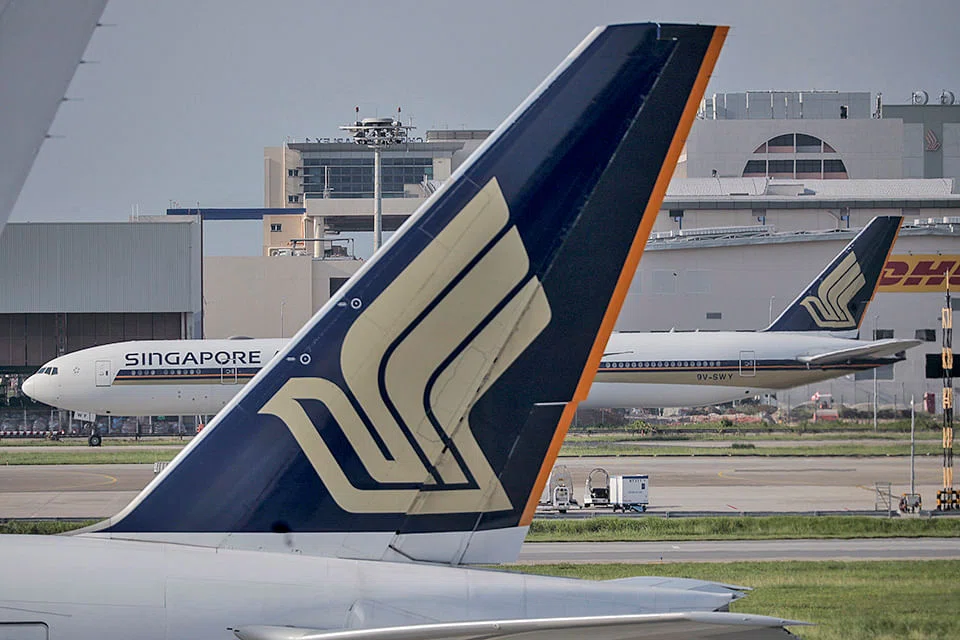
SINGAPORE Airlines (SIA) has implemented more measures to slash costs after posting a record quarterly loss, including deeper pay cuts for the bosses, a 10 per cent salary reduction for other employees, and early retirement for pilots and ground staff, according to a memo to staff seen by The Business Times.
Additional staff measures are also coming, given the slower growth trajectory and depressed market conditions. Chief executive officer (CEO) Goh Choon Phong said SIA will be engaging its staff unions on this matter, and will announce the measures when they have been firmed up.
The full quantum of the monthly variable component of salaries will be cut with effect from Aug 1, in accordance with the group's collective agreements with its unions.
This amounts to 10 per cent of the basic salary for all staff below the level of manager, said Mr Goh in a memo to staff this week.
Managers and senior managers will take a 12 per cent reduction, up from 10 per cent previously. Vice-presidents (VPs) and divisional VPs will have a 15 per cent cut, up from 12 per cent. Senior VPs will take a 25 per cent decrease, up from 20 per cent. Executive VPs will take a 30 per cent cut, up from 25 per cent. The CEO's salary will be slashed by 35 per cent, up from 30 per cent.
The company will also offer a Covid-19 special early retirement scheme (Sers) for all ground staff and pilots next week.
This scheme will be available to those aged 50 and above, with at least 15 years of service, and up to the level of divisional VP.
Applications for early retirement will be subject to approval based on organisational and operational requirements. The human resources department will provide more details "shortly", Mr Goh wrote.
He reiterated that the airline group needs to be prepared for "a long and hard Covid-19 induced winter".
Newly-sworn in Transport Minister Ong Ye Kung said on Thursday that Singapore cannot take for granted it will remain an aviation hub even when the COVID-19 pandemic ends.
Speaking to reporters after a ceremony at the Causeway to mark the official resumption of the Rapid Transit System (RTS) Link project, Mr Ong said the Government's top priority now was to revive Singapore's aviation sector which has been decimated by COVID-19.
"I think in the coming weeks and coming months, our top priority is really what steps can we take to revive our aviation hub. We are working on negotiating reciprocal green lanes with various countries which have managed to bring down their transmission," said Mr Ong.
When reached by BT, an SIA spokesperson confirmed the latest cost-cutting measures stated in its memo.
On whether there will be further cuts in the quarters ahead, the spokesperson said: "We will announce any additional measures, if necessary, at the appropriate time."
Not all staff unions are on board. The Air Line Pilots Association, Singapore (Alpa-S) on Thursday evening expressed in a newsletter to members that it was not agreeable to the Sers and pay cuts.
Alpa-S said it had not been consulted on the scheme before the meeting with the company on Thursday morning. Its representatives had also given their feedback on the "ineffectiveness" of the scheme and the "disappointing quantum offered as a result of the payout cap".
Alpa-S is also against the shift from compulsory no-pay leave to pay cuts for pilots. According to the newsletter, captains will take a 23 per cent reduction while first officers and second officers will take 13 per cent and 10 per cent cuts, respectively.
"By reducing the compulsory no-pay leave days, it will introduce more available man-days into the system, resulting in an increase of surplus crew numbers by about 20 per cent," Alpa-S wrote.
Alpa-S will be taking the matter up with the Ministry of Manpower (MOM). An SIA spokesperson said that it continues to be in discussions with Alpa-S and is also seeking the MOM's assistance in the discussions. The details, however, remain confidential until there is an agreement, said the SIA spokesperson. "Our immediate priority is to do everything we can to survive this crisis and be ready for the long trudge ahead of us," the spokesperson added.
Other unions are more amenable. Alan Tan, president of the Singapore Airlines Staff Union, which represents cabin crew and ground staff, told BT that it is a plus that the company has not let go of any staff.
Ravi Chandran P, general secretary of the Air-Transport Executive Staff Union, which represents ground executives, said: "Given what the aviation industry is going through, staff were already aware they had to undergo some pain."
In addition, he said, ground executives are less impacted as they are "involved in transformation projects".
"Our members have been understanding, and the union will work with the company to protect their interests," he added.
The SIA group carried 38,000 customers from April to June, compared to almost 9.4 million a year before.
Analysts are expecting further cost-saving measures. Shukor Yusof, founder of aviation consultancy Endau Analytics, told BT that SIA is on track to post successive losses in the coming quarters, with FY2021 its worst in history.
"This will force the airline to take drastic steps, including storing or scrapping more A380s, deferring aircraft deliveries, renegotiating orders, and retrenchments," said Mr Shukor.
DBS analyst Paul Yong said in a report on Thursday that SIA's earnings outlook remains "highly uncertain".
Given the impact on passenger traffic and revenue, the group had signalled that it is likely to see material impairment of older generation aircraft, especially the A380s, which could account for around S$1 billion in impairment charges, he said.
SIA's share price on Thursday fell as low as S$3.355 in intraday trading. SIA had reported on Wednesday a net loss of S$1.12 billion for Q1.
TRENDING NOW

He built the Vingroup empire. Now South-east Asia’s richest man is handing some key roles to his sons
US dollar falters after Iran’s offer to reopen Hormuz sends oil lower
Temasek’s Wan Chee Foong to helm PIL, Lars Kastrup to be board adviser

Despite the de-dollarisation debate, demand for dollar liquidity in Asia is growing

