SIAEC's innovations come from the ground up
Its innovation group plans to increasingly decentralise the function to various operating divisions, to improve outreach and be closer to real operations
Singapore
SIA Engineering Co (SIAEC) is trialling a string of innovative prototypes set to improve productivity based on its employees' on-the-ground experience.
SIAEC training academy skills trainer Peter Lazar, for example, came up with a solution for too-hot airplane brakes that is cheaper and faster than SIAEC's current equipment, which works one brake at a time.
The new brake heat extraction system applies a difference in pressure to the brakes on just-landed planes, simultaneously cooling up to sixteen brakes to regulation temperatures so they are fit for their next takeoff.
SIAEC's innovation group explained that the principle in operation is the Venturi effect - named after the Italian physicist - but Mr Lazar described the principle behind his solution more plainly.
"We work in the operating environment, we are on the ground, so we know what's best for us."
"We have unlimited ideas," he said. "You tell us the problem, we give you the solution."
Mr Lazar was presenting his invention at SIAEC's Innovation Week, a staff-oriented exhibition of in-house innovations as well as new technology from external vendors, all designed to foster employee-led ideation and implementation.
SIAEC's efforts at innovating are challenging as they have to work within the aviation industry's high safety concerns and corresponding regulations, said SIAEC senior vice-president for innovation, technology and fleet management Ng Wilin.
New technology and procedures must go through the original equipment manufacturers (OEMs), such as Boeing and Airbus, even before they are approved by regulators such as the Civil Aviation Authority of Singapore.
"Even though we want to do innovation, we must be mindful that we follow approved manuals and approved procedures," said Mr Ng.
These constraints are especially tricky considering rapid developments in the aviation industry that demand innovation across SIAEC's businesses in line maintenance, heavy maintenance, cabin services and fleet management.
"This is a very competitive industry. With advancements in technology, with the OEMs coming into aftermarket, with maintenance and check intervals being extended, workloads become lighter."
"With the population issues Singapore has, there will also be less of a workforce in the future," he said. Leveraging automation and technology is, therefore, essential to SIAEC's future.
"There's no option - it's a given. It's just how quickly we implement them, and how pervasively. The challenge a lot of organisations have today is implementing it at all levels . . . everybody must have that mindset."
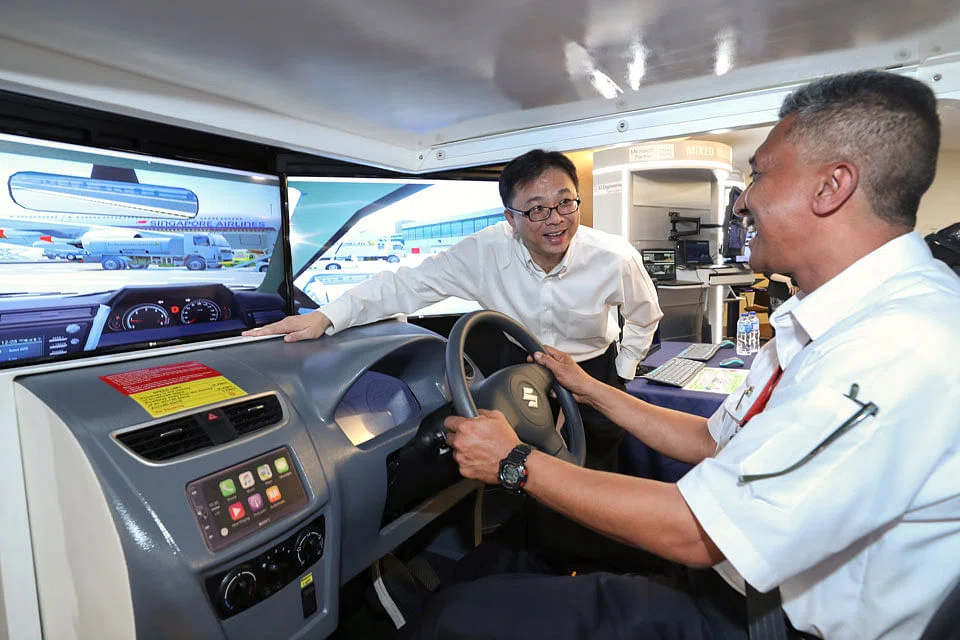
Other staff-initiated ideas at Innovation Week included heavy maintenance engineering supervisor and driver Yazid Mohd Said's driving simulator, mapped to the actual terrain of Changi Airport.
The simulator reduces the number of SIAEC vehicles used for training drivers and also allows trainees to respond to rarer events that cannot be staged in an actual airport.
A simulation allows drivers to practise responding to other drivers and even planes that fail to follow airport protocols, for example.
Innovation Week also featured external vendors such as Rolls-Royce, which has worked with SIAEC on technology that can record engine component numbers using Quick Response (QR) codes.
"Leveraging on our enhanced QR code technology, our staff just have to scan like at the supermarket," said Alvin Wong, acting manager for SIAEC's innovation group.
"Previously, the process took a day but now it can be reduced to two hours."
Storage-side innovations tend to be easier for SIAEC to implement, since they do not affect aircraft safety.
A SIAEC composite shop-designed jig for moving fan cowls, for example, has already been implemented, reducing fan cowl storage footprints by 75 per cent.
The original staff-made prototype, a cardboard miniature, was on hand at the exhibition to emphasise the employee's role in the process from ideation to implementation.
"It cannot just be 20 of us doing innovation," said Mr Ng.
"We plan to increasingly decentralise this function to the various operating divisions, so that they have innovators within themselves, so their outreach can be better and closer to the real operations."