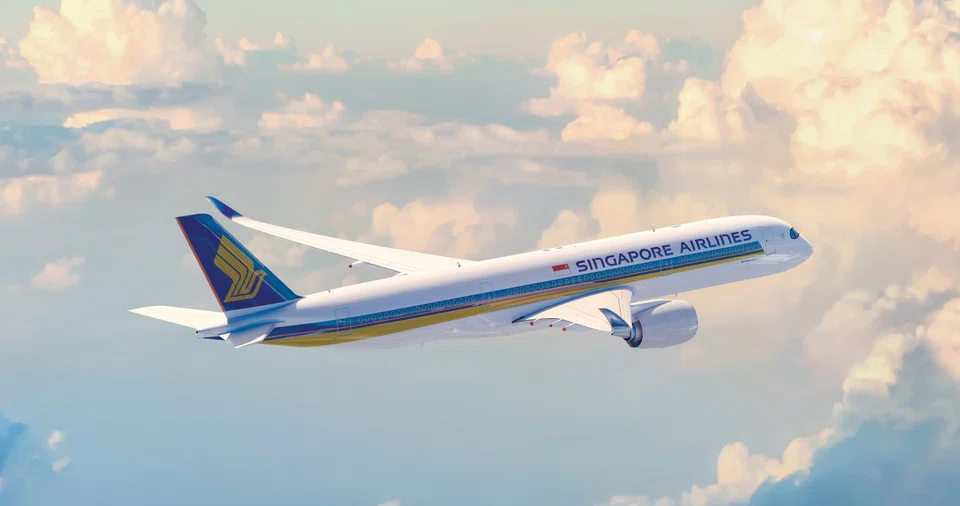
Singapore Airlines to invest S$1.1 billion in retrofitting Airbus A350 fleet
The upgrades across the cabin classes promise improved privacy and comfort and a beefed-up in-flight entertainment system

SINGAPORE Airlines (SIA) will spend S$1.1 billion to retrofit 41 Airbus A350-900 long-haul and ultra-long-range aircraft with newer cabin products as competitor airlines pump in billions to upgrade their fleet.
Under a multi-year retrofit programme, the airline will introduce a first-class cabin in seven planes that are ultra-long-range aircraft, SIA said in a note on Monday (Nov 4).
The new business-class seats, to be installed in all 41 aircraft, will feature designs that offer “greater privacy, comfort and convenience” – the same seat designs that will feature on SIA’s upcoming Boeing 777-9 aircraft.
Premium-economy class and economy-class cabins will also be upgraded, added the national carrier.
Post-retrofit, 34 A350-900 long-haul aircraft will be configured with 42 business-class seats, 24 premium-economy class seats, and 192 economy-class seats.
The seven aircraft that are the ultra-long-range variant – for flights lasting 16 hours or more – will comprise four first-class seats, 70 business-class seats and 58 premium-economy class seats.
Out of the 146 passenger aircraft that the full-service airline currently operates, 64 are the A350 model – 24 are for medium haul, 33 for long haul, and seven for ultra-long range.
The aircraft will be refurbished by SIA’s aircraft maintenance subsidiary SIA Engineering.
The first retrofitted A350-900 long-haul aircraft is expected to enter service in the second quarter of 2026, while the first ultra-long-range variant will begin in the first quarter of 2027.
SIA expects the entire retrofitting programme to be completed by the end of 2030.
Under the programme, SIA will also launch a refreshed in-flight entertainment system, which will offer “greater personalisation” and “an extensive range of lifestyle options across all cabin classes”.
New in-flight entertainment screens will also be installed in first-class and business-class seats.
Goh Choon Phong, chief executive officer of SIA, said the introduction of the new seats and entertainment system will “set new standards in innovation, customer experience and service excellence”.
Analysts told The Business Times that the move is expected to help maintain SIA’s competitive edge in premium travel.
“With capacity normalising and exceeding pre-pandemic levels in some regions, SIA will want to ensure that it has a leading premium product to attract passengers to support relatively higher tariffs and hence, passenger yields,” said Lorraine Tan, director of equity research in Asia at Morningstar.
Financial literacy website Beansprout pointed out that the enhancement to the fleet will protect SIA’s share in the premium sector as it looks like a response to Cathay Pacific’s promotion of its business class experience on the A350.
“As air travel demand normalises, two segments would hold better – premium/corporate travellers and low-end budget travellers,” Beansprout added.
Shukor Yusof, an analyst at Endau Analytics, believes that the upgrade is to ensure SIA can continue to compete with rivals from the Gulf such as Emirates and Qatar Airways. “Granted, it’s a lot of money to spend but there is a price to pay for SIA to remain one of the world’s best carriers, as well as to retain a high residual value for the A350s when the time comes to sell them in the secondary market.”
But Morningstar’s Tan commented that the investment is “reasonable” given it is spread across a total of 41 planes. “SIA is in a very comfortable financial position and can afford to make this investment,” she said.
However, she is unable to say for sure if the move also reflects the risk of further delays to SIA’s new Boeing 777-9s. “So it may be good to have new look A350s in its fleet to offer to passengers.”
Aircraft maker Boeing had said it would defer the delivery of 777X wide-body aircraft to 2026, amid labour strikes that have stretched into weeks. This would mean a delay of more than five years from the original timeframe, forcing customers around the world to reconsider their fleet plans.
Boeing’s delay will hurt Asian and Middle Eastern airlines’ capacity plans more than others, Bloomberg earlier reported, given that they account for the bulk of the order book and earliest delivery slots.
Beansprout questioned the capacity that SIA will take out from the system as the retrofit programme gets underway and the duration required, but it assumes the upgrading will be in phases till 2030.
Even as SIA is upgrading its A350 fleet, other airlines are not standing still. In August, Cathay Pacific said it would invest more than HK$100 billion (S$16.9 billion) over the next seven years, as part of a “bold new strategy”.
It said it would buy 30 Airbus aircraft on top of the previously ordered 70 as part of its investment drive, which brings total orders to up to 150 including purchase options.
The A350 was also in the news recently, when Cathay Pacific said it had found 15 of its 48 A350 jets needed repairs to fuel lines. Some carriers including SIA and Japan Airlines conducted precautionary checks of their entire A350 fleet subsequently.
SIA releases its half-year financial results this Friday; SIA Engineering announces its half-year earnings on Tuesday.
Shares of SIA closed 0.3 per cent or S$0.02 higher at S$6.46, while those of SIA Engineering rose 1.2 per cent or S$0.03 to S$2.45 on Monday, before this investment plan went public.