

Singapore bank earnings to continue riding higher-for-longer rates, wealth sector growth in 2025
Strong dividends remain attractive feature of local banks, analysts say

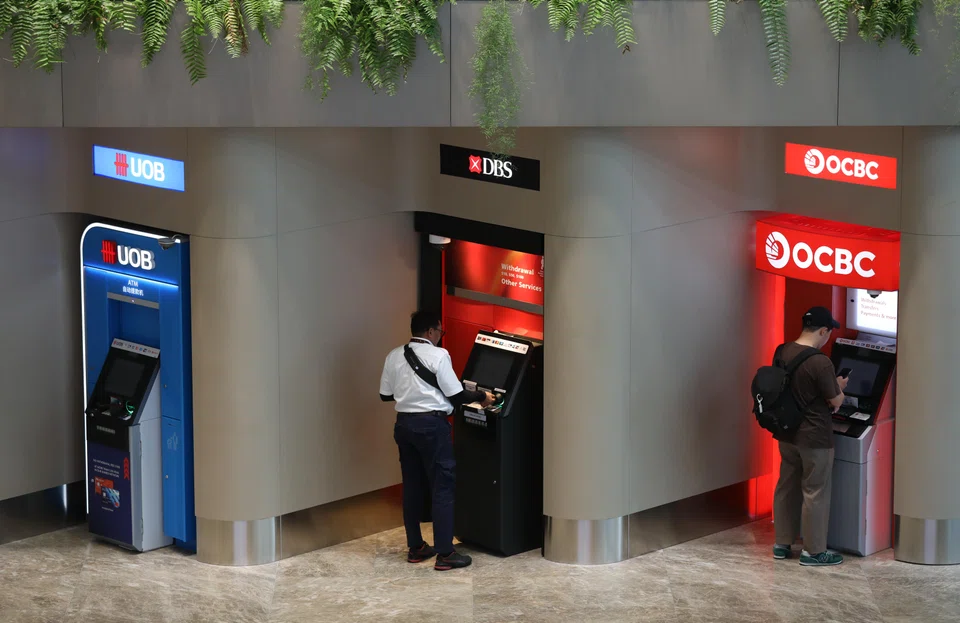
SINGAPORE banks will likely post earnings growth in 2025, led by higher-for-longer rates and a strong wealth management business, analysts said.
While the growth may be slower than previous years’, analysts expect that the banks’ clear dividend policies should keep them attractive to investors.
The banks had a strong showing in 2024, as higher-for-longer rates and growth in non-interest income boosted earnings to record highs.
This was coupled with the “very low base” during the pandemic, which resulted in strong double-digit growth in earnings, said Glenn Thum, senior research analyst at Phillip Securities Research.
For 2025, earnings will likely be driven largely by higher non-interest income, especially from the banks’ wealth franchises.
For the nine months ended Sep 30, 2024, assets under management (AUM) for DBS rose 14 per cent to S$401 billion; OCBC’s increased 5 per cent to S$284 billion; and UOB’s was up 32 per cent to S$184 billion.
But for most of 2024, this AUM was in fixed deposits, which generate little fees, observed Thilan Wickramasinghe, head of research and head of regional financials at Maybank Securities.
As interest rates fall, this creates a “significant latent opportunity” as customers turn to higher-fee-generating wealth management products, he noted.
Meanwhile, structural changes in geopolitics, taxation and Asia’s own growth should spur increasing wealth flows to Singapore, added Wickramasinghe. “This should drive faster wealth management fee income growth in the medium term. It should also provide counter-cyclical earnings support as interest rates fall.”
Wealth fees reached a historical high with the first US rate cut in the third quarter of 2024. Wickramasinghe said that this trend could accelerate going forward, as central banks continue to cut rates.
CGS International analysts Andrea Choong and Lim Siew Khee also expect wealth management and treasury income to be key drivers of non-interest income growth in 2025, as customers deploy their cash AUM amid the changing interest-rate and macroeconomic landscape.
They also expect steady improvement in fee income, particularly in credit cards for DBS and UOB, following the acquisition of Citi’s retail portfolios and market-related activity.
Fewer interest-rate cuts
Meanwhile, the potential for higher-for-longer rates should bode well for the net interest margins (NIMs) of the banks.
Markets have already priced in fewer cuts by the US Federal Reserve for 2025, as Donald Trump’s second presidential term in the United States is expected to be more inflationary.
DBS also noted potential upsides to total income with the Trump term when it announced its Q3 results. The other two local banks thought that it was still too early to say if they would truly benefit from Trump 2.0, although they agreed that higher rates would boost NIMs.
But the CGS analysts pointed out that higher-for-longer rates could slightly soften potential credit demand.
The banks have also reported lower sensitivities of their net interest income and NIMs to interest rates, given the changes in their funding profiles, they added. “We think that the sequential earnings upside from sturdier NIMs in 2025 have now been priced in.”
Nevertheless, Phillip’s Thum noted that data from the Monetary Authority of Singapore showed steady improvements in loan growth in the past few months, despite interest rates remaining high.
“Loans have started to recover as the overall environment improves, and consumers start to get more accustomed to the higher interest-rate environment,” he said.
Michael Makdad, senior equity analyst at Morningstar, also expects that the trade-off between NIMs and loan growth will favour NIMs in most cases, given their impact on net interest income.
“My base case is that NIMs moderate, net interest income increases slightly or is flat, but net profit grows due to increased non-interest income, good cost control, and limited credit losses,” he said.
Makdad noted that the banks’ return on equity (ROE) could decline from 2024, given the larger base of equity from retained earnings.
But UOB could be an exception and maintain its 2024 ROE, if it announces and conducts a buyback, he added.
Capital management
Analysts expect capital management to be a key area to watch in 2025.
Phillip’s Thum noted that the banks have a sizeable amount of excess capital. He said: “It will be good for investors and shareholders to see how the banks are returning (the capital) to them.”
The CGS analysts added that a clear dividend policy remains an attractive feature of the Singapore banks.
The banks so far have not changed their dividend policies; the clarity is further underpinned by strong Common Equity Tier-1 ratios – between 15 to 16 per cent when fully loaded – after implementing Basel IV, they said.
Meanwhile, Harsh Modi, co-head of Apac financials equity research at JP Morgan, expects consistent increases in capital return in the sector over the next 12 months, driven by strong capital generation and higher capital buffers following Basel IV.
In fact, Modi thinks that stocks could stall, or even weaken, in a scenario where banks undershoot capital-management guidance or do not provide sufficient visibility.
TRENDING NOW

Once staunchly pro-China, Malaysian Chinese businesses are now distancing themselves from Beijing

Britain’s mansion tax shows the difficulty of targeting wealth

Three hats, one goal: How Ng Kian Swan runs sustainability at NUHS

COE review: The gap between luxury and mass-market cars isn’t the only one worth bridging

