

Singapore bank shares may drag on Evergrande fallout; but analysts don't see direct risk
SINGAPORE banks have limited onshore China exposure and so will likely avoid direct hits from the Evergrande fallout, said analysts. But investors should watch share price impact, as the bank stocks are vulnerable to a drag from negative sentiment.
China's property giant Evergrande is teetering on bankruptcy as the world's most indebted property developer, buckling under more than US$300 billion of liabilities. It comes as in 2020, China regulators stepped in with new rules to curb excessive leverage taken by developers.
Singapore banks have benefited greatly from Greater China growth for a decade, by tapping on flows between China and Asean. But Hong Kong is a typical entry point, working with network customers, China state-owned enterprises (SOEs) and top-tier corporates. This means limited onshore exposure, said Citi analyst Robert Kong in a report. The non-performing ratios (NPLs) of loans related to their Greater China book are also relatively low.
Notably at DBS D05 , which just acquired a 13 per cent stake in Shenzhen Rural Commercial Bank, its Greater China exposure would be dominated by large China SOEs and Hong Kong conglomerates. Its mortgage and SME books are relatively small, largely secured and with low loan-to-value ratios. Based on DBS's first-half results, Hong Kong and Greater China account for 28 per cent of group loans, and 22 per cent of group pre-tax profit.
Out of OCBC's O39 total Greater China loans of S$70 billion, only S$5 billion are direct mainland China exposures. OCBC's mainland China loan exposures are mainly to network customers, which means for example, large Singapore property developers expanding into China. Based on OCBC's first-half results, Greater China accounts for 26 per cent of group loans, and 24 per cent of group pre-tax profit (inclusive of OCBC's 20 per cent stake in Bank of Ningbo).
As for UOB U11 , its exposures there are typically short-tenor trade-finance related in China, and to top-five domestic banks and three policy banks. In Hong Kong, exposure is to foreign banks. Based on UOB's first-half results, Greater China accounts for 16 per cent of group loans and 10 per cent of group pre-tax profit.
"China Evergrande's corporate information suggests the Singapore banks are not principal bankers. However when broader or systemic China concerns arise - as in 2015 and 2018 - Singapore bank shares can be affected," said Mr Kong.
While some Hong Kong and China banks are not far above their lows seen in March 2020 lows, Singapore banks hit near all-time highs in August. Based on the larger stock divergences of DBS' outperformance versus Bank of China (Hong Kong), investors of Singapore banks are looking at a price movement possibility of about 15 per cent, Mr Kong said.
Even at the worst-case scenario, the three banks will have sufficient buffers, said Jefferies Singapore analyst Krishna Guha.
He had assumed the property sector (ex-residential mortgage) to account for 40 per cent of Greater China loan and 20 per cent NPL ratio for the sector. Even on these stressed assumptions, banks here can still stomach the impact.
That said, an Evergrande default will be negative for sentiment, said Mr Guha.
"While near-term volatility may boost market-linked revenue, growth of balance sheet and non-interest income may not be sustained if economic growth does not pick up naturally or with stimulus," said Mr Guha.
The dividend yield of about 4.5 per cent and reasonable valuation - with the sector price-to-earnings below historic mean - should support the bank counters here as the market navigates the current situation.
"There may be inorganic growth opportunities for the banks as well as deal related lending if other Singapore companies are able to engage in opportunistic M&As," added Mr Guha, who kept his "buy" calls on the banks.
Shares of DBS closed on Wednesday at S$29.30, down 35 cents, shares of OCBC closed at S$11.39, down 10 cents, while shares of UOB ended at S$25.35, shedding 32 cents.
What are China's "three red lines"?
In 2020, the Chinese government put out metrics so-dubbed "three red lines" that define how much more debt China developers can take. There are three thresholds:
- 70% ceiling on liabilities to assets (excluding advance receipts)
- Net gearing ratio of less than 100%
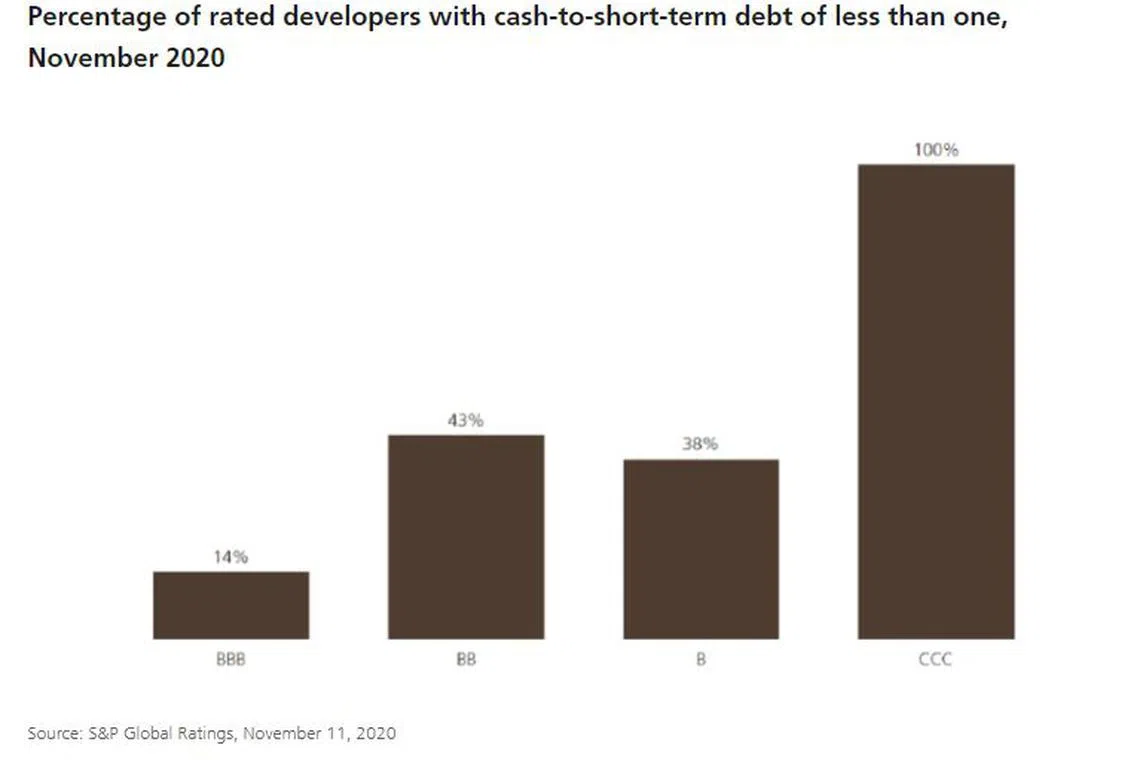
- cash to short-term borrowing ratio of more than one time
If they do not meet these thresholds, regulators step in to curb how much debt they can take.
An S&P report in November 2020 showed that just 6.3 per cent of their rated developers can fully comply with all of the "three red lines".
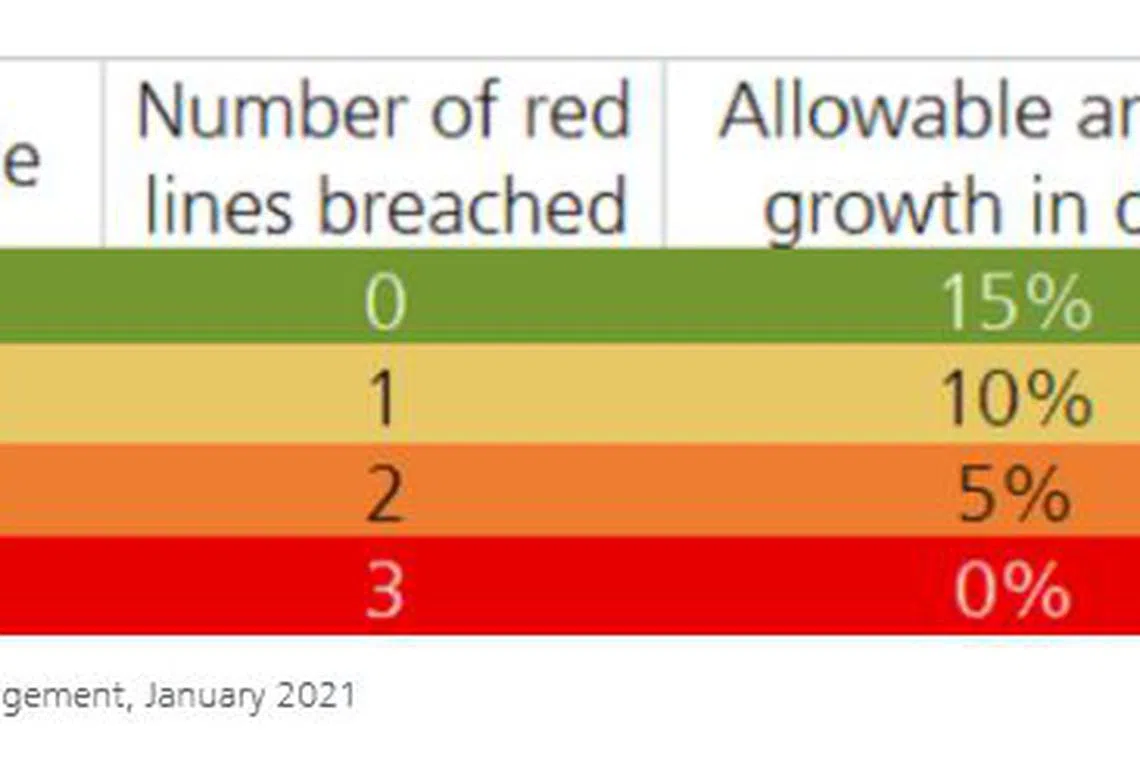
The move will force deleveraging by highly indebted developers in China.
CapitaLand said the ongoing shake-up in China's real estate sector levels the playing field and could throw up interesting opportunities for foreign property players such as itself.
Read more: Evergrande's teeter may clear path for Singapore players in China
TRENDING NOW

Singapore government slaps loan curbs on individual private-hire car buyers

If Europe goes to war, the fallout will be felt in East Asia
The grid is the transition: Why Asean’s next energy challenge is coordination

Indonesia stocks suffer worst plunge in nearly 30 years as MSCI proposes standalone status

