

Singapore banks brace themselves for tough months ahead
Q1 is likely just a small glimpse of the pain to come, as they are expected to see flattish growth at best for the rest of the year
Singapore
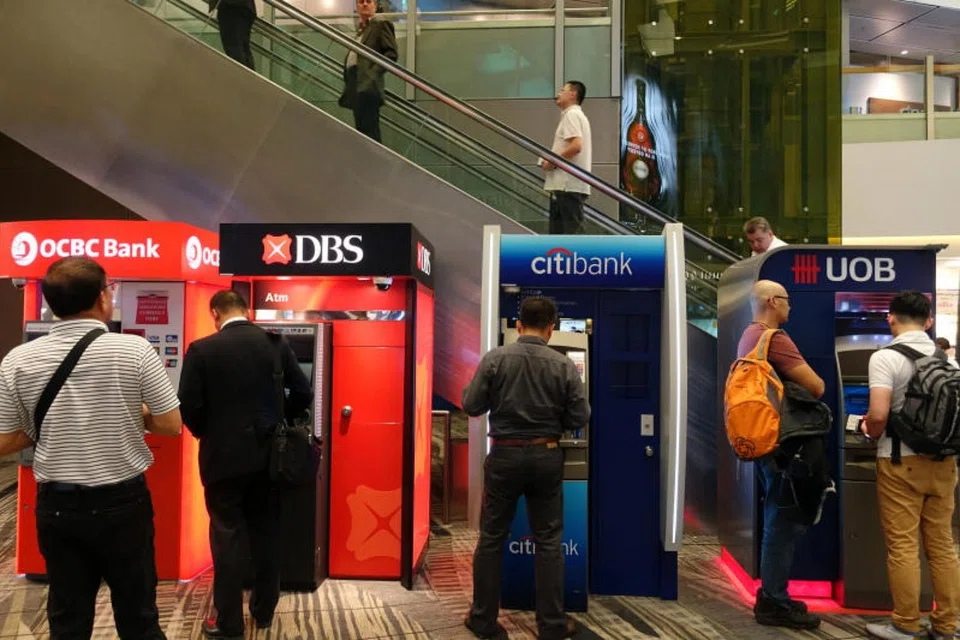
SINGAPORE banks posted lower earnings in the first quarter after bulking up their provisions to cushion against economic stresses brought on by the virus outbreak, and against some of their oil-and-gas exposure.
Q1 is likely just a small glimpse of the pain to come, with banks likely to see flattish growth at best for the rest of the year and having to take further impairments down the line. Their reported return on equity (ROE) also fell under 10 per cent. DBS's ROE stood at 9.2 per cent, that of OCBC was 6 per cent, and UOB's ROE was 8.8 per cent.
The size of dividends ahead is not fully assured. DBS has kept its quarterly dividend payment unchanged for now but has said it would watch how things go, while OCBC will look at the dividend payout closer to the half-year mark. UOB told analysts it is committing to a payout ratio of 50 per cent for now.
Various relief measures at a time of extraordinary fiscal support have also muddied the timeline for when the full brunt of crisis-driven credit costs would hit.
The banks, which remain well-capitalised, are making estimates of higher credit costs, but generally all through to end of 2021, with the debt repayment holiday periods through only to end of this year, analysts said.
Banks can then fully assess which accounts of customers who have taken loan moratoria and other forms of relief have to be taken as soured assets specifically.
The Monetary Authority of Singapore (MAS) had earlier guided that banks do not have to lump borrowers who took up loan moratoria as delinquent accounts.
MAS added that in assessing their provisions to account for the worsening macroeconomic conditions, banks can take into account the extraordinary fiscal support to "bolster economic resilience".
The guidance comes amid more complex accounting standards for the lenders today. Banks now need to account for a prediction of economic cycles, and hold their portfolio performance against that view. Singapore will see this year its sharpest economic contraction since its independence.
OCBC was the final bank to report its first-quarter results, posting on Friday a 43 per cent drop in Q1 net profit to S$698 million from a year ago, on higher provisions and mark-to-market losses at its insurance unit. This was weaker than the average estimate of S$941 million from four analysts, according to Refinitiv data.
Total allowances went up to S$657 million in Q1, consisting of specific allowances of S$275 million mainly for a "Singapore based corporate customer in the oil trading sector".
Singapore banks reportedly have a total exposure of about US$600 million to Hin Leong.
OCBC's general allowances surged to S$382 million, which reflects its projections for macroeconomic stresses, factoring in elements such as the economic outlook, unemployment ahead and property prices across all key markets, said OCBC's chief Samuel Tsien at a briefing.
Net profit contributed from OCBC's insurance operations slumped 94 per cent, with Great Eastern's earnings tumbling in Q1 on unrealised mark-to-market losses.
OCBC said overall cumulative credit costs over the next two years is estimated to be 100-130 basis points (bps) - higher than that in the global financial crisis (GFC), close to what it was in the Sars period, but lower than that in the Asian Financial Crisis.
Mr Tsien added that the next few quarters will be "very difficult" for individuals and businesses, with a stronger recovery unlikely till 2021.
The bank has estimated that it will extend moratorium relief and government-assisted loans of S$42 billion to more than 165,000 individuals, small and medium-sized enterprises (SMEs) and other corporate customers across Singapore, Malaysia, Hong Kong, Macau and Indonesia.
DBS's Q1 net profit dropped 29 per cent to S$1.165 billion from a year ago. This is in line with an average estimate of S$1.13 billion from four analysts polled by Refinitiv. Total provisions set aside by the bank in Q1 was S$1.09 billion, comprising a S$703 million cushion under general allowances and the rest for specific accounts gone sour.
DBS guided that credit costs are to rise to between S$3 billion and S$5 billion - reflecting 80-130 bps of loans - cumulatively over two years. The two-year period is to account for the uncertainties behind how various relief packages will impact souring assets or defaults later on, said DBS chief Piyush Gupta at a briefing.
A Citi report said the recession peaks on credit costs for the banks overall stood at 100 bps in the GFC.
DBS guided that its full-year profit before allowances would be around 2019 levels after factoring in declines for the rest of the year.
The bank has provided loan moratoria for more than 1,800 corporate facilities representing over S$3.4 billion in total loans outstanding. It has availed S$3.2 billion in loan facilities to Singapore SMEs under the government relief programme as well.
As it is, CGS-CIMB analyst Andrea Choong said fee income as well as trading income and investments gains had "saved the day" for the bank in Q1, with Mr Gupta guiding that the bank is unlikely to see strong fee income from the wealth management business in the coming quarters.
The bank's base-case scenario is that lockdowns in major economies last until mid-2020 and in its stressed scenario, until the end of this Q3.
Against its flat total income and higher provisions compared to a year ago, UOB's Q1 net profit was down 19 per cent to S$855 million, which still beat estimates by Refinitiv data.
UOB's impairment charges jumped to S$286 million in Q1. Another S$260 million was also set aside, but through the regulatory loss allowance reserve.
UOB told analysts that it would be realistic to assume for 10-15 per cent of those applying for loan moratoria to eventually be downgraded into non-performing loans.
Under various loan moratoria around the region, UOB has backed about a million customers, involving amounts up to 12 per cent of the loan book, a Citi report said.
Jeferries analysts Krishna Guha said Q1's profits were managed through "unusual provisioning". "Guidance was disappointing, especially given the bank has managed past cycles relatively well."
UOB did not host a media briefing for its Q1 results, but UOB CEO Wee Ee Cheong said in a statement the bank is in "a period of unmatched challenges and disruption" due to the pandemic. "But the first quarter of 2020 has also revealed the capacity and resolve of governments, industries and individuals to contain and to cushion the impact of the pandemic."
The banks disclosed their oil-and-gas (O&G) exposure, with DBS's exposure at slightly over 6 per cent of total loans, OCBC's exposure at 5 per cent of its loans, and UOB's exposure at 3.6 per cent.
DBS's Mr Gupta said of the bank's loan exposure to the "impacted industries" made vulnerable by the virus outbreak, O&G makes up the single-largest sector.
OCBC does not intend to reduce its exposure on the account of falling oil prices alone, but will evaluate their exposure to oil-related customers individually, said Mr Tsien.
Asked about the allegations of irregular activities in certain companies, Mr Tsien said he believes that these are "isolated" cases.
Further pressure on the banks' income will come from the squeeze in net interest margin, as interest rates continue to head south.
The three-month Singapore Interbank Offered Rate closed on Wednesday at its lowest point so far this year at 0.691 per cent - a level not seen since late 2014.
On Friday, DBS shares fell four cents to S$19.70, while OCBC and UOB shares closed flat at S$8.88 and S$19.88, respectively.
READ MORE: OCBC expects credit costs from Covid-19 impact to be higher than GFC
TRENDING NOW

He built the Vingroup empire. Now South-east Asia’s richest man is handing some key roles to his sons

32 companies, 6 individuals bag accolades at Singapore Corporate Awards 2026
Can a first-time homebuyer couple earning S$18,000 a month afford a new EC unit?

Floods compound Philippine growth woes from public-works scandal

