

Singapore banks to deliver solid Q3 earnings as rate hikes finally take hold: analysts

Kelly Ng
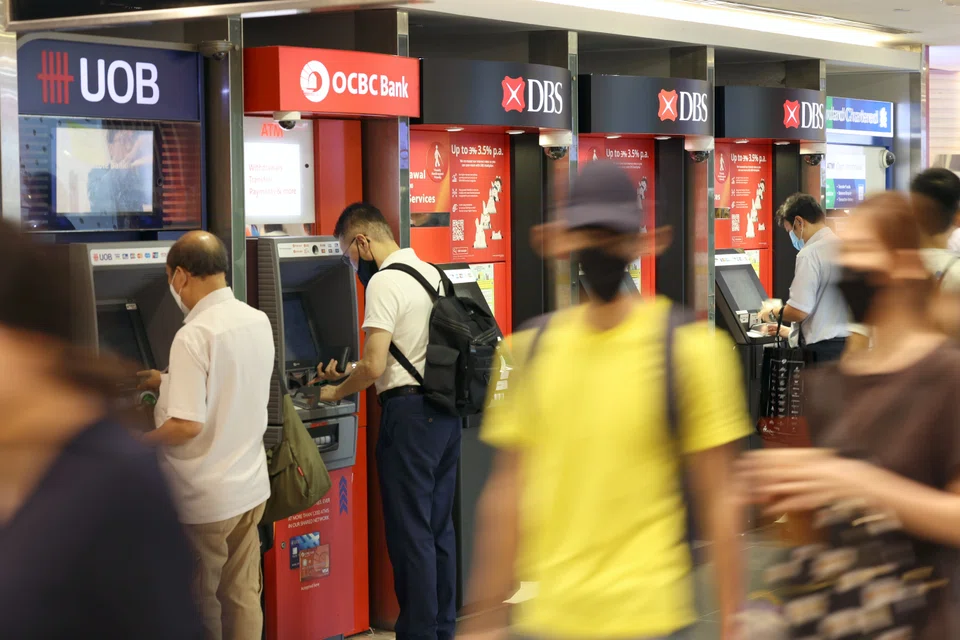
SINGAPORE’S banking trio are expected to reap substantial gains in the third quarter of 2022, as interest rate hikes finally make themselves felt considerably in the local financing environment.
While funding costs are set to rise, as deposits in current and savings accounts (Casa) are moved into products that command higher rates, higher loan yields should still dominate returns for the local banks, analysts said.
Many analysts have maintained their “buy” calls on the three banks, on higher absolute dividends for FY2022. UOB Kay Hian (UOBKH) raised its target price for DBS from S$39.50 in the previous quarter to S$45.75, and that of OCBC from S$14.75 to S$16.82. CGS-CIMB raised its target price for OCBC from S$14.20 to S$15.50, and maintained its S$35.60 target price for UOB.
Shares of DBS closed at S$32.81 on Thursday (Oct 27), having gained 3.8 per cent from a year ago. OCBC shares closed at S$11.78, down 0.7 per cent, while UOB shares ended the day at S$26.02, down 2.9 per cent.
Analysts forecast net interest margins (NIM) to expand by 20 to 30 basis points for the quarter, to surpass management’s previous guidances. For every 100 basis point hike in US dollar rates, DBS guided for net interest income to grow by S$1.8 billion to S$2 billion; OCBC earlier said its NIM could be expected to expand by 18 basis points; while UOB guided for a 12 to 16 basis point expansion.
DBS analyst Lim Ruiwen said she expects the NIM uplifts to translate into a record quarterly improvement for the sector, and a 3 to 6 percentage point growth in earnings.
While all three banks saw slight declines in their Casa ratios as at Q2, asset yields are expected to continue outpacing higher costs of deposits.
“Although snaking queues to place fixed deposits at multi-year high rates hint at continued outflow of Casa as we saw in (the previous quarter), the simultaneous repricing of loan portfolios on higher benchmark rates should still provide a sizeable 24 to 30 basis point quarter-on-quarter boost to NIMs (in Q3),” CGS-CIMB analysts Andrea Choong and Lim Siew Khee wrote in a research note.
Demand for government-backed fixed income instruments, such as the Singapore Savings Bonds, Singapore Government Securities bonds and Treasury Bills, soared alongside yields.
As the US Federal Reserve looks to temper inflation, it has raised its federal funds rate by a total of 3 percentage points this year. Many other central banks have also raised rates aggressively.
The Monetary Authority of Singapore does not set exchange rates to manage inflation, unlike most other central banks. Interest rates in Singapore do, however, reflect global rate movements.
Amid US labour market resilience, DBS researchers expected the federal funds rate to reach 5 per cent in early 2023, from the current range of 3 to 3.25 per cent.
UOBKH analyst Jonathan Koh was more muted in his expectations. He said rate hikes are reaching a climax and expects their intensity to be modest in 2023.
DBS is most sensitive to higher interest rates, Koh added, but OCBC and UOB benefit more from the reorientation of supply chains towards Asean countries.
Loan growth will, nevertheless, slow amid macroeconomic uncertainties, analysts said. And, asset quality will be of some concern in difficult times.
DBS’ Lim was not particularly worried: “While pockets of (non-performing loans) may emerge every now and then, these are likely stand-alone cases and not reflective of any broader systemic risk at the moment,” she said.
According to Lim, UOB will be able to reverse provisions taken on account of distressed Chinese developer Shimao, following a settlement, while UOBKH’s Koh said he expects DBS to top up general provisions.
One “critical risk” to watch out for, said Maybank’s head of research Thilan Wickramasinghe, is deteriorating asset quality from North Asia, which could raise credit charge guidance.
“Continuing stress in the Chinese property sector and potential contagion impacts landing on balance sheets cannot be ignored. In addition, continued Covid lockdowns adds further risk of stress,” Wickramasinghe added.
Fee income is expected to stay flat due to soft wealth management volumes, analysts said, while contributions from cards are expected to be a bright spot with the resumption of travel.
Maybank’s Wickramasinghe said continued weakness in the markets could result in downside surprises to trading and investment income, while DBS’ Lim said she expects customer flows for trading to be strong on the back of higher hedging activities in a rising rate environment.
TRENDING NOW

Philippine power giant First Gen rebuffs foreign offers, plans up to US$2.6 billion in expansion

Once staunchly pro-China, Malaysian Chinese businesses are now distancing themselves from Beijing

Nearly half of Singapore workers put in at least six unpaid hours a week: survey

Vietnam’s data-centre investment rush faces reality check on power and site constraints

