

Singapore banks’ dividends leave market mixed despite resilient Q4; outlook for 2024 remains stable

Tan Nai Lun
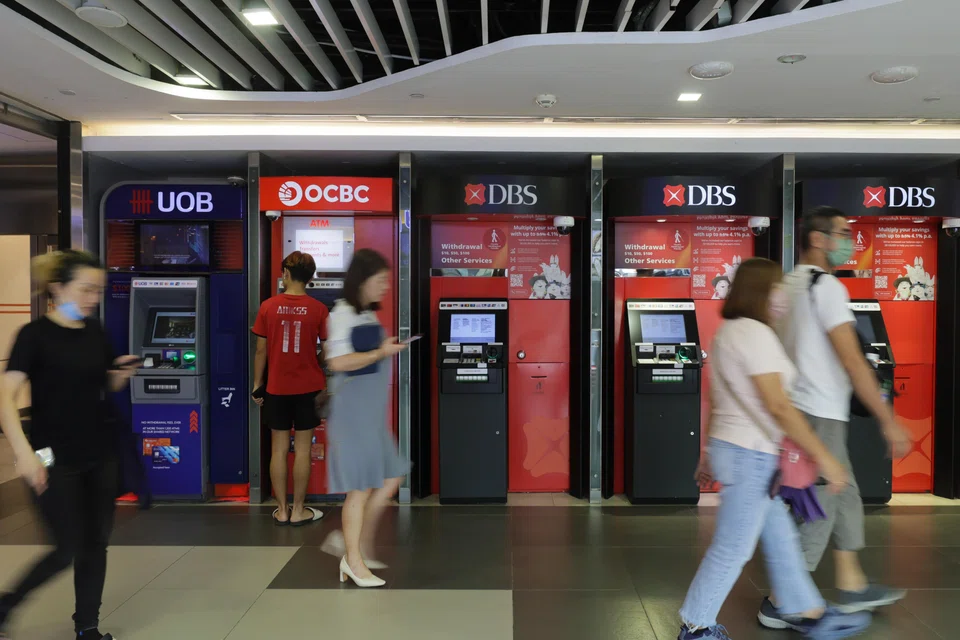
SINGAPORE banks wrapped up 2023 with another set of resilient earnings, with results for the fourth quarter largely in line with estimates.
But amid expectations of higher dividend yields, the dividends that each lender has proposed respectively have left market reactions mixed.
Shares of DBS rose after it proposed to raise its final dividend to 54 Singapore cents per share for Q4, and issue one bonus share for every existing 10 ordinary shares held.
DBS chief executive Piyush Gupta also said there will likely be more opportunities to return capital to shareholders, given the bank’s ample excess capital.
Analysts cheered the move. RHB’s Singapore research team upgraded its call on the counter to “buy” from “neutral”, due to improved clarity with respect to its shareholder returns commitment.
The team noted that DBS’ focus on absolute dividend per share, as compared to payouts, offers investors “bond-like coupons” with yields that are now “too good to ignore”.
Citi analyst Tan Yong Hong also upgraded his call on DBS to “buy”, as he expects the lender will reverse its share price underperformance due to an enhanced capital return and clarity to stable net interest income.
For Q4 ended December, DBS’ net profit fell 3 per cent on year to S$2.27 billion.
Excluding one-time costs from the acquisition of Citigroup’s Taiwan retail business and a corporate social responsibility commitment, net profit would have been S$2.39 billion, up 2 per cent on year.
Gupta noted that it was a “fairly good solid quarter”, with momentum coming back in the underlying business, especially in fee income.
But the bonus issue has likely put pressure on the other Singapore banks, as it raised expectations for higher dividend payouts, Tan said.
He noted that OCBC’s final dividends – which stood at S$0.42 per share – likely disappointed the market. This was despite the lender’s dividend payout ratio coming in at 53 per cent, which was above its commitment of 50 per cent.
“DBS’ aggressive capital management drove up expectations for peers, especially so for OCBC with sector-leading Common Equity Tier-1 ratio of 15.1 per cent post-dividends,” Tan said.
Shares of OCBC – which saw a boost post-DBS announcement – fell after the release of its results, also in part due to a miss in earnings estimates.
OCBC posted a 12 per cent gain in net profit to S$1.62 billion for Q4, amid a rise in operating profit as well as lower allowances.
The results missed estimates due to weaker contributions from its insurance segment.
Nevertheless, CGS-CIMB analysts Andrea Choong and Lim Siew Khee noted that OCBC was the only local bank to record net interest margin (NIM) expansion in the quarter.
While the lender’s NIM – at 2.29 per cent in Q4 – fell 2 basis points (bps) on year, it was up 2 bps on quarter.
Maybank Securities head of research Thilan Wickramasinghe also noted that OCBC posted a 0.6 per cent rise in loans for Q4, unlike its peers where lending was flat.
Synergies of the bank’s “one group” strategy are starting to show, he said.
Meanwhile, OCBC’s dividend payout policy has set a clear base expectation for dividends, although excess capital continues to be an overhang, he added.
As for UOB, Citi’s Tan noted that the market had reacted negatively to UOB’s falling NIM trajectory, despite stable net interest income and optimism for net interest income growth in 2024.
This is warranted, given the 20 basis point contraction in NIMs from Q4 2022 to Q4 2023. But Tan still prefers UOB as he expects the bank to be the most resilient to interest rate cuts among the trio.
UOB’s net profit for Q4 rose 21.8 per cent to S$1.4 billion, due to higher net fee income and other non-interest income.
Excluding one-off expenses from its acquisition of Citigroup’s retail portfolio in Malaysia, Indonesia, Thailand and Vietnam, core net profit would have been S$1.5 billion.
Its NIM declined for a fourth straight quarter to 2.02 per cent, due to rising costs in maintaining deposits, coupled with the lack of loan growth.
Tan noted that UOB is shifting its focus from NIM guidance to net interest income and total income growth for 2024. The bank will likely achieve this via volume growth.
“With trade-off between NIM contraction and loan growth, UOB can still achieve a stable net interest income outcome while keeping relationships,” he said.
Stable outlook
Looking ahead, analysts expect the banks to stay resilient given their well-supported asset quality, although risks from the uncertain macroeconomic outlook remains.
Maybank’s Wickramasinghe said DBS’ earnings growth has likely peaked, but levers such as loan growth, fee income and large general provision overlays should keep earnings supported at current levels.
UOB’s regional franchise, especially with the integration of Citi, is also set for expansion, especially as economic growth in South-east Asia takes off.
Wickramasinghe believes the OCBC’s positioning in the region – as well as the possibility that activities are bottoming out in greater China – should provide an upside.
The chief executives of the three lenders remain cautiously optimistic, even as all three are guiding for low-single-digit loan growth in 2024.
DBS’ Gupta noted that the macroeconomic outlook around the world is now looking brighter than it did during the bank’s last briefing in November for its Q3 results.
He kept guidance for 2024 largely unchanged, which includes maintaining net interest income around 2023 levels, and sustaining its underlying profits within a S$10 billion range. Meanwhile, full-year NIM is likely to be slightly below its 2023 exit NIM of 2.13 per cent.
UOB chief executive Wee Ee Cheong also noted that South-east Asia continues to be a bright spot, even though the global economic outlook remains uncertain in the near term.
He expects the sacrifice in NIMs to be short-term, but its strategy should translate into a bigger customer base and more fees in the longer term.
UOB expects to post a double-digit fee growth, supported by the bank’s credit card business, as well as positive growth in total income in 2024.
Meanwhile, OCBC chief executive Helen Wong said there will likely be continued growth potential, as the lender optimises in capturing growth opportunities through its Asean-Greater China links.
The lender is guiding NIM to be in the range of 2.2 to 2.25 per cent.
At the market close on Friday (Mar 1), shares of DBS were up 0.7 per cent to S$33.55; UOB rose 0.9 per cent to S$28.19; while OCBC was up 0.1 per cent to S$12.99.
TRENDING NOW

Philippine power giant First Gen rebuffs foreign offers, plans up to US$2.6 billion in expansion

Cliff Tan has 7 million followers and a 4-month waitlist. Why won’t he expand his business?

Could stablecoins be the future of money?

From finance aspirant to Asean CEO: TUV SUD’s Jonas Strahberger on finding people who believe in you

