

Singapore banks getting better at spotting dirty money, but penalties still lack bite, says global watchdog
FATF recognises role of Republic’s strong public-private cooperation and information collaboration in curbing money laundering
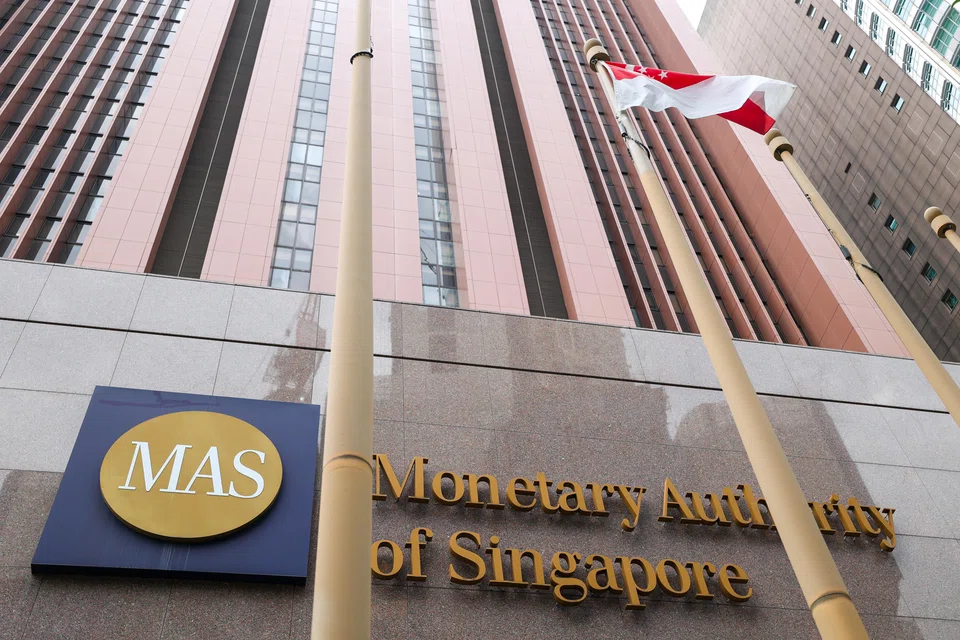
[SINGAPORE] Singapore’s banks have improved their ability to detect financial crime through initiatives such as data-sharing tools, said a global watchdog. But it added that penalties and supervision could be strengthened to better deter misconduct.
In its latest report, the Financial Action Task Force (FATF) noted that financial institutions (FIs) in the Republic play a central role in detecting and reporting suspicious activity, with strong public-private cooperation and increasing use of financial intelligence among the key strengths of its anti-money laundering regime.
Banks were found to have a strong understanding of financial crime risks, supported by robust internal controls and reporting frameworks.
The FATF is an independent global body established by the Group of Seven nations in 1989 that sets international standards to combat money laundering, terrorist financing and proliferation financing. It currently comprises 40 members, with Singapore joining in 1992.
Sharing data
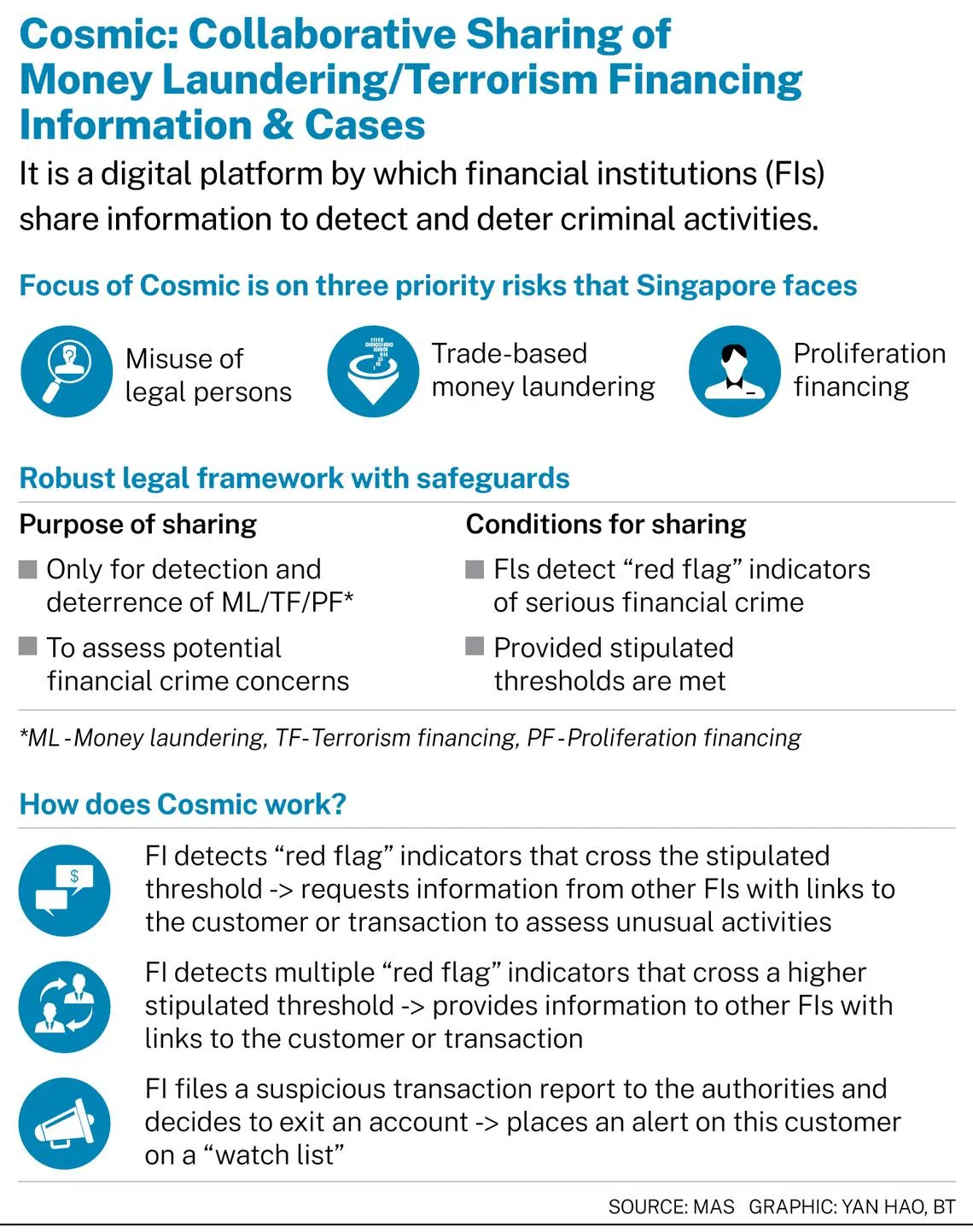
The report pointed to initiatives such as the Collaborative Sharing of Money Laundering/Terrorism Financing Information and Cases (Cosmic). The platform, co-developed and led by the Monetary Authority of Singapore (MAS), has “significantly improved the participant banks’ ability to detect bad actors”, noted FATF.
Radish Singh, EY Asean financial services risk consulting leader, said: “Cosmic is the first-of-its-kind regulator-led FI-to-FI information-sharing platform, and reflects a broader shift from institution-level controls to system-level defence.”
The platform allows participating banks to voluntarily exchange information on customers with multiple red flags linked to money laundering and related risks.
Launched in April 2024, Cosmic involves six major lenders – DBS, OCBC, UOB, Standard Chartered, Citibank and HSBC – and focuses on three key risk areas: misuse of legal persons, misuse of trade finance for illicit purposes and proliferation financing.
By enabling banks to pool insights on suspicious behaviour, it aims to address blind spots that can arise when FIs operate independently.
Ashlynn Siau, head of compliance at Citi Singapore, noted that the Cosmic platform positions Singapore as a leader in implementing FATF Recommendation 40 on inter‑institutional information sharing at scale.
“By enabling financial institutions to share intelligence on suspicious customers within a robust legal framework, Cosmic helps address risks such as ‘bank hopping’ across institutions,” she added.
In its first year, the platform contributed to an additional 461 suspicious transaction reports involving more than S$1.6 billion, and the closure of 1,152 suspicious customer accounts, said the report.
Even so, FATF flagged gaps in how FIs are supervised and disciplined.
Supervision could be more consistently based on risk, while penalties and sanctions could be more dissuasive to deter misconduct, stated the report.
FATF also pointed to uneven effectiveness across parts of the system, including possible under-reporting in higher-risk segments, such as digital payment token service providers.
In a joint statement issued by MAS, the Ministry of Home Affairs and Ministry of Finance, the authorities said that Singapore will expand Cosmic to allow information sharing in significant cases, and include other major banks which are close partners in fighting financial crime.
The FATF report recommended that the use of Cosmic be expanded to other FIs beyond the current participating commercial banks, and that it could cover financial crime risks beyond the present three areas.
Tanty Muliani, chief compliance officer for Singapore and Asean at StanChart, said that the bank will continue to collaborate with its peers and MAS to further enhance the Cosmic framework, including exploring additional membership and risk typologies that would be beneficial over the longer term.
Lam Chee Kin, group head of legal and compliance at DBS, noted that the lender looks forward to working with MAS and other stakeholders to study the report’s findings and implement the recommendations.
He added that it is particularly encouraging for Singapore to be recognised for the collaboration between its public-sector agencies and private-sector partners, with platforms such as Cosmic improving intelligence-sharing and steering operational resource allocation.
“Ultimately, this is another forward progression in a constantly evolving battle against the highly organised criminal elements abusing the system, while serving the greater good of making sure Singapore thrives as a financial centre and remains a desirable place to live in,” he said.
Decoding Asia newsletter: your guide to navigating Asia in a new global order. Sign up here to get Decoding Asia newsletter. Delivered to your inbox. Free.
Copyright SPH Media. All rights reserved.
TRENDING NOW

Once staunchly pro-China, Malaysian Chinese businesses are now distancing themselves from Beijing

Looking beyond looming CEO succession, should UOB potentially pursue a transformative merger?

Could stablecoins be the future of money?

Grab CEO’s wife Chloe Tong on life with Anthony Tan and finding her purpose

