

Singapore banks keep guard against rate cuts, market volatility in Q2, but expect to remain strong
They have taken various measures to reduce their interest rate sensitivity, lower funding costs, and ensure enough capital

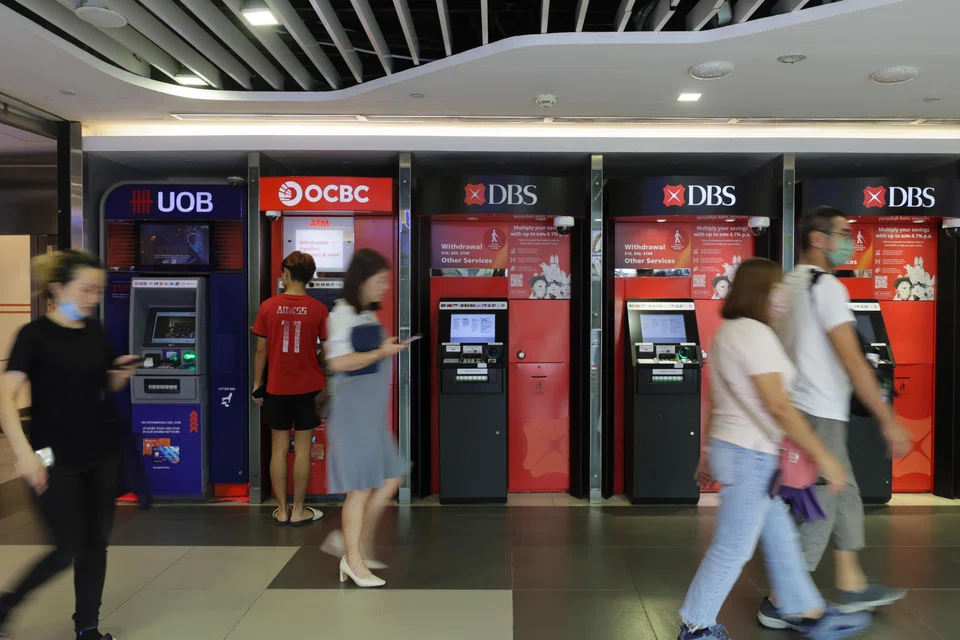
SINGAPORE banks continue to shore up against market volatility and impending rate cuts, even as their earnings remain ahead of expectations.
All three local banks – DBS, OCBC and UOB – reported strong second-quarter net profits, and guided for this strength to remain for the rest of 2024.
But with rising macroeconomic uncertainty and interest rate cuts likely to happen at the end of the year, they also took on various measures to reduce their interest rate sensitivity, lower funding costs, and ensure enough capital.
The banks posted their Q2 results in August – UOB on Aug 1, OCBC on Aug 2, and DBS on Aug 7.
UOB’s net profit rose 1 per cent on year to S$1.43 billion, amid double-digit fee income growth and lower credit allowances.
OCBC’s net profit rose 14 per cent to S$1.94 billion, underpinned by broad-based income growth and a decline in allowances.
DBS’ net profit rose 6 per cent to S$2.79 billion, on the back of income growth, particularly in fee income.
Chief executives of the three lenders still expect strong 2024 results. But they were watchful of interest rate cuts, and were more cautious about the rising uncertainty ahead.
DBS chief Piyush Gupta expects heightened uncertainty, although he noted that the bank has built resiliency against a potential economic slowdown and lower interest rates.
OCBC chief Helen Wong highlighted the bank’s focus on protecting its net interest income ahead of interest rate cuts.
Meanwhile, UOB chief Wee Ee Cheong was more positive, as he expects rate cuts will benefit the bank by spurring more economic growth and activity in Asia.
Fed rate cuts in 2024
With a higher likelihood of interest rate cuts to take place in 2024, several risks have emerged for the banks.
For OCBC, net interest income inched up 2 per cent on year to S$2.43 billion, led by a 5 per cent increase in average assets, but partially offset by a six-basis-point (bps) drop in net interest margin (NIM) to 2.2 per cent.
The lender had deployed liquidity to higher-quality but lower-yielding assets to prepare for the rate cuts, which led to net interest income growth, but compressed overall NIMs.
It also plans to prioritise its net interest income levels ahead, instead of solely maintaining its NIM.
Thilan Wickramasinghe, head of Singapore research at Maybank Securities, said that potential rate cuts could further erode NIMs.
Given that the quantum of the hedges is not large, it should likely only slow NIM erosion, although an increase in low-cost current and savings accounts (Casa) should help keep NIM declines in check, he said.
Loan yields also continue to tighten as OCBC chases a limited pool of high-quality clients amid strong liquidity, while loan growth visibility is low, he added.
For DBS, CEO Gupta said the lender has placed excess liquidity into longer-duration fixed-rate high-quality assets to sustain net interest income.
This has led the bank to reduce its net interest income sensitivity to S$4 million per basis point of the US Fed funds rate, from S$18 million to S$20 million in 2021.
Q2 commercial book net interest income rose 5 per cent to S$3.77 billion, on balance sheet growth and a slightly higher commercial book NIM of 2.83 per cent.
Group NIM was down two bps on year to 2.14 per cent, but unchanged on quarter.
Wickramasinghe said DBS’ NIMs are holding better than peers, but he expects headwinds amid Fed rate cuts. The erosion of low-cost Casa may also have a downside impact on NIMs.
Meanwhile, UOB’s Wee noted that the bank’s efforts to manage funding costs and to lengthen the duration of its assets have borne fruit.
Net interest income fell 1 per cent on year to S$2.4 billion, and NIM fell seven bps on year to 2.05 per cent, although it is up three bps on quarter.
Therefore, DBS Group Research analyst Lim Rui Wen said UOB’s active management of deposit costs can buffer its earnings going forward.
Wickramasinghe also said corporate investment activity could be returning, which should reduce some competitive pressure and help with credit pricing.
Areas to watch
Fee income likely remains a bright spot for the lenders amid rate cuts.
CGS International analysts Andrea Choong and Lim Siew Khee expect a progressive recovery in OCBC’s wealth management fees, amid lower rates and more risk-on sentiments.
Maybank’s Wickramasinghe also expects fee income to be a bright spot for UOB and DBS, as the banks gain from the return of wealth management activity.
Amid rising uncertainties, analysts continue to watch for the banks’ asset quality, although it remained strong in Q2.
DBS’ Lim said she remains watchful of asset quality risks in the uncertain macroeconomic and high-interest rate environment, especially for exposures to the commercial real estate sector, which has seen weakness.
But the three banks still have a strong capital base that provides “strong dividend visibility”, Wickramasinghe said. OCBC may have excess capital returns if it achieves full ownership of Great Eastern, and UOB should continue to deliver dividends supported by strong capital and good execution.
For DBS, he expects a strong balance sheet, a high common equity Tier-1 ratio, and a focus on returning capital back to shareholders to keep dividend visibility high, even as rates come down.
At the close on Thursday, DBS was down 0.2 per cent to S$33.57, OCBC rose 1.1 per cent to S$14.23, and UOB gained 0.5 per cent to S$30.
TRENDING NOW

Philippine power giant First Gen rebuffs foreign offers, plans up to US$2.6 billion in expansion

Cliff Tan has 7 million followers and a 4-month waitlist. Why won’t he expand his business?

Could stablecoins be the future of money?

From finance aspirant to Asean CEO: TUV SUD’s Jonas Strahberger on finding people who believe in you

