

Singapore banks lead gains on STI; benchmark index up 1.6%
The key regional indices all end the day down
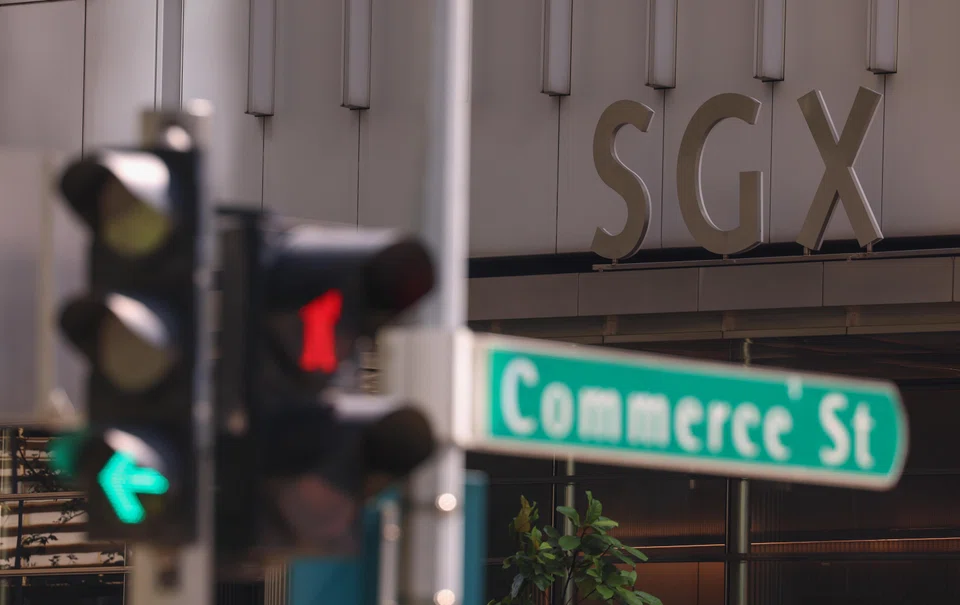
[SINGAPORE] Singapore stocks ended higher on Tuesday (Jul 7), led by gains in the local banking trio.
The benchmark Straits Times Index (STI) gained 1.6 per cent or 82.43 points to finish at 5,342.24.
OCBC was the top gainer on Singapore’s blue-chip index, rising 3.3 per cent or S$0.85 to end at S$26.34.
DBS gained 2.6 per cent or S$1.73 to S$68.64, and UOB was up 2.9 per cent or S$1.17 at S$41.69.
The closing prices for all three lenders were again at all-time highs on Tuesday.
The worst performer among STI constituents was DFI Retail Group , which fell 2.5 per cent or US$0.09 to close at US$3.56.
Within the iEdge Singapore Next 50 Index, Pan-United Corporation was the top gainer, rising 8.7 per cent or S$0.12 to finish at S$1.50; PC Partner was the biggest loser, falling 12.3 per cent or S$0.34 to end the session at S$2.42.
Across the broader market, losers beat gainers 308 to 231, after 1.2 billion securities worth S$1.9 billion changed hands.
Key regional indices were negative. Hong Kong’s Hang Seng Index lost 0.5 per cent, Japan’s Nikkei 225 fell 2.1 per cent, South Korea’s Kospi was down 4.9 per cent and the FTSE Bursa Malaysia KLCI declined 0.04 per cent.

Vishnu Varathan, managing director and head of Asia-Pacific macro strategy at Mizuho Securities, noted “a significant degree of uncertainty that remains unmitigated”.
The decline in oil prices following the US-Iran truce – and the attendant relief – “is understandable, but nevertheless appears to be exaggerated and accelerated” vis-a vis a much milder shock from Russia-Ukraine, he said.
The current spot oil price understates lingering latent and knock-on threats from oil shocks, given the significant degree of uncertainty over the durability of the Middle East truce and distribution of oil deliveries, Varathan added.
All this points to “a more pronounced risk premium – across rates and FX, scaled for energy-import dependencies and external cost shock vulnerabilities – for the same ‘on-screen’ price of oil”, he said.
This article has been written with the assistance of AI and reviewed by a reporter
Decoding Asia newsletter: your guide to navigating Asia in a new global order. Sign up here to get Decoding Asia newsletter. Delivered to your inbox. Free.
Share with us your feedback on BT's products and services
TRENDING NOW

Malaysian king buys stake in Singapore-listed mining firm expanding into rare earths

Grab CEO’s wife Chloe Tong on life with Anthony Tan and finding her purpose

Once staunchly pro-China, Malaysian Chinese businesses are now distancing themselves from Beijing
Longer wait times expected as S’pore healthcare institutions report system disruptions

