

Singapore banks lose over S$37 billion in market value as tariff sell-off continues
Slower growth and potential rate cuts by US Fed could weigh on bank margins and earnings

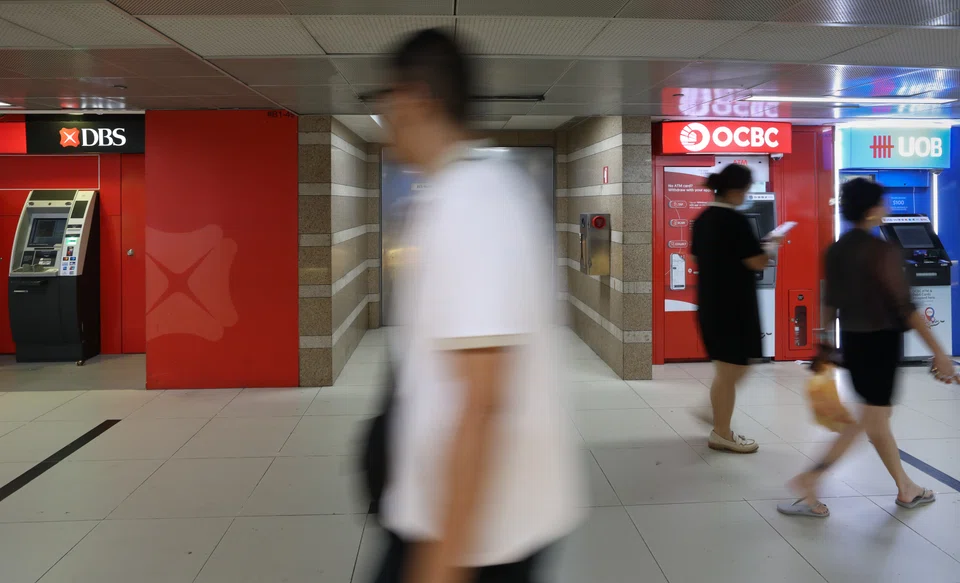
[SINGAPORE] Shares of Singapore’s three local banks continued to slide on Monday (Apr 7), leading a broader market sell-off triggered by concerns over US tariffs.
At market close, DBS had dropped 9.3 per cent to S$39.28; OCBC declined 6.9 per cent to S$15.47; and UOB slid 6.3 per cent to S$33.23.
The benchmark Straits Times Index – which is heavily weighted by the three banks – fell 7.5 per cent to 3,540.50, just days after it breached the 4,000-point milestone on Mar 28.
This comes amid a broader sell-off in local banking shares. Since Mar 28, Singapore’s three local lenders have collectively shed S$37.3 billion in market value as at midday trading on Monday, according to calculations by The Business Times.
While the banks are not immediately affected by US President Donald Trump’s sweeping reciprocal tariffs, analysts said potential rate cuts by the US Federal Reserve – in response to slower growth caused by the tariffs – could weigh on bank earnings.
“Slower growth expectations are a key headwind for the (banking) sector as this may impact new credit formation and risk-taking by customers,” wrote Maybank analyst Thilan Wickramasinghe in a research note last Friday.
“While still unclear, potential Fed rate cuts could compress net interest margins (NIMs) faster than anticipated, pressuring net interest income (NII),” he added.
DBS Group Research also pointed out in a note last Thursday that expected US interest rate cuts would put pressure on the banks’ NIMs.
It added that UOB would be the “most affected” by Asean tariffs.
For the 12 months ended Dec 31, 2024, UOB derived S$6.2 billion of its S$14.3 billion in total operating income from outside Singapore – accounting for 43.6 per cent, the highest proportion among the three local banks.
The reciprocal tariff rates imposed by the Trump administration on Apr 3 include 46 per cent on Vietnam, 36 per cent on Thailand, 32 per cent on Indonesia, and 10 per cent on Singapore – the lowest among Asean countries.
China has been hit with a 34 per cent tariff, while India faces a 26 per cent rate.
Citi research analyst Tan Yong Hong on Monday issued his second downgrade on Singapore banks in a month, citing “imminent earnings risks”.
These include pressure on the banks’ NII from falling Singapore Overnight Rate Average rates, as well as heightened business uncertainties weighing on loan growth and trade-related fee income.
Said Tan: “Our earnings (predictions) are now 4 to 5 per cent behind consensus for DBS, 2 to 5 per cent for OCBC and 4 to 10 per cent for UOB.”
Monday’s sell-off on the Singapore bourse was part of a broader global decline.
Citigroup dropped 7.8 per cent at last Friday’s close, while Hong Kong-listed shares of HSBC plunged 14.8 per cent on Monday. Standard Chartered fell 2.1 per cent during early trading on the London Stock Exchange.
All three counters have declined by at least 15 per cent over the past five days.
Not all doom and gloom
However, Singapore banks’ robust liquidity profiles and diversified funding mixes will shield them from market volatility amid global trade risks and growth concerns, said Rena Kwok, senior credit analyst at Bloomberg Intelligence.
“Strategic-deposit repricing and targeted customer-acquisition strategies to obtain high-quality, low-cost deposits will help bolster Singapore banks’ interest margins during expected rate cuts in 2025,” she added.
Despite Monday’s pull-back in valuations, there has not been a “broad-based rush” to exit local banking stocks, noted Daphne Tan, director of business development at CMC Markets.
“As blue-chip stalwarts, DBS, OCBC, and UOB are typically held by long-term investors for their stability and consistent dividends,” she said. “The recent dip may even present a buying opportunity for some, with valuations becoming more attractive amid ongoing market volatility.”
Maybank’s Wickramasinghe expects that lower interest rates could support fee income growth, particularly in wealth management, helping to offset declines in NII.
And while South-east Asia will be affected by US tariffs, the region stands to benefit from supply chains shifting away from China due to “widening” tariff differentials.
He added: “The Singapore banks with their integrated regional businesses should be key beneficiaries from this trend.
“At the same time, China may respond with increased domestic stimulus to offset tariffs impact. This may provide opportunities for the banks given their North Asian exposure.”






