

Singapore banks ride wave of recovery, but keeping an eye out for Asean

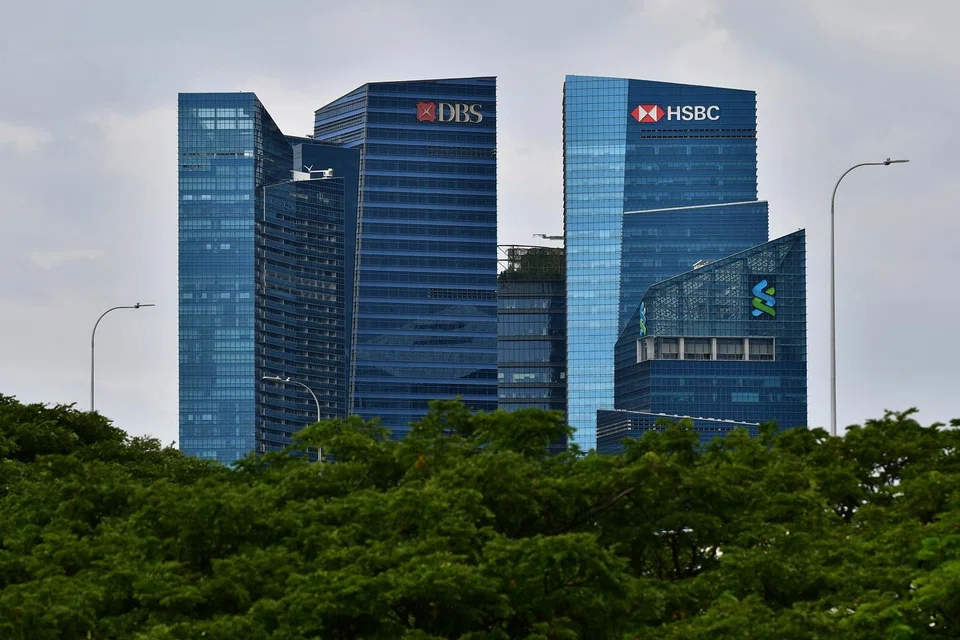
SINGAPORE banks are on the watch for signs of asset quality deterioration in Asean, given fresh lockdowns and resurging Covid-19 cases in the region, but strong capital levels and ample provisions should be more than enough to help them tide through, analysts have said.
This comes as the trio of banks ride the wave of global economic recovery, reporting strong double-digit growth in second-quarter net profits that beat street estimates, on the backs of lower allowances for bad loans and higher wealth management fee income.
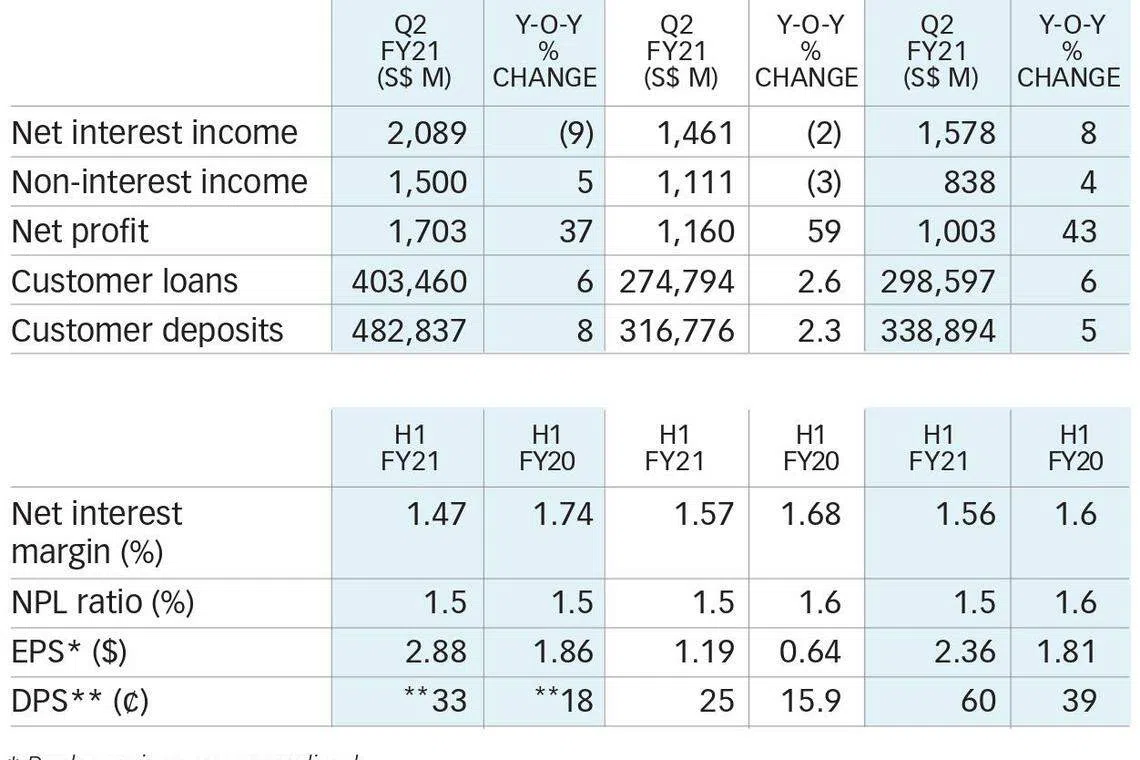
In the second quarter, DBS' net profit jumped 37 per cent to S$1.7 billion; OCBC's net profit soared 59 per cent to S$1.16 billion, and UOB's net profit surged 43 per cent to S$1 billion.
Singapore banks have reinstated dividends following the lifting of restrictions by the Monetary Authority of Singapore in July.
DBS declared a quarterly dividend of S$0.33 per share, bringing its first-half dividend payout to S$0.51 per share. OCBC declared a dividend of S$0.25 per share for the first half of the year, translating to a payout ratio of 42 per cent. UOB declared an interim dividend of S$0.60, translating to a 50 per cent payout ratio.
Despite Asean uncertainties, Krishna Guha, analyst at Jefferies, said that the second-quarter results "confirmed the improving economic growth outlook and asset quality, especially for large corporates".
"Overall, the three banks beat estimates accompanied by improvement in guidance and restoration of dividend back to pre-pandemic level."
Analysts expect DBS and UOB to continue their 50 per cent dividend payout ratio, with room for OCBC to catch up with its peers. OCBC has the lowest dividend payout ratio at 42 per cent.
Kevin Kwek, managing director for Asian financials at Alliance Bernstein, noted that DBS and UOB have Common Equity Tier one (CET-1) ratios of above 14 per cent, with OCBC's at above 16 per cent. The target operating range for local banks is between 12.5 and 13.5 per cent.
He considers OCBC's CET-1 ratio, which is a signal of a bank's capital strength, "excessive".
Mr Kwek told The Business Times: "Despite management rhetoric on keeping 'sustainable and progressive' dividends, and what can be interpreted as a wait-and-see attitude, it is highly unlikely loan growth can rise that much to bring CET-1 ratio down." He added that the bank had also said that there is nothing imminent on the acquisition front.
"If there is anything that stood out in the Q2 reporting, it is that OCBC again reverted to a lower-than-peers payout policy, and street views are that the justification given isn't robust."
While the banks are overall positive on the growth outlook, OCBC stood out again for striking a more circumspect tone than DBS and UOB.
OCBC has set aside allowances in the second quarter as a "buffer against potential credit deterioration" in the region, in view of the pandemic's resurgence in South-east Asia. Allowances for impaired assets stood at S$283 million for the first half of the year, and were "mainly for various corporate accounts for Malaysia and Indonesia", in the second quarter.
The bank expects to see an increase in relief loans from the two countries in the coming quarter.
Andrea Choong, analyst at CGS-CIMB, noted that OCBC has a "more cautious asset quality outlook" given the situation in Asean, and has since taken a "conservative" stance in the region by beefing management overlays.
About 17 per cent of OCBC's loans are from Malaysia and Indonesia, compared with 14 per cent for UOB. As for DBS, South-east Asia and South Asia's share of gross loans (excluding Singapore) is about 8 per cent.
While UOB could see a potential uptick in loans under relief and delinquencies in the region, its chief financial officer Lee Wai Fai is confident that the S$3 billion general provisions that the bank has in its balance sheet are "more than adequate" to ride through the storm.
However, he stopped short at writing back provisions, saying that the pandemic and general economic conditions have not improved to the extent that the bank will consider doing so.
Robert Kong, managing director of Citi Research, pointed out that general provisions reversals are likely only post-pandemic, or from 2022.
Thilan Wickramasinghe, head of research, Maybank Kim Eng, said that UOB's exposure in Asean could take longer to recover, given the pandemic taking a worse turn in Asean. "Nevertheless, strong provisioning and capital levels should provide sufficient offset for this risk," he wrote in a note.
Among the banks, DBS was the only one to write back general provisions of S$85 million, slightly lower than last quarter's S$190 million. This signalled DBS' "very high" degree of confidence in its prospects going into the second half of the year, said group chief executive Piyush Gupta.
During the briefing, he pointed out that the impact on DBS' loan book is driven more by business segments than geographical mix, with a larger proportion of its portfolio in the large corporate and secured business segments.
Analysts mostly concur with DBS on its optimistic outlook, with FY2021 earnings likely to be revised upwards.
Eugene Tarzimanov, vice-president and senior credit officer at Moody's Investors Service, noted: "DBS maintained its very high creditworthiness and strong balance sheet, with NPLs unchanged at 1.5 per cent and the CET-1 capital ratio rising to 14.5 per cent."
He expects DBS to maintain its "very strong credit metrics" in 2021-2022.
On Thursday, shares of DBS closed up 22 cents or 0.72 per cent to S$30.80; those of OCBC fell 3 cents or 0.24 per cent to S$12.43. Shares of UOB rose 18 cents or 0.68 per cent, to end at S$26.49.
Quotes from the top:
OCBC
CEO Helen Wong:
"The Greater Bay Area, obviously, is a very important market that we are looking at and putting more resources in. We are partnering with Chinese banks to look at the cross border wealth flows that will be coming up... We talked about (boosting) the China business units, but domestically (within China), we are also increasing the coverage strength."
"We see long term trends remaining stable, and this will continue to drive our loan growth. We are also seeing good momentum on the consumer side, in particular in Singapore where we actually see housing sales increasing. And thus we have a good momentum on our mortgage book."
CFO Darren Tan:
"With the recent situation in our South-east Asian markets, we have prudently set aside allowances in the second quarter to buffer against potential credit duration deterioration in the region. ...We do expect to see an increase in relief loans in Malaysia and Indonesia in the coming quarter as we continue to support our customers there."
UOB
CEO and deputy chairman Wee Ee Cheong:
"We confirm a positive outlook for the rest of the year. Overall, we are optimistic on growth prospects as the economies pick up pace in recovery as vaccination levels increase."
"We have extended S$13 billion of sustainable financing to our clients, and on track to meet our goal of S$15 billion, well ahead of our original target. We see huge opportunities in green trade finance, with more than S$1 trillion trade flows through Singapore, of which we estimate, more than S$90 billion are eligible for green trade finance, currently."
"We are optimistic that the situation will gradually pick up in Southeast Asia. We remain confident of the region, (its) underlying prospects and Asean's upside potential."
DBS
Group chief executive Piyush Gupta:
"We focus a lot on the number of (Covid) cases... The more important thing is that the macroeconomic data and indicators continue to be very robust and that's where the bulk of the banking sector portfolios tend to be concentrated."
"Isolated sectors (such as food and beverage and tourism) tend to suffer, but certainly if you look at the nature of our book, our actual exposure to those sectors is very small. The bulk of our exposure (includes) manufacturing, TMT (technology, media and telecommunications) and property. Property prices are on fire around the world."
"It's quite helpful that we have a disproportionately large part of our portfolio in the large corporate and secured business segments. Our exposure in the SME and consumer segment - excluding the mortgage book in Singapore which is fine - is really not very large."
READ MORE:
TRENDING NOW

Fed hike throws Singapore banks a margin lifeline; UOB most likely to feel impact

He built the Vingroup empire. Now South-east Asia’s richest man is handing some key roles to his sons

Real-estate veteran Desmond Sim quits from CEO roles at Realion, ETC
Chagee, Mixue and Luckin won the market. Sustaining their edge is the harder part

