

Singapore banks rival JPMorgan, Goldman Sachs in long-term shareholder returns
DBS, OCBC and UOB have beaten global benchmarks and some of the biggest US lenders over the past 20 years

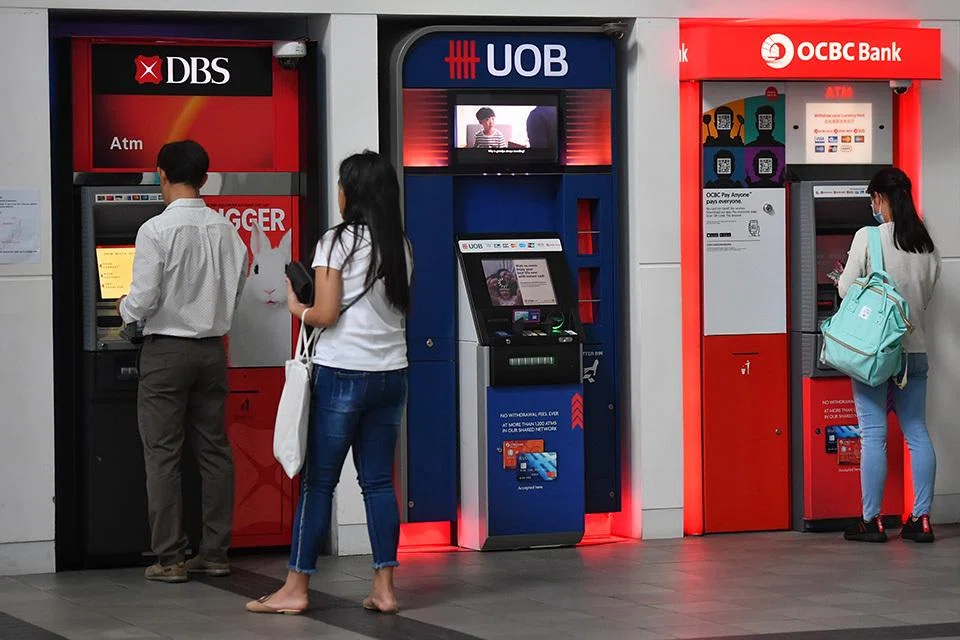
[SINGAPORE] For all the attention lavished on Wall Street’s biggest banks, Singapore-based investors would have done just as well – or better – backing lenders on the Republic’s shores over the past two decades.
Across five-year, 10-year and 20-year periods, total shareholder returns (TSR) delivered by Singapore’s three banks – also South-east Asia’s largest lenders by assets – have matched, and in some cases outpaced, local and global benchmarks.
Leading the pack is DBS , whose 20-year TSR in Singdollar terms stood at 955.7 per cent as at last Friday’s (Apr 17) close. Put another way, every S$1 invested in 2006 would have grown to about S$10.56.
OCBC posted a 20-year TSR of 684.3 per cent, equivalent to a 7.8 times return, while UOB delivered 452.6 per cent, or 5.5 times.
TSR measures the total return to shareholders, combining share-price gains with dividends reinvested over time.
The Singapore lenders’ long-run performance also compares favourably with some of the world’s best-known banking names.
For comparison, in Singdollar terms, JPMorgan Chase posted a 20-year TSR of 878.1 per cent, Goldman Sachs 524.1 per cent, Morgan Stanley 259.4 per cent, and HSBC 177.1 per cent.
Singapore’s banks also beat, or remained competitive with, the 543.7 per cent return generated by S&P 500, a global benchmark, and the 293.8 per cent delivered by the Straits Times Index, where the three lenders have long been dominant constituents.
DBS ranked second globally for 10-year TSR among the world’s top 100 listed banks by assets from end-2015 to end-2025, trailing only Morgan Stanley, data presented by DBS’ chief executive Tan Su Shan at the bank’s annual general meeting on Mar 31 showed.



Asked why the Republic’s banks have generally outperformed global benchmarks and Wall Street peers, Kathy Chan, equity analyst at Morningstar, said: “Structurally, we think all three Singapore banks benefit from funding cost-based advantage, underpinned by their respective strong, low-cost and sticky deposit base, which should allow the banks to enjoy strong returns above cost of equity, supporting long-term TSR.”
Meanwhile, DBS’ comparative outperformance against its local peers was partly driven by the successful scaling of its wealth-management business, which is asset-light, less rate-sensitive and more fee-driven, said Chan.
“In our view, this has led investors to favour DBS for its ability to consistently deliver superior return on equity (ROE),” she added.
“While we think DBS’ wealth business is the strongest of the three banks, we expect OCBC and UOB to also strategically expand their wealth business over time, which should be supportive of ROE.”
Shareholder focus
Dividends and share-price performance were recurring themes at the annual meetings of all three local banks.
Thousands of shareholders – many of them retail investors – turned up at the Sands Expo and Convention Centre on Mar 31, Apr 16 and Apr 17 for the annual meetings of DBS, OCBC and UOB, respectively, with all three held in the same ballroom venue.
There, shareholders queued at microphones placed around the hall, including several familiar faces who attended and posed questions at every meeting.
For many retail investors, the annual meetings remain a rare chance to directly question boards that include some of Singapore’s wealthiest business figures and former senior civil servants.
Looking ahead, Lim Rui Wen, an analyst at DBS Group Research, expects the Singapore banks’ TSR to continue being supported by the attractiveness of the Singdollar as a safe-haven currency, lifting share prices through stronger demand.
“Renewed interest in the broader Singapore market as a whole is a factor as well,” she said.
But she flagged that asset quality “continues to be an overhang” for UOB, as investors express concerns over its existing corporate real estate portfolio.
Shares of DBS closed little changed at S$57.24 on Monday. OCBC fell 0.2 per cent to S$22.67, while UOB was flat at S$37.40.
Decoding Asia newsletter: your guide to navigating Asia in a new global order. Sign up here to get Decoding Asia newsletter. Delivered to your inbox. Free.
Copyright SPH Media. All rights reserved.
TRENDING NOW

DBS, OCBC, UOB rout lops billions off STI as inflation, rate concerns spook investors

Grab CEO’s wife Chloe Tong on life with Anthony Tan and finding her purpose

OCBC sheds S$8 billion in value as shares close nearly 6% down; analysts cautious on banks

Deal between tycoon friends sparks scrutiny of Philippine power sector

