

Delayed rate cuts expected to benefit Singapore banks’ otherwise uneventful Q1 earnings
Net interest margins could also gain from more room to cut deposit rates, given that the lenders hold excess liquidity, says one researcher

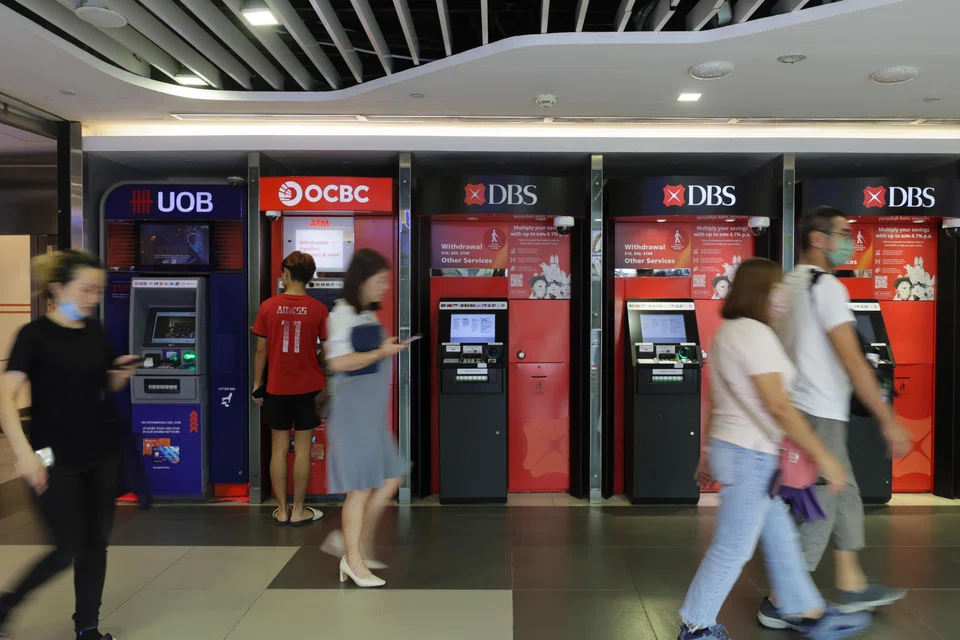
SINGAPORE’S local banks are unlikely to surprise in their earnings for the first quarter of 2024. But a potential delay in interest-rate cuts in the US should boost their results for the year, said analysts.
The local banking trio are due to report their Q1 results in early May – beginning with DBS on May 2, followed by UOB on May 8, and then OCBC on May 10.
The overall earnings momentum will likely flatline in Q1 from a combination of peaking net interest income and slower non-interest income recovery, said Thilan Wickramasinghe, head of Singapore research and regional head of financials at Maybank Investment Banking Group.
The net interest margins (NIMs) of the local banks will likely continue to decline, as loan yields have peaked and funding costs creep up in Singapore and regionally, he said.
Analysts also expect the decline in the Hong Kong Interbank Offered Rate (Hibor) to hit NIMs, especially for DBS and OCBC.
Hong Kong dollar-denominated loans accounted for around 11 per cent of DBS’ loans and 13 per cent of OCBC’s loans, said UOB Kay Hian analyst Jonathan Koh.
The steep Hibor decline could therefore shave off four to six basis points from their NIMs, he said.
Meanwhile, loan growth will likely remain muted.
Demand for credit should remain weak amid higher interest rates, and loan repayments are likely to continue outstripping existing loan demand, said DBS Group Research analyst Lim Rui Wen.
Wickramasinghe also expects loan growth to be weighed down by weak North Asia growth, high pricing, and Singapore dollar translation losses.
Higher-for-longer rates
But while higher funding costs may chip away at NIMs, rising expectations of rate-cut delays may provide some offset in keeping loan yields supported, he said.
The banks may also raise guidance on their NIMs if a no-rate-cut or a slow-rate-cut scenario takes shape, he added.
Markets are anticipating that the US Federal Reserve will maintain interest rates at the current level for longer than anticipated as inflation remains sticky.
The pushback in rate-cut expectations could be a positive for Singapore banks in FY2024, which have based their guidance on three to five rate cuts throughout the year, said DBS’ Lim.
She noted that DBS economists have already adjusted their Fed cut expectations from four cuts to two in 2024.
A further upside to NIMs could also come from more room to cut deposit rates across the banks, given that they hold excess liquidity due to healthy loan-to-deposit ratios and weak loan demand, she said.
She also noted that the banks are looking at managing costs of funds more actively to safeguard NIMs as margins have peaked.
Furthermore, the strong asset quality of the Singapore banks makes them well-placed to benefit from higher-for-longer rates, said Jefferies analysts Sam Wong, Chen Shujin and Calvin Leung.
But for Q1, NIMs could somewhat moderate on quarter, due to an ongoing repricing in deposits, the Jefferies team said.
Fee income
Singapore banks continue to make headway in growing fee income, which will be a key revenue driver for FY2024, said DBS’ Lim.
In particular, she predicts that the strong momentum for wealth has continued into Q1, based on channel checks, as investment activity continued to dial up.
But Wickramasinghe said fees will likely remain slow in Q1, except for credit cards, which may have received boosts from Chinese New Year and tourism-related activities.
He expects wealth management to be a key area to watch, on whether clients are finally taking on more risks in the current macro environment.
For FY2024, CGS International analysts Andrea Choong and Lim Siew Khee expect net profit to stay flattish, and banks will likely utilise their capital and dividend policies to keep investors’ interest in the sector.
Earnings downside is likely limited at this juncture, with resilient asset quality and up to S$2 billion in management overlays across each of the banks, the CGS analysts said.
Meanwhile, Singapore banks’ share prices have performed “relatively well” despite the impending US Fed fund rate cuts, indicating that investors might have looked past the earnings downside risks from these reductions, they added.
At the close on Friday (Apr 26), DBS lost 0.1 per cent to finish at S$34.42, OCBC fell 0.4 per cent to S$14.27, and UOB was down 0.4 per cent to S$30.41.
TRENDING NOW

Once staunchly pro-China, Malaysian Chinese businesses are now distancing themselves from Beijing
Stocks to watch: HPL, Aims Apac Reit, Zico, Advanced Systems Automation, ComfortDelGro

‘How many will survive?’: Bubble fears arise as China’s humanoid robotics face reality check
Smaller board lots can’t fix a market run by three banks

