Singapore business leaders optimistic about agentic AI, but readiness gaps remain: Report
A new SAP survey finds businesses expect returns from AI to almost double within two years, but stronger data foundations, governance and workforce readiness will be needed to scale those gains

A significant majority of Singapore businesses are confident that agentic AI can deliver business value, but few are fully prepared to deploy it across their organisations.
That gap between optimism and operational readiness is one of the key findings from The SAP Value of AI Report 2026 unveiled at SAP NOW AI Tour Southeast Asia 2026 in Singapore on Aug 4.
The study, jointly conducted by SAP and Oxford Economics, surveyed 2,600 business leaders across 13 countries including 200 in Singapore. It found that 89 per cent of local businesses believe agentic AI has moderate to very high potential to transform their organisations. Yet only 2 per cent say they are fully prepared to adopt it.
Businesses also expect AI to deliver growing returns. Respondents project overall AI return on investment to increase from 19 per cent this year ($4.5 million) to 36 per cent ($13.3 million) within two years, while agentic AI alone is expected to generate $12.6 million in value over the same period.
For Liher Urbizu, president and managing director of SAP Southeast Asia, the conversation has shifted beyond whether AI works. The bigger challenge is ensuring businesses have the right data, governance and business processes to allow AI to deliver value at scale.
What makes agentic AI different
Many businesses today are familiar with AI assistants that answer questions or automate individual tasks. Agentic AI goes a step further.
Unlike AI assistants that respond to one prompt at a time, AI agents trained on quality data can retrieve information, identify exceptions, coordinate actions across different business processes and recommend the next steps based on real-time business data.
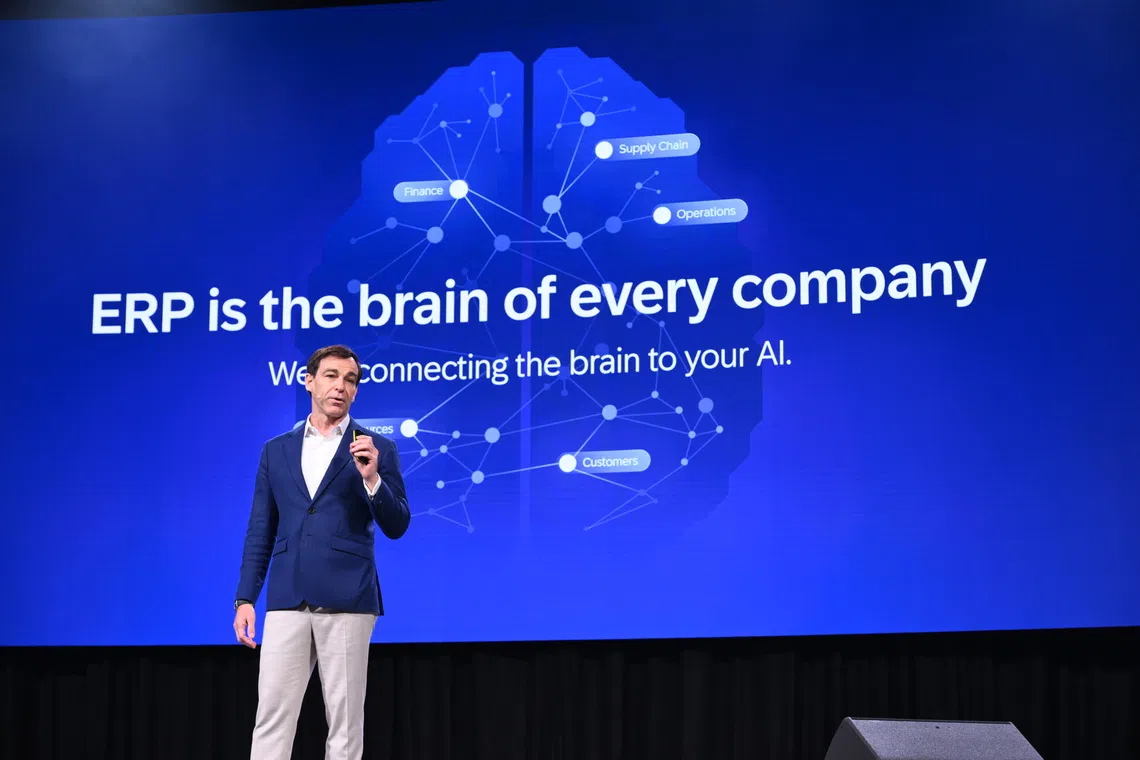
Urbizu illustrates this with the month-end financial close: Instead of simply automating tasks such as journal entries or reconciliations, agentic AI can continuously monitor the closing process, flag missing information, coordinate follow-up actions and recommend solutions before reporting deadlines are affected.
This shifts AI from helping employees complete individual tasks to helping organisations orchestrate entire business processes, while people continue to provide oversight and judgment.
“If you do point automation, you unlock point productivity. If you go for end-to-end business process automation with agentic AI, that is where you can really create exponential growth,” says Urbizu.
Why AI readiness matters
The report found AI already supports around 27 per cent of all tasks across the average Singapore business, a figure expected to rise to 47 per cent within two years.
As AI becomes embedded into more day-to-day operations, many organisations are finding that adopting the technology is only part of the challenge.
Less than half (45 per cent) have a dedicated AI leader. Only 32 per cent have leadership KPIs tied to AI adoption, while just 37 per cent provide training on AI capabilities and risks. Further, nearly eight in 10 businesses (79 per cent) are not convinced workforce upskilling is keeping pace with AI tools.
The report also found that data quality and governance remain the biggest barriers to scaling AI.
Data readiness among Singapore businesses has fallen from 62 per cent last year to 55 per cent this year, and more than four in five businesses (82 per cent) report challenges with incomplete data.
“The slight drops in data readiness for AI are understandable as Singapore companies begin to understand what is needed to move from single-purpose AI tools to a more strategic implementation,” says Urbizu.
Data issues have led 81 per cent of businesses to experience poor AI outputs that result in rework, delays or backlogs.
With regards governance, only around one in 10 businesses believe their governance frameworks (10 per cent) or skills (12 per cent) are fully prepared for AI.
“Only by investing broadly in our data foundations, governance and quality will we ensure successful AI outcomes,” says Urbizu.
These findings highlight that businesses cannot treat AI as a standalone technology project.
“The unlocking of agentic AI value depends increasingly on how well organisations connect intelligent technologies like AI to data, processes and people to run their businesses,” says Urbizu.
Guardrails for AI governance
For Urbizu, the priority is not for businesses to deploy AI as quickly as possible, but to build the right foundations first to become autonomous enterprises.
“When you put a system in place where people are in charge and AI is doing the work, then you have a truly autonomous enterprise. One in which every decision informs the next, insights turn into action, and action drives continuous innovation.”
He recommends organisations focus on three priorities: ensuring enterprise data is AI-ready; establishing governance, security and human oversight; and identifying business processes where agentic AI can deliver measurable business outcomes.
Those priorities align closely with Singapore’s evolving IMDA framework for agentic AI.
SAP has also embedded enterprise safeguards such as verified AI agents, traceable decision-making, human-in-the-loop oversight and access controls into its AI platform, while aligning with the EU AI Act.
To help companies bridge gaps in their AI journey, SAP runs AI Discovery Workshops that help businesses transition their AI optimism into reality.
For Urbizu, the organisations that will realise the greatest value will not necessarily be those adopting the newest technology first.
“The organisations that will unlock the most value from agentic AI will be the ones that connect AI to trusted data, sound governance, strong business processes and their people.”
Watch the SAP NOW AI Tour Southeast Asia 2026 on demand.
Winning edge: Using AI to generate live esports data insights

The experience of Team Liquid illustrates the importance of building the right foundations for agentic AI deployment.
As the global esports and entertainment company expanded, its challenge shifted from collecting data to connecting fragmented information across teams and regions for coaches, analysts and players to analyse and act on quickly.
“In the beginning, our key need was on our athletics side, as we have several games that are too complex to fully analyse manually, with too much data provided by game publishers,” says Team Liquid founder and CEO Steve Arhancet.
The company collects a vast amount of information – around 50,000 data points per match, with 20,000 games played per day.
Rather than simply adding AI to existing systems, Team Liquid first connected all of its previously siloed data. The company deployed SAP’s AI assistant Joule and its AI agents to search more than 1.6TB of historical esports data spanning over 10 million games using plain English, instead of having analysts manually sift through multiple data sources.
“We needed a partner who could store all relevant match data and create a single source of truth to present that data in a legible way, so our analysts could use it and then ask more complex questions to help us take the next step,” says Arhancet.
Coaches and players can now access insights in seconds, accelerating match preparation, talent development and strategic decision-making.
SAP estimates the solution saves Team Liquid about US$250,000 (S$322,586) annually in analyst time, freeing them up to pursue higher-impact work such as interpreting data and formulating action plans.
With the right AI foundations in place, Team Liquid has co-developed a new AI-Based Voice Intelligence Application with SAP. The app can track who is speaking during games and perform sentiment analysis. The solution analyses players’ voice communications at scale, uncovering insights that previously took hours of manual review to find.
“We’ve used this new application to improve our team cohesion and work with specific players on specific things,” says Arhancet.

Share with us your feedback on BT's products and services