

Singapore data centre industry likely to focus on AI niche for computational efficiency: experts
With the government’s latest road map, data centres will be better placed to serve higher-value workloads


THE limited capacity in the data centre sector is likely to push the local data centre industry towards higher-value artificial intelligence (AI) use cases.
Experts such as Bain & Company partner Kiran Karunakaran expect the nation to take the lead in the region to convert existing data centre capacity to AI-enabled data centres.
He estimates that hyperscalers which operate large-scale cloud platforms, such as Google and Amazon, account for 70 per cent of local data centre usage. These companies will likely leverage their presence in Singapore for AI workloads, while shifting more traditional workloads to Malaysia and Indonesia.
“Many of the data centres in Singapore have already started thinking about AI workloads; (in terms of) their readiness in terms of GPU (graphics processing unit) availability, their readiness in terms of conversion of current Tier 4 data centres to AI-enabled data centres, they are already ahead,” he said. GPUs are semiconductor chips used to train and run AI models.
Even with Singapore’s move to increase allocated capacity to the industry, the sector still faces energy and water constraints. In May, Singapore said that it will provide at least 300 megawatts (MW) of additional capacity for data centres in the near term.
Janil Puthucheary, senior minister of state for communications and information, said in a speech in May that another 200 MW or more could be made available to operators who tap green energy.
Singapore currently has more than 70 data centres, with 1.4 gigawatts of capacity.
Even with the expected shift towards AI-enabled data centres, BMI technology, media and telecoms analyst Niccolo Lombatti said that the types of AI workloads executed here matters, too.
Currently, there is a lot of focus on training and improving AI models, such as OpenAI’s GPT and AI Singapore’s Sea-Lion large language model project, but he said that the nation will not have sufficient capacity to train such models.
Lombatti noted that the average data centre development in the US already takes up 200 MW.
“I think that the 300 MW may be better used, and I think that will be the plan, in AI inference, which requires less power density but requires being much closer to the user,” he said.
AI inference refers to the use of AI models to generate results. For instance, AI inference for autonomous driving could be done locally in Singapore for optimal performance and safety.
Another factor supporting the growth of AI is Singapore’s world-class connectivity, according to Digital Realty managing director and head of Asia-Pacific, Serene Nah.
She believes that Singapore can retain critical workloads, and remain a key connectivity hub in the region by providing a range of connectivity options.
“Singapore’s world-class connectivity makes it a prime location for deploying cutting-edge AI. Co-locating AI with global networks in Singapore allows for seamless data processing across vast distances and access to a wide range of customers,” she said.
She added that there are several ongoing initiatives to import renewable energy and develop low-carbon energy technologies locally.
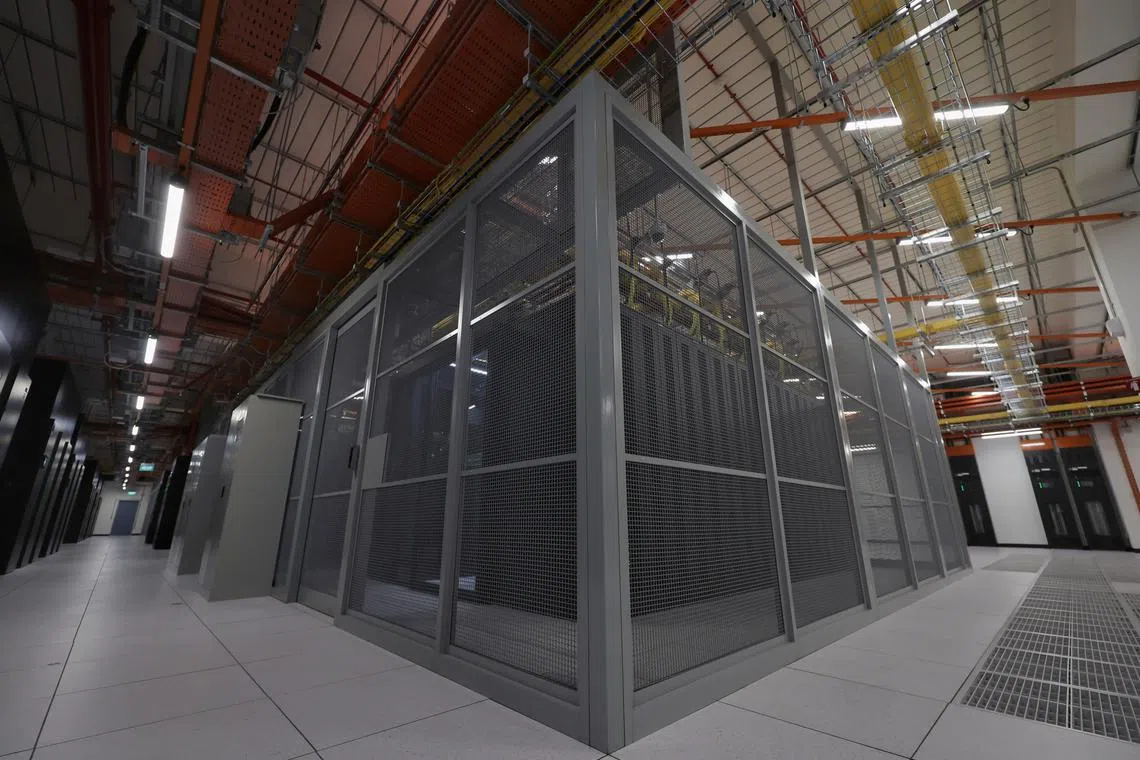
Local readiness for AI
The local data centre industry is taking on the challenge of hosting these AI workloads.
Bill Chang, chief executive officer of Singtel’s data centre arm Nxera, said that the company is phasing out its older, less efficient data centres and building more sustainable data centres in their place.
“This involves building highly efficient data centres that optimise land, power and water use through advanced technologies, such as liquid cooling and smart operations, to achieve better overall energy efficiency and operational resiliency, and making a complete switch to renewable energy from the grid for our internal operations and common utilities,” he said.
The company’s 58 MW Tuas project, which is expected to have a power usage effectiveness (PUE) of 1.23, will double the company’s operational capacity in Singapore to 120 MW when it is completed in end-2025.
PUE refers to the ratio of energy used for cooling on top of the IT load, and a ratio of one indicates no additional energy used for cooling.
But with the shift towards AI, these workloads will consume more power. Experts note that there are new technologies in place to boost cooling efficiency.
In its road map, the Infocomm Media Development Authority (IMDA) noted that AI workloads will have higher rack densities. While the average server rack consumed 8.4 kilowatts (kW) per rack in 2020, this could rise to over 100 kW per rack.
Air cooling, where servers are placed in air-conditioned rooms, can only support up to 20 kW per rack density. Hence, more sophisticated liquid cooling solutions will be necessary to effectively cool higher-density racks.
AI cloud service provider Sustainable Metal Cloud co-founder Oliver Curtis said that AI-enabled servers could be more power-efficient than traditional servers. This would allow the nation to produce more output for the same amount of power capacity that it currently has.
The company has retrofitted existing data centre capacity from ST Telemedia Global Data Centres to host AI servers that are immersed in thermally conductive liquid that removes heat more efficiently than air.
This improves their PUE from 1.5 to 1.1, well below IMDA’s threshold of 1.3 for what is considered a “green” data centre.
“That allows us to price our product as cheap as in the US, yet we’re doing so here in a much more high-cost environment,” Curtis said.
Given energy constraints and the need to be sustainable, NTT Data Singapore CEO Png Kim Meng said that if there were an update to the local Green Data Centre Roadmap, he would like to see a deeper integration of green initiatives and advanced technologies such as AI.
“Enhancements should focus on expanding the scope of sustainable development practices within data centres, promoting energy efficiency, and reducing carbon footprints,” he said, adding that robust incentives and clear guidelines will incentivise more companies to invest in green technologies.
Competition from the region
BMI’s Lombatti said that because energy and power are scarce resources in Singapore, companies have looked to Malaysia’s Johor Bahru and Indonesia’s Batam to deploy capital, even if these markets are not as digitally mature.
Still, he noted that there is a broader risk that the explosive growth in these markets could lead to resource constraints as well.
Johor Bahru city council mayor Mohd Noorazam Osman said in May that data centre investments should not compromise the state’s domestic water and power needs.
Lombatti said that regulators and governments may later realise the scale of the water and energy drained by data centres after they are built, only to implement regulations that create uncertainty for operators.
“They will likely introduce either a local ban, perhaps in a town or a specific region, or it can be a countrywide ban, where there is no more building activity,” he said.
Bain’s Karunakaran pointed out that one factor in Singapore’s favour is that the regime offers businesses certainty. This likely contributes to the 20 per cent premium that local data centres tend to draw.
He noted that data centre operators in Indonesia have faced foreign ownership limits, along with significant currency risks and some potential difficulties in repatriating profits back to shareholders as dividends.
While the proportion of South-east Asian data centre capacity hosted in Singapore may fall, he does not expect the proportion of revenue generated by local data centres to decline in the next three years.
Singapore-based data centre operator Princeton Digital Group Singapore’s managing director, Asher Ling, also noted that the IMDA’s Green Data Centre Roadmap helps to establish the guard rails for companies seeking new data centre capacity.
Meanwhile, the company has also been executing its SG+ strategy since 2023, to build data centre campuses in Singapore, Batam and Johor Bahru in collaboration with the Economic Development Board.
“We’re able to work collaboratively, symbiotically with Johor and Batam to create a larger region that really serves all the complex needs of the global community...
“I think that really becomes a very interesting case study for the world to see in the next five years or so,” he said.
TRENDING NOW
From AI financing to Indonesia outlook: 4 takeaways from Singapore banks’ Q3 results
VinFast, Mitsubishi weigh Philippine EV production as state incentives near

Analysts cut DBS target price on lower 2027 earnings, but see buying opportunity after share price slide

Could Japan trigger the next global financial crisis?

