Singapore doubles down on AI with S$1 billion R&D push amid US, China dominance
Authorities will partner industry players such as Changi Airport Group and Sembcorp to build core AI engineering capabilities

[SINGAPORE] The Singapore government will be committing more than S$1 billion to artificial intelligence (AI) research and development (R&D) over five years from 2025 to 2030.
This comes as the Republic steps up efforts to build research capabilities anchored here, in a field increasingly dominated by US and China tech giants.
The latest round of funding is on top of the S$500 million already invested by the government through AI Singapore, a national programme that seeks to grow domestic AI capabilities and talent.
The investment supports Singapore’s broader ambitions under the National AI Strategy 2.0 announced in 2023 to position the Republic as a global hub in this area.
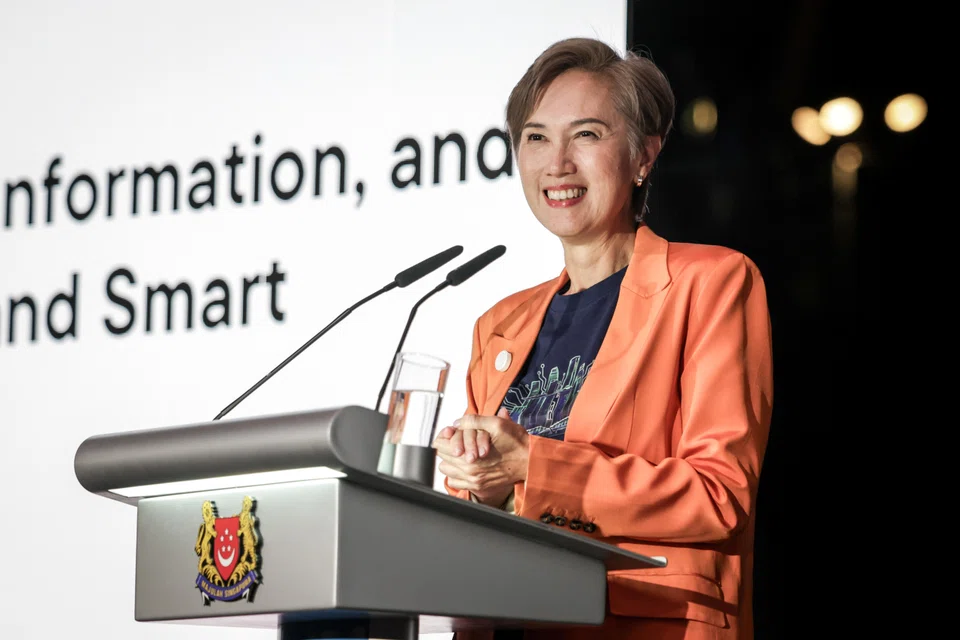
Unveiled by the Minister for Digital Development and Information Josephine Teo on Saturday (Jan 24), the investment under the National AI R&D Plan will focus on research in priority areas, industry application and talent development.
Rather than compete head-on with global players such as OpenAI, Singapore aims to focus on building and adapting foundational AI capabilities, retaining deep technical expertise while tailoring models for regional and security needs.
“Despite extraordinary breakthroughs, there are fundamental limitations in AI development,” Teo said in her opening remarks at the AI Research Week Gala Dinner, held at Jewel Changi Airport.
Citing the example of data centres – which consume large amounts of resources such as water and electricity – she noted that its expansion must be managed carefully against Singapore’s net-zero commitments.
Through AI R&D, the government will find new ways to gain efficiency, she said, adding that Singapore already has one of the region’s densest concentrations of data centre capacity.

“This vision is inspired by how we dealt with our water constraint – an existential risk for Singapore,” she said
Developing a research hub
A significant portion of the investment will be poured into the development of AI research centres of excellence, which will involve local and international researchers.
These centres will complement the government’s existing network of more than 60 AI centres of excellence, but will be fewer in number and backed by larger investments in each.
Through these research centres, the authorities hope to improve the efficiency of AI through researching data-efficient AI training methods and more energy-efficient chips.
At the same time, guardrails for the models will need to be strengthened. Efforts will be made to enhance safeguards for AI to ensure the technology remains reliable and secure.
Bridging the gap between research and real-world deployment will be another focus. “We aim also to build core AI engineering capabilities for the translation of theory to systems and applications,” Teo said.
She added that the updated R&D plan aims to nurture talents who are both proficient in AI and have domain expertise.
It was announced in December 2025 that the government will invest S$37 billion in research and innovation in key economic sectors such as semiconductors.
The authorities will work closely with industry partners – such as Changi Airport Group and Sembcorp – to build core AI engineering capabilities, while also identifying effective use-cases to translate and deploy AI solutions at speed and scale.
Talent development
Central to these efforts will be the development of Singapore’s AI talent pool.
Part of the S$1 billion investment will go towards scaling initiatives including the AI Visiting Professorship, which aims to attract top researchers in the field to work with Singapore to address key AI challenges such as AI performance and reliability.
Since its inception in 2024, eight professorships have been awarded to international researchers, to support their collaborations with local academics.
The government will also build up its talent pipeline by stepping up outreach at pre-university and tertiary levels to support young researchers pursuing competitive AI research careers, while sparking interest in the field from an early age.
This includes enhanced scholarship and research opportunities for students, so that they will be “well-placed” for competitive PhD, post-doctorate and faculty openings in top institutions, Teo said.
“We believe good outcomes will emerge out of a vibrant, diverse yet close-knit research ecosystem,” said the minister, adding that the different players are already working together to shape how AI is developed and deployed responsibly.
Decoding Asia newsletter: your guide to navigating Asia in a new global order. Sign up here to get Decoding Asia newsletter. Delivered to your inbox. Free.
Copyright SPH Media. All rights reserved.