Singapore firms both winners and losers in yuan's downtrend
Those with production base in China and selling in USD could reap major forex gains

Singapore
THE US-Sino trade war and the fallout on the Chinese yuan are both benefiting and hurting Singapore companies - depending on what's their currency of costing and sales vis-a-vis their reporting currency.
Among the beneficiaries are several companies with costs in yuan and sales in US dollars.
For mainboard-listed contract manufacturer Hi-P International, a big boost came from the renminbi's (RMB) decline against the US dollar, as its China cost base is in yuan while it sells mostly in the US unit and reports in Singapore dollars.
Hi-P posted a 128 per cent jump in foreign exchange gains for its third quarter to S$6.5 million, which was attributed mainly to a stronger US dollar against the yuan and Sing dollar. About 93 per cent of Hi-P's revenue was in the greenback but only 39 per cent of purchases were in the US unit.
According to its 2018 annual report, a sensitivity analysis performed for foreign currency risk showed that a 1 per cent strengthening of the US dollar against the yuan would lift its pre-tax profit by S$1.9 million and the same magnitude of appreciation in the greenback over Sing dollar would improve the figure by S$989,000.
Reaping similar benefits of the yuan's dip are Valuetronics and Singapore-listed, China-based Yangzijiang Shipbuilding, which bills customers in US dollars, but incurs expenses and reports its results in yuan.
Last year, Yangzijiang booked 357 million yuan (S$70 million) in foreign exchange gains after the greenback appreciated 10 per cent from a low of 6.27 to a high of 6.97 in 2018.
Janice Chua, DBS regional equity research head, told The Business Times: "If the (company's) net exposure is unhedged, every 1 per cent US dollar appreciation could lead to a 1.6 per cent increase in net profit", all else being the same.
In Valuetronics' case, 45 per cent of its sales are from the US, with its transactions, liabilities and assets principally denominated in Hong Kong dollar, US dollar and yuan. Maybank Kim Eng analyst Neel Sinha said a stronger US and Sing dollar against the yuan would be "modestly positive" for Hi-P and Valuetronics. "Some production capacity in China, so a part of the cost base will shrink in Sing dollar terms. End-product pricing is largely US dollar."
The converse is of course true, especially for affected companies that do not hedge their forex exposure.
Sasseur Reit, which has its entire portfolio of four outlet malls in China, will be one of the victims. Maybank Kim Eng's Mr Sinha commented on Sasseur Reit: "Negative. All assets in China, so 100 per cent of the revenue streams in yuan will be affected as it translates to reporting currency Sing dollar."
But Wong Siew Lu, head of investor relations and corporate affairs at Sasseur Reit, told BT: "Sasseur Reit('s) policy is to hedge a portion of our renminbi income on a three or six months' rolling basis to mitigate the impact of the devalued RMB on the SGD distribution income."
Ms Wong said Sasseur Reit "hedged a major portion of RMB distributable income", without being specific. According to its annual report for 2018, its pre-tax total return would be down about S$2.5 million if Sing dollar strengthens against yuan by 5 per cent.
The Reit posted distributable income of S$19.2 million for the second quarter ended June, up 2.3 per cent.
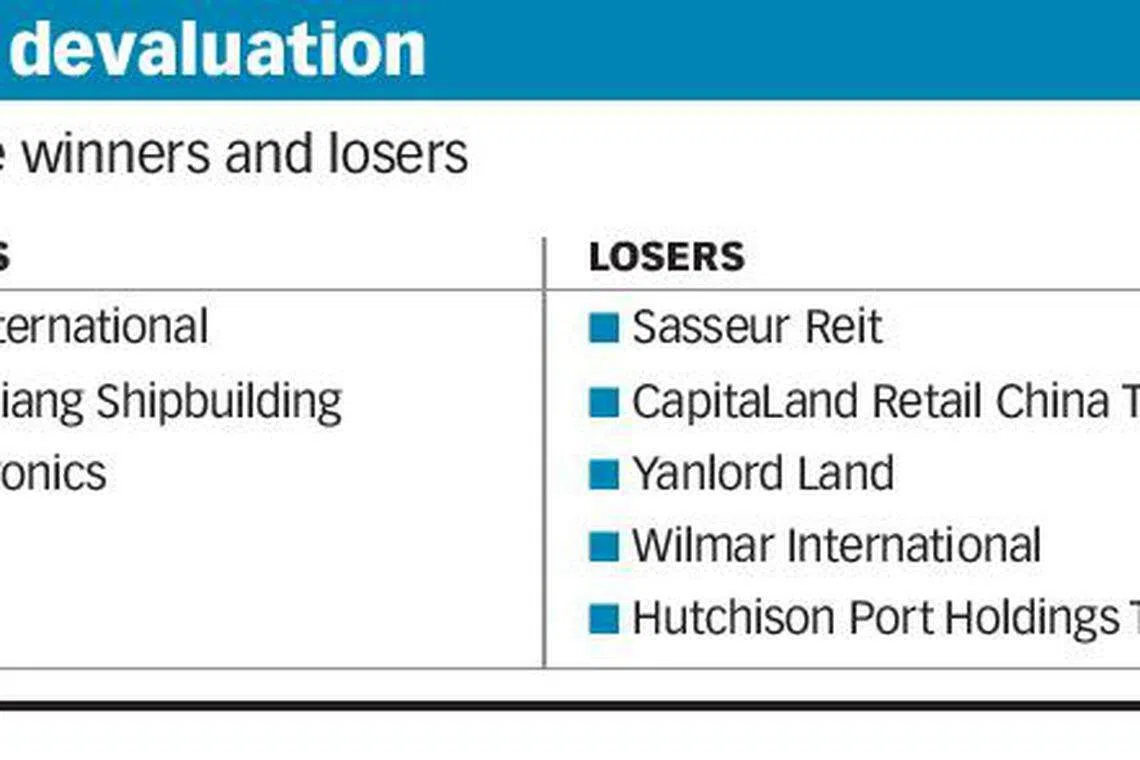
China-focused CapitaLand Retail China Trust (CRCT) said in its latest quarterly results presentation that its policy is to hedge at least 50 per cent of its half-yearly distributable income into Sing dollar.
DBS' Ms Chua estimates a 1 per cent decline in yuan vs SGD will have a resulting 1 per cent drop in CRCT's distribution per unit. CRCT's DPU for the third quarter edged up 0.8 per cent to 2.43 Singapore cents.
In the case of China-based property player Yanlord Land, income and results are in yuan, but dividends are paid in Sing dollar. According to its latest results for the quarter ended June, pre-tax profit of 2.38 billion yuan included a net foreign exchange loss of 40.8 million yuan.
Another Singapore-listed company that Ms Chua of DBS expects to " see some impact" is agribusiness group Wilmar International. She said a 1 per cent yuan fall could cause Wilmar's profit to dip by 0.83 per cent, all else being constant.
Wilmar reported profits of US$1.13 billion for 2018. Its 2018 annual report showed its pre-tax bottom line would have fallen by US$54 million if the US dollar had strengthened against yuan by 5 per cent in the sensitivity analysis, with other variables held constant.
Mainboard-listed container port business trust Hutchison Port Holdings Trust is another possible loser in the devaluation of the yuan. DBS' Ms Cha said that all of its earnings currently come from Shenzhen while its Hong Kong operations are loss-making, making most of its revenues and costs denominated in yuan. "Hence, a RMB depreciation would lead to a similar percentage decrease in reported earnings for the company, which reports its financials in HK dollar."
Given the wide impact yuan movements have on Singapore businesses, what's the prognosis?
Samuel Siew, investment analyst at Phillip Futures, sees a south-bound trajectory. "As the yuan has already depreciated approximately 11 per cent against the USD since the Sino-US trade tensions started in April 2018, we expect more gradual weakness... unless we see sudden further escalation in the trade war, which will result in a sharp yuan depreciation."
Han Tan, market analyst at FXTM, believes the onshore yuan is expected to have a weakening bias as long as external headwinds persist, with USD-yuan potentially testing 7.20 towards the year-end if existing tariffs remain. Mr Tan also expects SGD-yuan to be up this year, albeit by a thinner margin, pending the signing of a limited US-China trade deal.
Against the yuan, the US currency has appreciated about 7.44 per cent from this year's low to the high of 7.1771, first breaching the seven yuan psychological mark in early August - when the Chinese currency dipped to a decade low. Year-to-date, it has strengthened about 2.06 per cent against the Chinese currency and is now hovering at 7.02.
The Singapore dollar has gained 2.03 per cent vis-a-vis the Chinese currency year-to-date while it was a 5.27 per cent strengthening from a low of 4.937 to a high of 5.197 this year.
The currency pair is at 5.15 now.
READ MORE: Fund managers bullish, and 'melt up' possibility cited if US and China forge deal