Singapore must tap technology to ‘leapfrog’ regional peers in equity markets: Piyush Gupta
AI could be used in compliance and oversight, such as in distributed ledger technology which can reduce the cost of listings by automating filings
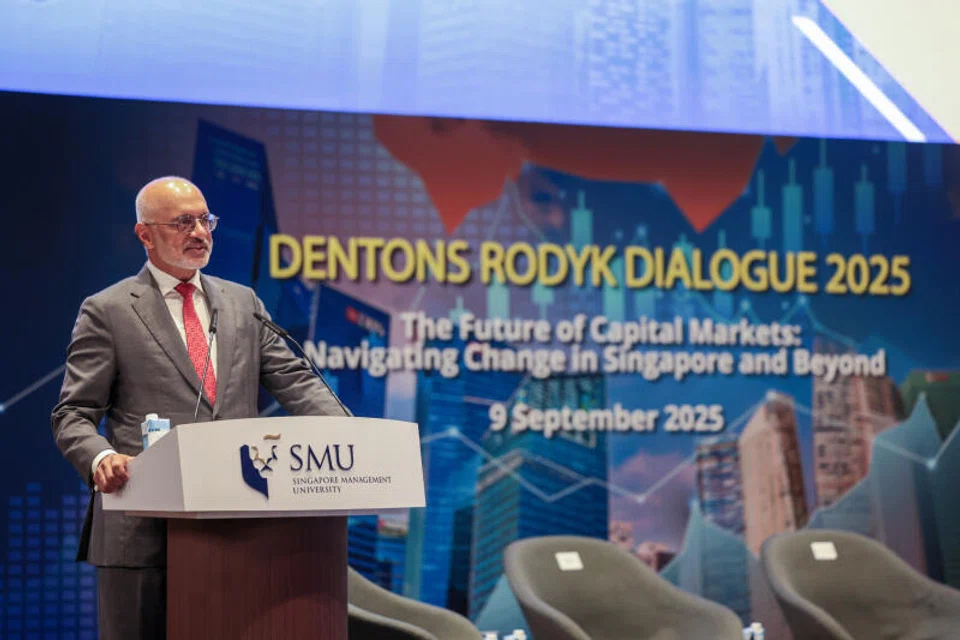
[SINGAPORE] The Singapore equity market is “lagging behind” its regional peers, but rather than trying to catch up, the local bourse should aim to “leapfrog” others through the use of technology, said former DBS chief executive officer Piyush Gupta on Tuesday (Sep 9).
Gupta, who stepped down as CEO of DBS in March 2025 after more than a decade, was delivering the keynote address at a conference organised by law firm Dentons Rodyk and the Singapore Management University (SMU), where he is chairman of the board of trustees.
The event, titled The Future of Capital Markets: Navigating Change in Singapore and Beyond, also featured several other speakers including Pol de Win, head of global sales and origination at Singapore Exchange (SGX) Group, and Aurelio Gurrea-Martínez, associate professor of corporate law at SMU.
A market losing ground
Gupta said that the SGX has been in decline, noting that the number of listed companies fell from 776 in 2015 to 643 today. By comparison, markets in Malaysia, Indonesia and Thailand each have around 1,000 listed companies.
He added that Singapore has struggled to attract new listings because of relatively lower valuations, high listing costs and a limited pool of domestic companies seeking to go public. Drawing international issuers has also been challenging, he pointed out.
“Singapore’s listing requirements are quite onerous and not effective,” Gupta noted.
Concerns over current efforts
Gupta said that some of the recommendations from the Monetary Authority of Singapore’s market review committee are “on point” but added that they may not be sufficient to revive the bourse.
He cited the S$5 billion Equity Market Development Programme, aimed at encouraging fund managers to invest in the local market, as an example. While “not a bad idea”, he said the sum is unlikely to “move the needle” compared to the SGX’s overall market capitalisation of about S$960 billion.
Gupta acknowledged that the committee’s measures have already provided “some lift” to the local equity market.
“But everything we are doing, I worry is not enough,” said Gupta. “And it is not enough because of our starting position. Thailand, Malaysia, India – each one of them is building momentum. They’ve got large numbers of domestic companies in large domestic markets.”
He added: “I think we will do all of this (improving liquidity and pricing), and we still find it hard to actually win.”
“Redefine the turf”
To remain competitive in the capital market space, Singapore will have to “redefine the turf”, Gupta said. He cited his time at DBS, where the bank had used technology to compete with larger international players.
Gupta pointed to DBS’ internal audit process as an example, where data flows into an artificial intelligence (AI)-driven dashboard that highlights anomalies. “I believe the same is true today for the entire world of capital markets.”
He pointed out that AI can write, synthesise and take action on smart contracts and distributed ledgers – things that people used to do. “We can use this (AI) as a weapon and say: how do you put all of these together to... leapfrog and try to redefine the system itself?”
One application, he noted, is in compliance and oversight. Distributed ledger technology, which synchronises digital data over multiple sites, could reduce the cost of listings by automating filings.
Regulators could also be automatically alerted to discrepancies between reported and actual company performance with the use of smart contracts, which automatically execute contracts when preconditions are met.
Shareholder decisions could also be disclosed instantly and securely through blockchain-based systems, he added.
“And it’s my belief that for Singapore to... establish a leadership position in these markets, we… should... be thinking big and trying to figure out how to change the turf,” said Gupta.
Gupta noted that Singapore has the resources to implement technology at scale, adding: “We have the capacity to bring the private and public sector together. So we could make it work, but we have to focus and put our minds (to) it.”