Singapore remains ‘bedrock’ for family offices, but more turn to Hong Kong or Middle East for extra bases: StanChart’s private bank head
Affluent clients bring lender close to US$52 billion in net new money in 2025

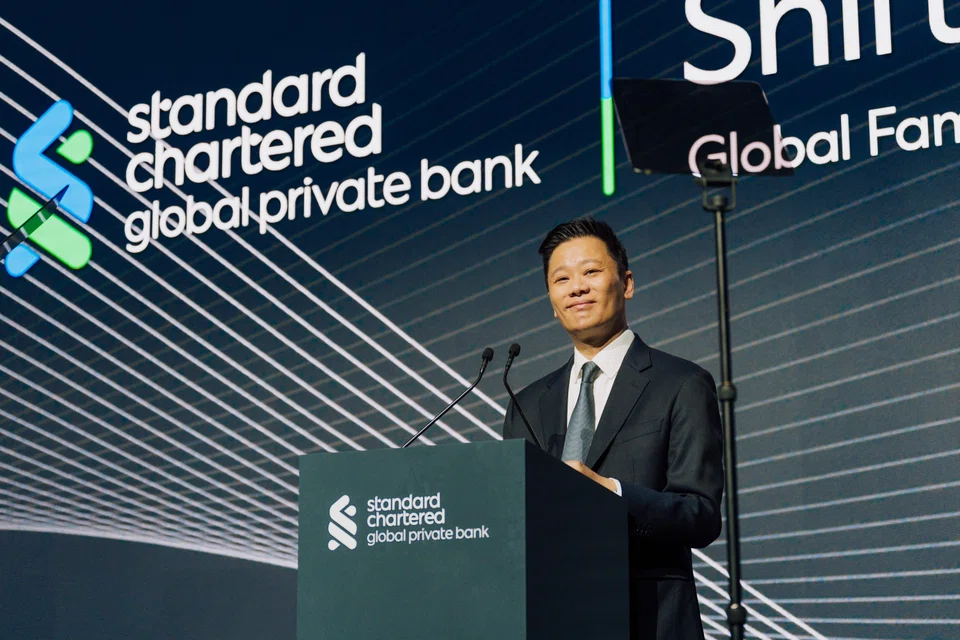
[SINGAPORE] More wealthy families with family offices in Singapore are setting up additional bases in other hubs such as Hong Kong, Dubai or Abu Dhabi, said Raymond Ang, global head of private bank and affluent clients at Standard Chartered.
While Singapore “will always be the bedrock” for setting up family offices in Asia, different centres have their roles and strengths, and serve different purposes, said Ang, who is also head of wealth and retail banking for Greater China and North Asia.
According to the latest available data, the number of single-family offices in Singapore exceeded 2,000 as at end-2024, up 43 per cent on year.
Meanwhile, Hong Kong recorded 3,384 family offices as at end-2025, up 25 per cent on year. The Dubai International Financial Centre tracks family-related entities instead – which includes holding companies and foundations – and saw 1,289 of such entities as at end-2025, a 61 per cent increase from a year earlier.
“In the beginning, a lot of family offices chose Singapore as a result of wanting a safe haven, good governance and residency,” he said. “But as the family offices get bigger... they want investable assets as well.”
Singapore has a head start over Hong Kong and the United Arab Emirates when it comes to building an ecosystem to attract family offices, he noted.
But Hong Kong is also attractive, given its strong trading flow and active capital market, while the two cities in the UAE provide businesses a “great place of access” to the West.
These Asian families are mimicking those in the West, where the wealthy typically open their family offices in three to four places.
“In a way, it’s an evolution of the tenor of wealth,” Ang said.
For a bank like StanChart – which has booking centres in Singapore, Hong Kong, the UAE and Jersey – this is good news, Ang noted.
“Exactly because we are a network bank – we practice an advisory centre and booking centre kind of framework – so it doesn’t matter whether a client chooses to book in Singapore, Hong Kong, Dubai or London,” he said.
StanChart has ambitions to grow its affluent business. In 2024, it set a target to hit US$200 billion in net new money and double-digit wealth growth by 2029.
With a US$1.5 billion investment, the bank plans to hire more relationship managers, accelerate product innovation, improve its digital experience, and upgrade and launch new client centres.
It is “particularly focused” on serving global Chinese and global Indian clients. That these two groups dominate flows is a “natural consequence”, said Ang, given that China and India are the most populous countries in the world.
On top of having “culturally attuned” multilingual relationship managers, the bank has also boosted flagship client centres in key markets like mainland China, Hong Kong and Singapore, and launched dedicated Global Indian centres.
The bank’s strategy has worked thus far – its client mix has already gravitated towards the high-net-worth and ultra-high-net-worth segment, from the “medium range” segment.
In the past 12 quarters, it added more than 60,000 new-to-bank affluent clients each quarter.
“With this big shift (in client mix), the hub countries become very important, because when clients have more than a million dollars, they are usually more international in nature,” Ang said.
For the 2025 financial year, the bank recorded assets under management of US$447 billion for its wealth and retail banking segment, of which 54 per cent was from its wealth segment.
Net new money from its affluent clients – those with at least S$200,000 in deposits or investments with the bank – stood at US$51.5 billion.
In comparison, net new money stood at US$27.1 billion in FY2023 and US$43.9 billion in FY2024.
On Tuesday, StanChart reported in its full-year results that pre-tax profit rose 16 per cent to US$6.96 billion, on the back of robust performances from its global banking and wealth businesses.
In particular, its wealth management business stood out, with income up 24 per cent in 2025, driven by double-digit growth in both investment products and bancassurance.