

Singapore revs up for transportation of Covid vaccines
A taskforce is identifying the logistics of doing this; SIA and Sats acknowledged as being strong in cold-chain transport

Tay Peck Gek
Singapore
AHEAD of vaccines against Covid-19 becoming ready for distribution and use, the Civil Aviation Authority of Singapore and Changi Airport Group (CAG) have set up a private-public taskforce to identify and tackle the critical risks and challenges in the air transport of such vaccines, so that they can be effectively delivered into Singapore and the region through Changi Airport.
Lim Ching Kiat, managing director of air hub development at the CAG, told The Business Times that the taskforce has key air-cargo industry members; these include ground handlers, airlines, logistics partners and relevant government agencies.
Meanwhile, Singapore Airlines (SIA) is actively engaging stakeholders in Singapore's freight ecosystem and in overseas key pharma markets to prepare to distribute the vaccines when they become available.
But the national carrier declined to say whether it has received orders to transport vaccines, because it is "commercially sensitive information", its spokesperson said in response to BT's queries.
SIA is talking to container suppliers to ensure there are enough supplies that can function at the required temperature ranges, the spokesperson added.
It is also collaborating with partners in the supply chain, forwarders and shippers, as well as fine-tuning procedures and expanding infrastructure with its ground-handling agent partners.
One of the company's ground handlers is the Singapore Mainboard-listed Sats, with which SIA said it works very closely to ensure the safe end-to-end carriage of pharma shipments in general.
Both companies are certified as having met the safety, security, efficiency and compliance standards for handling and transporting health-care and life-science products. They also have cold-chain capability.
SIA was re-certified by the International Air Transport Association (Iata) Centre of Excellence for Independent Validators in Pharmaceutical Logistics (CEIV Pharma) earlier this year.
The company was also recently accredited with Envirotainer's Qualified Envirotainer Provider (QEP) Training and Quality Programme; 11 of the flag-carrier's stations in the Asia Pacific and Europe have attained this recognition.
Envirotainer is the global market leader in secure cold-chain solutions for air transport of pharmaceuticals.
The SIA spokesperson said: "These accreditations reaffirm our ability to handle high-value, time-sensitive and temperature-controlled pharmaceutical cargo with speed, reliability and efficiency."
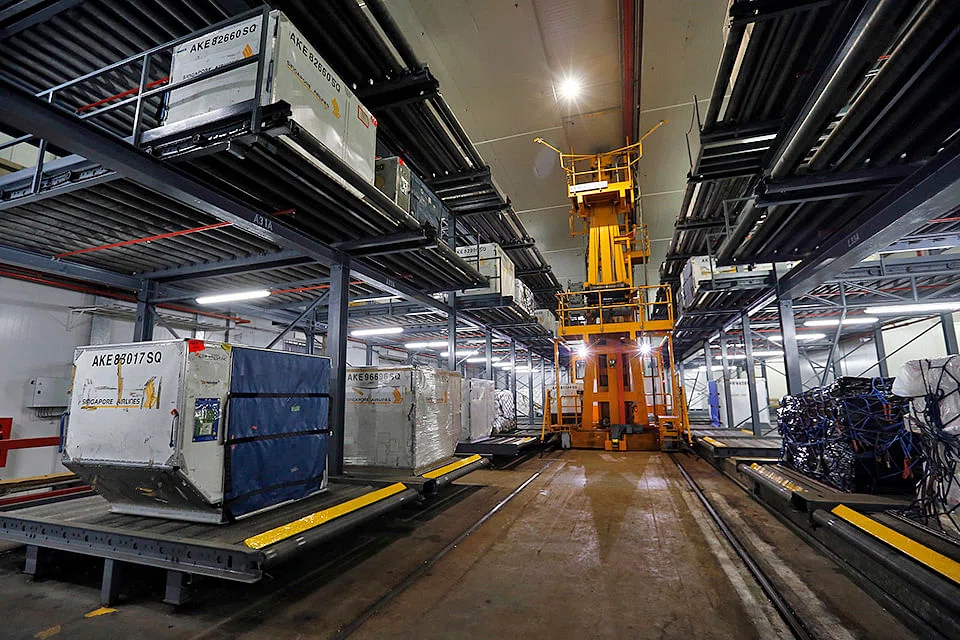
Sats Coolport is an in-airport handling centre dedicated to the cold-chain handling of airfreighted perishables bound for import, export or transhipment in Singapore. The S$16.5 million purpose-built terminal is equipped with electronic temperature-monitoring technology and cold rooms designed to handle commodities with specific temperature requirements.
A Sats spokesperson said that the centre offers direct air-side access for air cargo shipments to be handled entirely within a secure cold chain, from the facility to the aircraft and vice-versa. Occupying 8,000 sq m, Sats Coolport, with its 18 cold rooms, has an annual capacity for 250,000 tonnes of cargo in four main temperature zones. Temperatures can go as low as minus 28 degrees Celsius.
The transportation and storage of vaccines at extreme temperatures such as minus 80 degrees Celsius will require manufacturers to prepare a special packaging solution and cooling agent to keep the temperatures that low.
Sats' chief executive Alex Hungate said in a results briefing this month that the firm was gearing up to handle vaccines against the novel coronavirus. Besides Coolport, the company's overseas units in Beijing, Muscat and Bangalore are all Iata CEIV Pharma-certified.
The company is obtaining certification for its facilities in Jakarta and Kuala Lumpur, he had said.
SIA and Sats are part of the Pharma@Changi community, comprising CAG and a dozen companies certified by Iata CEIV Pharma; Changi has the Asia-Pacific's largest CEIV Pharma-certified community.
At least one company in Pharma@Changi is operating in each segment of the air-cargo supply chain.
Additionally, CAG is a member of Pharma.Aero, a global cross-industry collaboration for pharma shippers, CEIV-certified cargo communities and other air cargo industry stakeholders, including pharmaceutical producers such as Pfizer.
The Pfizer/BioNTech vaccine is one of three vaccine candidates that have made the news on the strength of its efficacy against the coronavirus.
Pfizer's contracts are with governments. It will supply doses according to such customers' preferred channel and designated vaccination locations, said its fact sheet on the distribution of the vaccines in the United States.
It declined to give details of the companies that will be distributing its vaccine when queried by BT. The company said: "The intent is to utilise Pfizer-strategic transportation partners to ship by air to major hubs within a country/region and by ground transport to dosing locations. However, we cannot provide any additional details, regarding our partners, at this point."
Rico Merkert, a professor of transport at the University of Sydney's business school, said that airlines such as Singapore Airlines could be involved, besides the freighters UPS, Fedex and DHL.
"Also, ground handlers such as Sats, and more importantly, airport facilities such as the Pharma hub at Singapore Changi Airport, of which both UPS and DHL are strategic partners, will have to play a role in the distribution networks of any vaccine.
"The distribution of the vaccine is too important and too good of a business opportunity for airlines and any element in the aviation supply chain not trying to become part of it," he said.
United Nations humanitarian relief agency Unicef told BT that it is sharing information on expected vaccine volumes of two billion doses, and also their cold-chain requirements, with a large number of airlines and logistics operators so that these shippers can plan capacity and requirements accordingly.
A Unicef spokesperson stated that it has not decided on the airlines to be engaged for the various transport routes, but it would make the selection based on factors including the airline's network, cargo capacity and flight frequency, cold-chain handling capabilities and commercial rates for transportation of the vaccines.
An Iata platform shows that there are only 24 airlines that are CEIV Pharma-certified globally, including SIA, Korean Air and Cathay Pacific Airways; Australian and New Zealand airlines are not on the list.
DBS analyst Paul Yong thinks Changi Airport, SIA and Sats could play an important role in facilitating the distribution of vaccines to the region, with Singapore as a hub. This is especially if the transportation and storage requirements for the vaccine are onerous, such as in the case of the Pfizer/BioNTech vaccine candidate, which must be stored at minus 70 degrees Celsius.
He added that pricing for air freight would likely remain high when the vaccines are being transported, and that the rates for vaccine shipment in particular would be higher than for other cargo since refrigeration is needed.
Aviation consultancy Endau Analytics founder Shukor Yusof said SIA, Sats and Changi Airport are strong contenders due to their competencies in safety and efficiency.
TRENDING NOW

Far East Organization’s The Serra Residences sells less than a quarter of units released at average S$3,460 psf

Once staunchly pro-China, Malaysian Chinese businesses are now distancing themselves from Beijing

Ageing in Asia: Huge potential for the consumer economy

DBS, OCBC, UOB face rate hike reality check

