

Singapore shares close lower amid mixed regional showing; STI down 0.8%
Sembcorp Industries leads the gainers on the blue-chip index
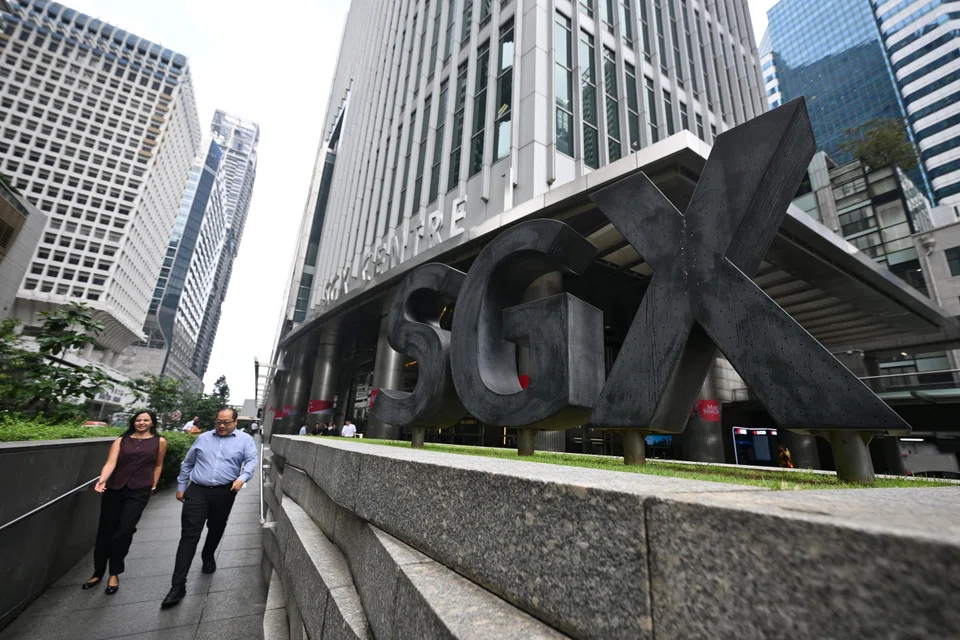
[SINGAPORE] Singapore stocks ended lower on Tuesday (Sep 1) amid a mixed regional showing from Asia markets.
The benchmark Straits Times Index (STI) lost 0.8 per cent or 44.99 points to finish at 5,710.37.
Sembcorp Industries led the gainers on Singapore’s blue-chip index, rising 2.4 per cent or S$0.14 to S$6.06.
The worst performer among STI constituents was DFI Retail Group , which fell 4.3 per cent or US$0.16 to US$3.55.
The local banks all ended lower. DBS lost 0.6 per cent or S$0.49 to S$76.91, OCBC fell 0.6 per cent or S$0.18 to S$31.34, and UOB was down 0.3 per cent or S$0.14 at S$41.42.
Within the iEdge Singapore Next 50 Index, Golden Agri-Resources was the top gainer, rising 4.8 per cent or S$0.015 to S$0.33. Food Empire was the biggest loser, falling 4.3 per cent or S$0.10 to S$2.21.
Across the broader market, losers beat gainers 324 to 238, after 1.4 billion securities worth S$2.1 billion changed hands.
Key regional indices were mixed. Hong Kong’s Hang Seng Index lost 0.9 per cent, Japan’s Nikkei 225 fell 0.2 per cent, and the FTSE Bursa Malaysia KLCI declined 1.5 per cent. South Korea’s Kospi was up 0.2 per cent.
Such performance comes amid a broad gauge of global government bonds surging to 3.72 per cent, a new high since mid-2008, with yields erupting in Japan, Australia and the US.


This came after US Federal Reserve chair Kevin Warsh’s hawkish Jackson Hole speech collided with a fresh spike in oil prices, driven by escalating geopolitical tensions.
Nigel Green, CEO of deVere Group, said that the two-decade high is “moving fast enough to blow through mortgage rates, corporate loans and pension valuations before most people have even noticed it happened”.
“Anyone still treating long-dated bonds as the safe, boring corner of their portfolio needs a serious rethink.”
The deVere CEO is wary of reading the sell-off as proof that the Fed is about to hike rates in September, arguing that the bond markets have a habit of sprinting ahead of the central banks they are supposedly forecasting.
“(The) yields have already done the Fed’s job for it without a single vote being cast,” he noted.
This article was written with the assistance of AI and reviewed by a reporter
Decoding Asia newsletter: your guide to navigating Asia in a new global order. Sign up here to get Decoding Asia newsletter. Delivered to your inbox. Free.
Share with us your feedback on BT's products and services
TRENDING NOW

Companies still in search of AI use cases with worthwhile ROI, says Broadcom’s CEO

Beauty World Plaza up for collective sale for S$165 million

Trouble in paradise: Bali runs low on fuel, sparking long lines at pumps

Philippine power giant First Gen rebuffs foreign offers, plans up to US$2.6 billion in expansion

