

Singapore shares edge lower at Wednesday’s open; STI down 0.1%

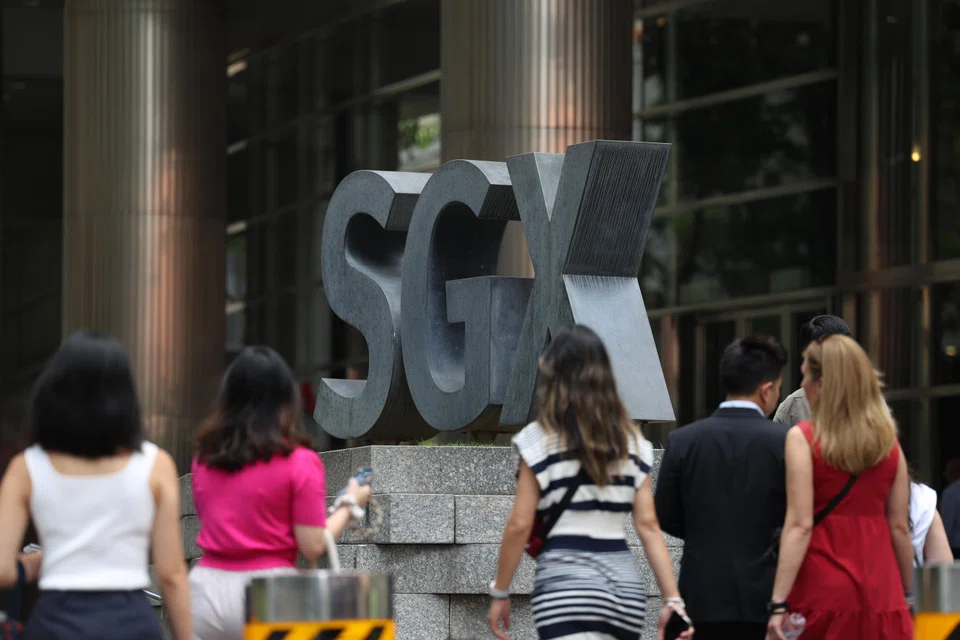
SINGAPORE stocks started Wednesday (May 29) on a softer note, after US markets closed overnight mixed.
Singapore’s Straits Times Index (STI) was down 0.1 per cent or 3.37 points to 3,326.72 as at 9.02 am. Across the broader market, losers outnumbered gainers 55 to 48 after 51.2 million securities worth S$77 million changed hands.
The most active counter by volume included Thai Beverage , which rose 1 per cent or S$0.005 to S$0.51 with 4.8 million shares changing hands, as well as CapitaLand Integrated Commercial Trust , which traded flat at S$1.97 with 4.5 million units transacted. Other heavily traded securities included Singtel , which remained unchanged at S$2.46 with 2.5 million shares traded.
Banking stocks were mixed in early morning trade. DBS remained at S$35.78, while UOB advanced 0.5 per cent or S$0.15 to S$30.69. OCBC lost 0.6 per cent or S$0.08 to S$14.42.
US indices closed Tuesday mixed. While the Nasdaq hit fresh record high, the Dow ended lower as Treasury yields rose. The Dow Jones Industrial Average fell 216.73 points, or 0.6 per cent, to 38,852.86, the S&P 500 gained 1.32 points, or 0.02 per cent, to 5,306.04 and the Nasdaq Composite gained 99.09 points, or 0.6 per cent, to 17,019.88.
Over in Europe, shares fell on Tuesday as cautious commentary from Federal Reserve officials weighed on investor sentiments. The pan-European Stoxx 600 index closed 0.6 per cent lower, registering its biggest single-day day drop in a month.
Decoding Asia newsletter: your guide to navigating Asia in a new global order. Sign up here to get Decoding Asia newsletter. Delivered to your inbox. Free.
Copyright SPH Media. All rights reserved.
TRENDING NOW
MSCI proposes standalone status for Indonesia; Jakarta stocks plunge 8%
Palm oil stocks slide after Singapore begins looking into which firms responsible for haze
High Court rules against Julius Baer’s Singapore trust arm in US$50 million family trust dispute

Why is the haze so bad in South-east Asia this year?

