Singapore shares fall; OCBC, UOB lead STI’s 1.6% decline on Wednesday
Across the broader Singapore market, gainers edge out losers 270 to 269
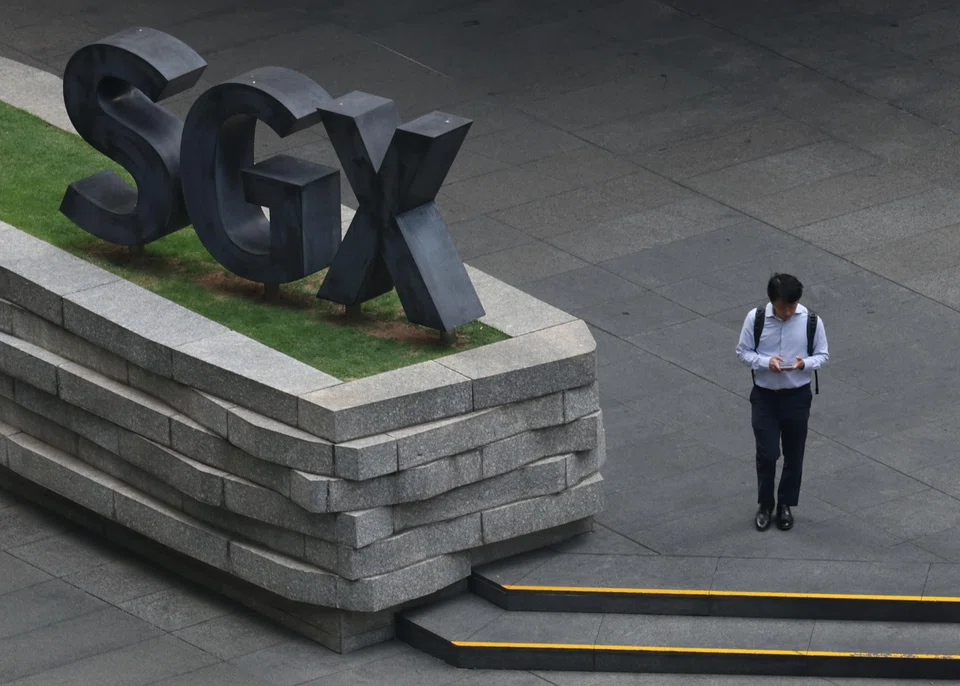
[SINGAPORE] Singapore stocks tracked regional declines to end lower on Wednesday (Oct 7).
The benchmark Straits Times Index (STI) lost 1.6 per cent or 93.1 points to finish at 5,608.44.
This was led by OCBC , which fell 5.9 per cent or S$1.90 to S$30.30, and UOB , which was 2.9 per cent or S$1.28 lower at S$42.44. DBS also shed 1.4 per cent or S$1.07 to S$77.49.
In a report on Wednesday, Citi analyst Tan Yong Hong downgraded his call on OCBC to “sell” from “neutral”, and reiterated his “sell” call on UOB.
He said that the banks’ third-quarter results – set to be released in the first week of November – may be lower than market forecasts due to misplaced optimism on Singdollar rates, especially after an exceptional first-half wealth-related income.
The day’s gainers on the STI were led by Hongkong Land , which rose 2.7 per cent or US$0.22 to US$8.28.
Across the broader Singapore market, gainers edged out losers 270 to 269, after 1.2 billion securities worth S$2.8 billion changed hands.
CapAllianz was the most actively traded stock with 58.5 million shares changing hands. OCBC was the most actively traded stock in terms of value, with 27.1 million shares worth S$831.3 million.
Within the iEdge Singapore Next 50 Index, First Resources was the top gainer, rising 5.5 per cent or S$0.24 to S$4.57, while Top Glove was the biggest decliner, falling 3.6 per cent or S$0.01 to S$0.265.


Elsewhere in the region, key indices landed in the red.
Hong Kong’s Hang Seng Index lost 0.6 per cent, Japan’s Nikkei 225 fell 0.9 per cent, South Korea’s Kospi was down 2 per cent and the FTSE Bursa Malaysia KLCI declined 1.3 per cent.
Vishnu Varathan, head of Asia-Pacific macro strategy at Mizuho Securities (Singapore), said global and US bond market stress and the spillover risks of a wider contagion should something “crack” is chronically understated.
The “usual” standalone metrics to measure risks, such as volatility and credit spreads, inadvertently understate underlying bond market stress, and do not fully capture the unprecedented scale and scope of overlapping. “Hence, (this results) in familiar risk gauges being susceptible to gaps and/or “blind spots” in uncharted waters,” he said.
This article was written with the assistance of AI and reviewed by a reporter
Decoding Asia newsletter: your guide to navigating Asia in a new global order. Sign up here to get Decoding Asia newsletter. Delivered to your inbox. Free.
Share with us your feedback on BT's products and services