

Singapore shares fall as STI sheds 0.6% on bank losses
UOL Group leads the gainers on the blue-chip index

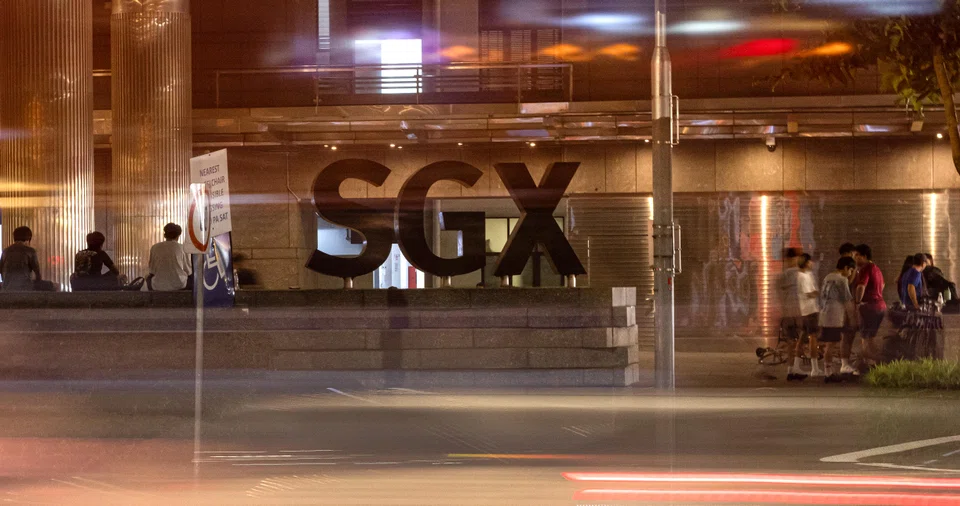
[SINGAPORE] Singapore stocks ended lower on Wednesday (Aug 12).
The benchmark Straits Times Index (STI) lost 0.6 per cent or 33.42 points to finish at 5,720.75.
UOL Group led the gainers on Singapore’s blue-chip index, rising 2.4 per cent or S$0.24 to S$10.17.
The worst performer among STI constituents was DBS , which fell 1.5 per cent or S$1.14 to S$75.85.
The other local banks also ended lower. OCBC fell 0.5 per cent or S$0.17 to S$31.19, and UOB was down 0.5 per cent or S$0.21 at S$41.95.
Within the iEdge Singapore Next 50 Index, PC Partner was the top gainer, rising 6.4 per cent or S$0.19 to S$3.16, while Yangzijiang Maritime was the biggest loser, falling 8.5 per cent or S$0.055 to S$0.59.
Across the broader market, losers edged out gainers 281 to 276, after 1.2 billion securities worth S$2.2 billion changed hands.
International Cement was the most actively traded stock on the Singapore bourse, with 115.1 million shares changing hands.
DBS was the most actively traded stock in terms of value, with 5.1 million shares worth S$390.8 million traded.
Key regional indices ended mixed. Hong Kong’s Hang Seng Index lost 0.8 per cent, while Japan’s Nikkei 225 rose 0.8 per cent, South Korea’s Kospi was up 3.7 per cent and the FTSE Bursa Malaysia KLCI advanced 0.6 per cent.
Stephen Innes, managing partner at SPI Asset Management, said that markets have moved from a phase of pricing in bad news to one that is now “more sensitive to relief”.
He added that the central risk to watch is not a growth slowdown, but the opposite scenario, where growth stays firm enough to push long-end bond yields past the market’s comfort zone.
This article has been written with the assistance of AI and reviewed by a reporter
Decoding Asia newsletter: your guide to navigating Asia in a new global order. Sign up here to get Decoding Asia newsletter. Delivered to your inbox. Free.
Copyright SPH Media. All rights reserved.






