

Singapore stocks close higher amid mixed regional showing; STI up 0.3%
DFI Retail Group leads the gainers on the Republic’s blue-chip index
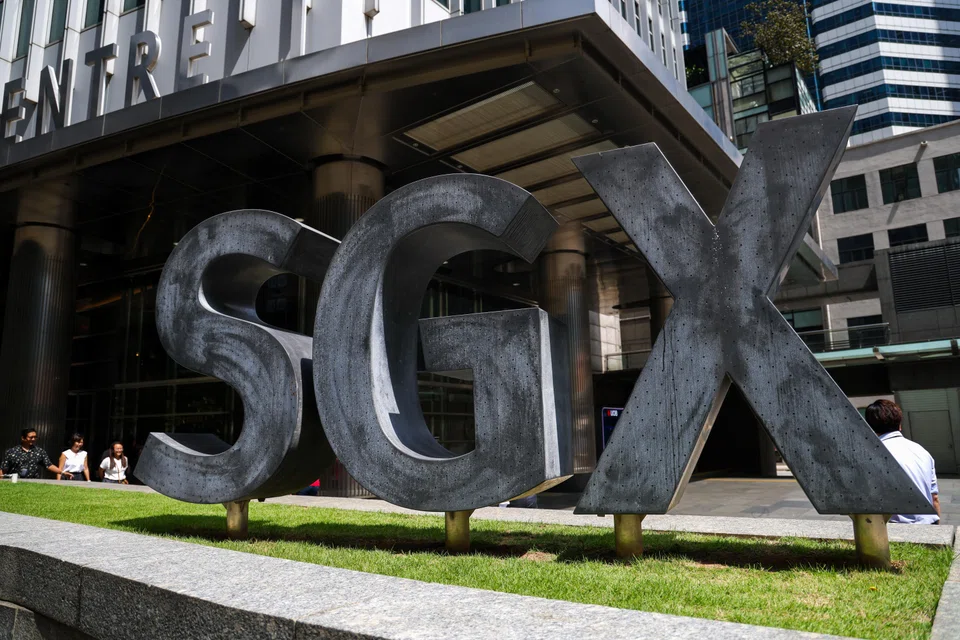
[SINGAPORE] Singapore stocks ended higher on Monday (Jun 29) amid a mixed showing in Asian markets.
The benchmark Straits Times Index (STI) gained 0.3 per cent or 17.02 points to finish at 5,208.75.
DFI Retail Group led the gainers on Singapore’s blue-chip index, rising 3 per cent or US$0.11 to US$3.80.
The worst performer among STI constituents was Yangzijiang Shipbuilding , which fell 2.6 per cent or S$0.09 to S$3.41.
The three local banks ended higher. DBS gained 0.9 per cent or S$0.60 to S$66.03, OCBC rose 0.1 per cent or S$0.02 to S$24.88, and UOB was up 0.3 per cent or S$0.10 at S$39.90.
Within the iEdge Singapore Next 50 Index, Top Glove was the top gainer, rising 4.8 per cent or S$0.01 to S$0.22. ValueMax was the index’s biggest decliner, falling 3.91 per cent or S$0.035 to S$0.86.
Across the broader market, gainers edged out losers 365 to 211, after 1.3 billion securities worth S$1.5 billion changed hands.
Key regional indices were mixed.
Hong Kong’s Hang Seng Index gained 1.6 per cent and Japan’s Nikkei 225 rose 0.2 per cent. Meanwhile, South Korea’s Kospi was down 0.2 per cent and the FTSE Bursa Malaysia KLCI declined 0.1 per cent.


Norbert Rucker, head of economics and next-generation research at Julius Baer, said that despite some uncertainty arising from US-Iran conflict, the oil market’s reaction has been “contained”.
“Oil prices traded up temporarily but remained close to US$70,” he noted. “With the alternative export routes still in full use, transits through (the Strait of Hormuz) do not need to recover to pre-conflict levels for overall trade to normalise.”
That said, he added that “hiccups” along the way can be expected, and that the conflict “may not reach a lasting resolution soon”.
This article has been written with the assistance of AI and reviewed by a reporter
Decoding Asia newsletter: your guide to navigating Asia in a new global order. Sign up here to get Decoding Asia newsletter. Delivered to your inbox. Free.
Share with us your feedback on BT's products and services
TRENDING NOW

DBS, OCBC, UOB rout lops billions off STI as inflation, rate concerns spook investors

Grab CEO’s wife Chloe Tong on life with Anthony Tan and finding her purpose

OCBC sheds S$8 billion in value as shares close nearly 6% down; analysts cautious on banks

Deal between tycoon friends sparks scrutiny of Philippine power sector

