

Singapore stocks continue losing streak on Wednesday, STI falls 0.7%
Frasers Centrepoint Trust leads the gainers; the Big Three banks all end lower
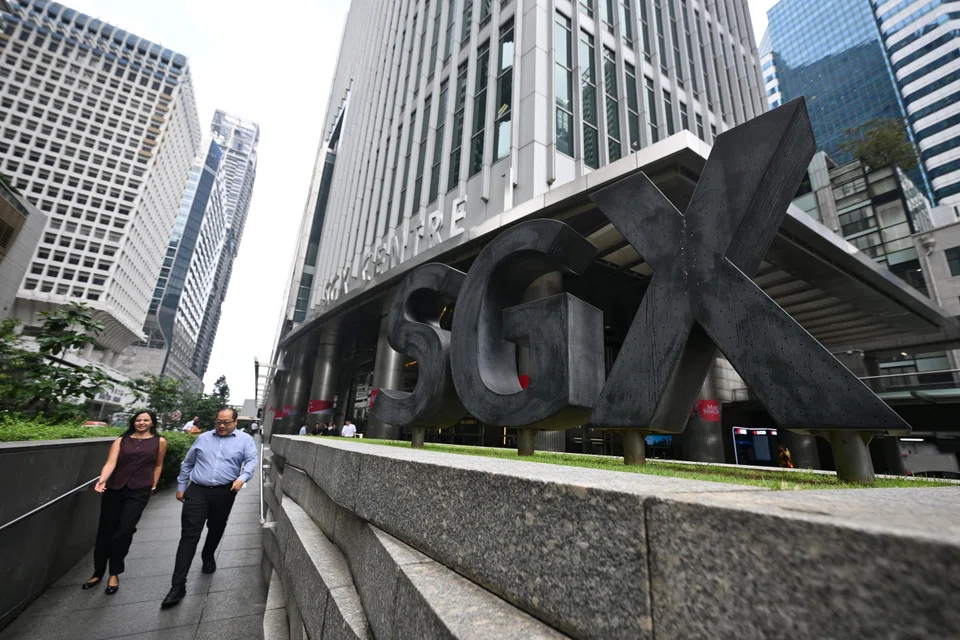
[SINGAPORE] For the second day in a row, Singapore stocks ended lower on Wednesday (Sep 30).
The benchmark Straits Times Index (STI) lost 0.7 per cent or 38.96 points to finish at 5,675.88.
Frasers Centrepoint Trust led the gainers on Singapore’s blue-chip index, rising 1.5 per cent or S$0.03 to S$2.09.
The worst performer among STI constituents was Venture Corporation, which fell 2.8 per cent or S$0.47 to S$16.23.
The local banks all ended lower. DBS lost 1.1 per cent or S$0.88 to S$77.50, OCBC fell 0.5 per cent or S$0.17 to S$31.99, and UOB was down 1.1 per cent or S$0.048 to S$42.84.
The iEdge Singapore Next 50 Index gained 0.1 per cent or 1.19 points to 1,483.71.
Within the iEdge Singapore Next 50 Index, UMS Integration was the top gainer, rising 3 per cent or S$0.08 to S$2.71. Yanlord Land was the biggest decliner, falling 2.8 per cent or S$0.015 to S$0.525.
Across the broader market, gainers trailed losers 250 to 283, after 1.5 billion securities worth S$2.5 billion changed hands.
Capital World was the most actively traded stock with 104 million shares changing hands. DBS was the most actively traded stock in terms of value, with a volume of 5.9 million shares and a value of S$462.2 million.

Key regional indices were mixed. Hong Kong’s Hang Seng Index gained 0.4 per cent, Japan’s Nikkei 225 rose 1.9 per cent, South Korea’s Kospi was down 0.5 per cent and the FTSE Bursa Malaysia KLCI advanced 0.4 per cent.
The ongoing impasse between Washington and Teheran continues to roil markets, sending bond yields higher, said José Torres, senior economist at Interactive Brokers. Wall Street fears the Fed will tighten monetary policy meaningfully to curb inflation as oil prices continue to soar.
Torres added: “President Trump’s disagreements with his Iranian counterpart are concerning investors because this conflict could be long-lasting, creating a headwind for government debt and stocks for an extended period.”
This article has been written with the assistance of AI and reviewed by a reporter
Decoding Asia newsletter: your guide to navigating Asia in a new global order. Sign up here to get Decoding Asia newsletter. Delivered to your inbox. Free.
Share with us your feedback on BT's products and services
TRENDING NOW

Grab CEO’s wife Chloe Tong on life with Anthony Tan and finding her purpose
Brokers maintain ‘buy’ on CDL despite investor reservations over strategic review

Deal between tycoon friends sparks scrutiny of Philippine power sector

Hwa Seng Builder, two China companies win S$1.2 billion Tuas Road Viaduct phase two contracts

