Singapore stocks end lower on Monday; STI down 0.1%
Wilmar International leads the gainers on the blue-chip index
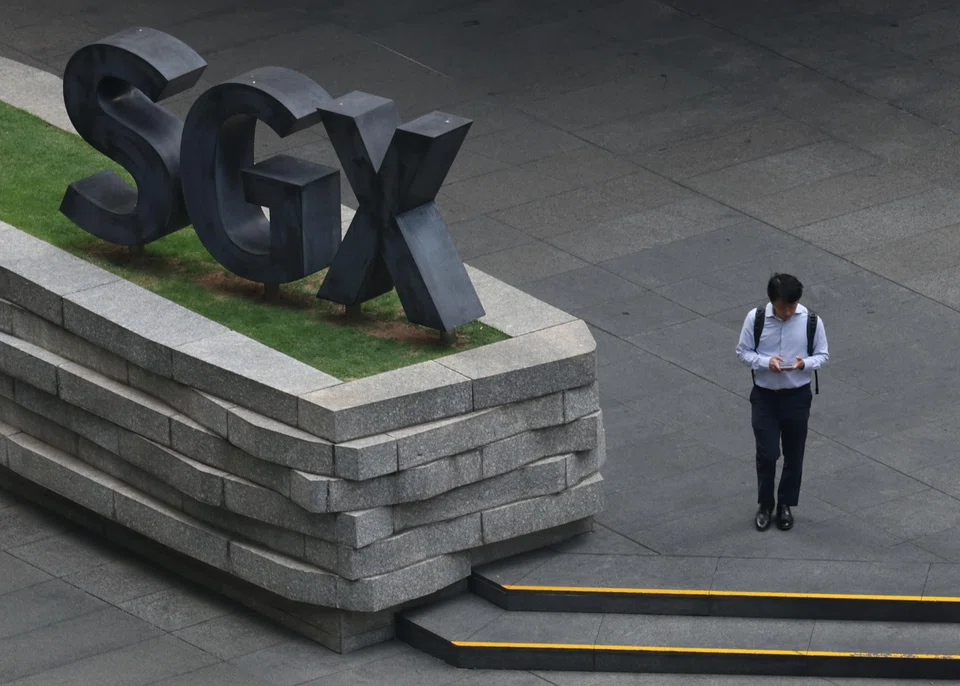
[SINGAPORE] Singapore stocks ended lower on Monday (Aug 24).
The benchmark Straits Times Index (STI) lost 0.1 per cent or 8.50 points to finish at 5,680.46.
Wilmar International led the gainers on Singapore’s blue-chip index, rising 1.3 per cent or S$0.05 to S$3.76.
The worst performer among STI constituents was Seatrium , which fell 2.8 per cent or S$0.06 to S$2.09.
The three local banks ended mixed on Monday. UOB rose 0.5 per cent or S$0.20 to S$40.73, while DBS finished 0.6 per cent or S$0.44 lower at S$75.56 and OCBC closed 0.2 per cent or S$0.06 lower at S$30.92.
Within the iEdge Singapore Next 50 Index, UltraGreen.ai was the top gainer, rising 13.4 per cent or US$0.085 to US$0.72; CSE Global was the biggest decliner, falling 4.8 per cent or S$0.06 to S$1.19.
Salt Investments was the most actively traded stock, with 259.5 million shares changing hands.
DBS was the most actively traded stock in terms of value, with a volume of 2.5 million shares worth S$186.2 million.
Across the broader market, losers outnumbered gainers 336 to 250, after 1.4 billion securities worth S$1.5 billion changed hands.
Key regional markets ended lower on Monday. Hong Kong’s Hang Seng Index fell by 1.9 per cent, South Korea’s Kospi slumped 3.1 per cent, Japan’s Nikkei 225 closed 0.7 per cent lower and the FTSE Bursa Malaysia KLCI inched down 0.01 per cent.
George Bory, Allspring’s chief investment strategist for fixed income, said he expects Fed chair Kevin Warsh to reinforce a clearer division of responsibilities between the US Federal Reserve and the US Treasury, potentially in his speech on Friday.
He said he believes Warsh will emphasise the Fed’s traditional mandate and role in monetary policy, while a more assertive Treasury takes a larger role in managing market and yield-curve dynamics.
“In this framework, monetary policy would help anchor short-term rates, while the Treasury would address technical factors affecting the broader yield curve,” he added.
This article was written with the assistance of AI and reviewed by a reporter
Decoding Asia newsletter: your guide to navigating Asia in a new global order. Sign up here to get Decoding Asia newsletter. Delivered to your inbox. Free.
Share with us your feedback on BT's products and services