Singapore stocks fall, tracking regional decline; STI down 0.1%
Across the broader market, decliners outnumber gainers 315 to 262 after 1.3 billion securities change hands
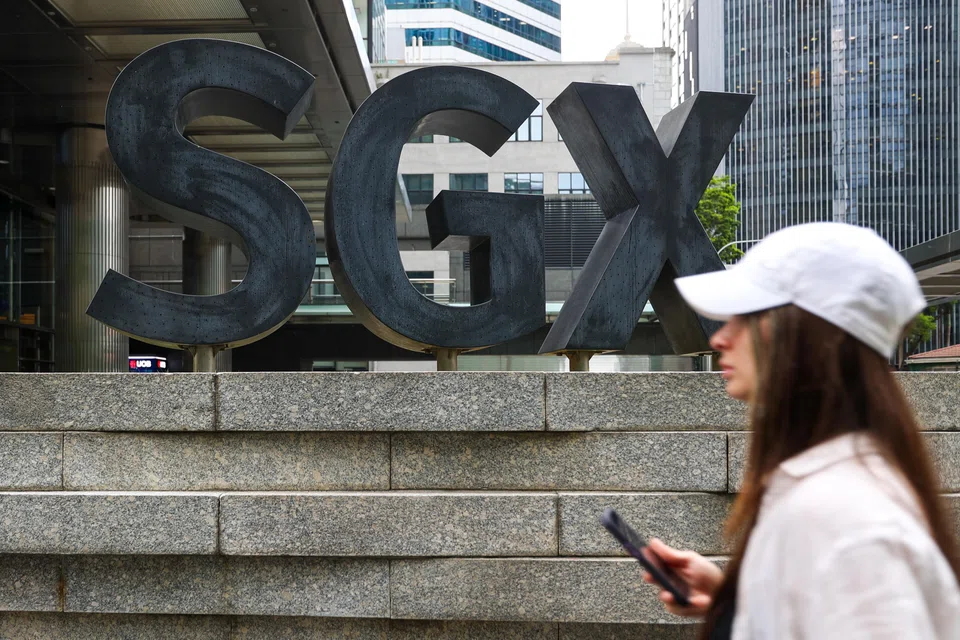
[SINGAPORE] Singapore stocks ended lower on Monday (Apr 13), tracking declines across regional bourses as investors remained cautious amid the continuation of the Middle East conflict.
The benchmark Straits Times Index (STI) lost 0.1 per cent or 5.24 points to finish at 4,984.17.
Sembcorp Industries led the gainers on Singapore’s blue-chip index, rising 1 per cent or S$0.07 to S$6.96.
The worst performer among STI constituents was Hongkong Land , which fell 2.1 per cent or US$0.17 to US$7.91.
The three local banks bucked the broader declines to end higher on Monday. DBS gained 0.3 per cent or S$0.17 to S$57.52, OCBC rose 0.5 per cent or S$0.11 to S$22.58, and UOB was up 0.1 per cent or S$0.03 at S$37.42.
Across the broader market, decliners outnumbered gainers 315 to 262 after 1.3 billion securities worth S$1.5 billion changed hands.
Regional markets were in negative territory. Hong Kong’s Hang Seng Index shed 0.9 per cent, Japan’s Nikkei 225 fell 0.7 per cent, South Korea’s Kospi was down 0.9 per cent, and the FTSE Bursa Malaysia KLCI declined 0.6 per cent.
The failed US-Iran talks over the weekend and US President Donald Trump’s subsequent pledge to block the Strait of Hormuz squashed nascent hopes of ending the Middle East conflict.
“Markets want to look through the uncertainty of the negotiations and trade the end result,” said Eric Robertsen, global head of research and chief strategist at Standard Chartered. “The challenge is that the path to that destination may involve significantly more volatility.”

He added that as negotiations unfold, the economies of energy importers continue to suffer, putting further strain on their fiscal balances.
“It’s difficult to fade optimism. But we are inclined to believe that the road ahead remains rocky, and we expect more volatility.”
Decoding Asia newsletter: your guide to navigating Asia in a new global order. Sign up here to get Decoding Asia newsletter. Delivered to your inbox. Free.
Copyright SPH Media. All rights reserved.