

Singapore stocks fall on Thursday, bucking regional trend; STI down 0.2%
Yangzijiang Shipbuilding leads the gainers on the blue-chip index
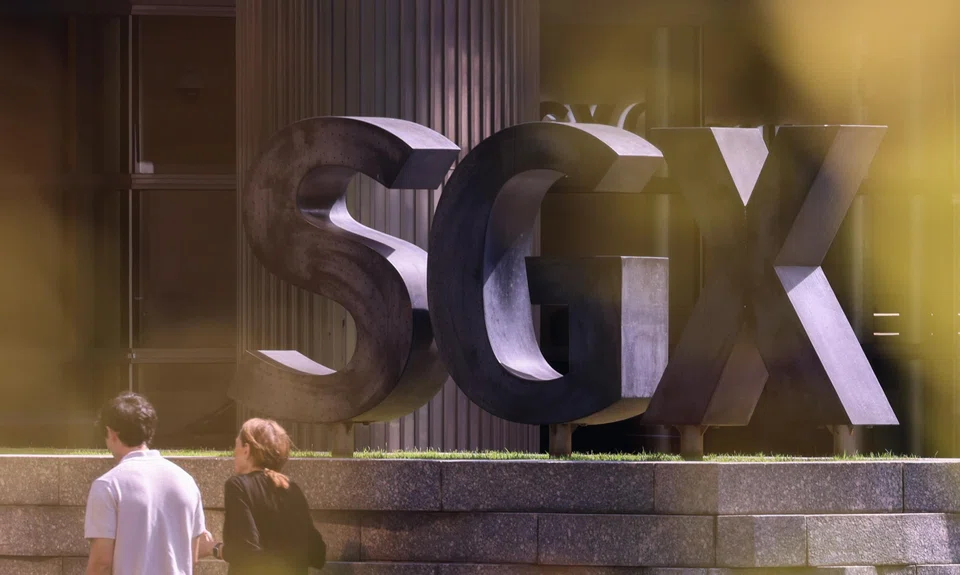
[SINGAPORE] Singapore stocks retreated on Thursday (Jul 23), even as key regional exchanges ended higher.
The benchmark Straits Times Index (STI) lost 0.2 per cent or 13.66 points to finish at 5,581.76.
Yangzijiang Shipbuilding led the gainers on Singapore’s blue-chip index, rising 2.3 per cent or S$0.09 to S$4.03.
The worst performer among the STI constituents was DFI Retail Group , which fell 5.3 per cent or US$0.19 to US$3.40.
The local banks all ended lower. DBS lost 0.2 per cent or S$0.16 to close at S$73.50, OCBC fell 1 per cent or S$0.28 to S$28.90, and UOB was down 0.1 per cent or S$0.04 at S$43.
Within the iEdge Singapore Next 50 Index, Olam Group was the top gainer, rising 3.1 per cent or S$0.04 to S$1.32. Top Glove was the biggest decliner, dropping 2.4 per cent or S$0.005 to S$0.205.
Across the broader market, gainers outnumbered losers 321 to 247, after 1.1 billion securities worth S$1.9 billion changed hands.
Meanwhile, key regional indices were positive. Hong Kong’s Hang Seng Index gained 1.3 per cent, Japan’s Nikkei 225 rose 0.5 per cent, South Korea’s Kospi was up 4.4 per cent and the FTSE Bursa Malaysia KLCI advanced 0.2 per cent.
Stephen Innes, managing partner at SPI Asset Management, noted: “Asia remains the most direct picks-and-shovels expression of the artificial intelligence boom. The suppliers receive orders and near-term cash flow, while the hyperscalers absorb more execution risk and shoulder the growing capital burden.”


He cited Kospi’s surge on the back of semiconductor and memory players “benefiting from the expectation that Alphabet’s larger budget will translate into stronger demand for chips, servers, networking equipment and power infrastructure”.
This article has been written with the assistance of AI and reviewed by a reporter
Decoding Asia newsletter: your guide to navigating Asia in a new global order. Sign up here to get Decoding Asia newsletter. Delivered to your inbox. Free.
Share with us your feedback on BT's products and services
TRENDING NOW

Once staunchly pro-China, Malaysian Chinese businesses are now distancing themselves from Beijing

Looking beyond looming CEO succession, should UOB potentially pursue a transformative merger?

Could stablecoins be the future of money?

Grab CEO’s wife Chloe Tong on life with Anthony Tan and finding her purpose

