Singapore stocks fall on Tuesday, STI edges 0.3% lower
Across the broader market, gainers trail losers 236 to 298, with 1.4 billion securities worth S$2 billion traded
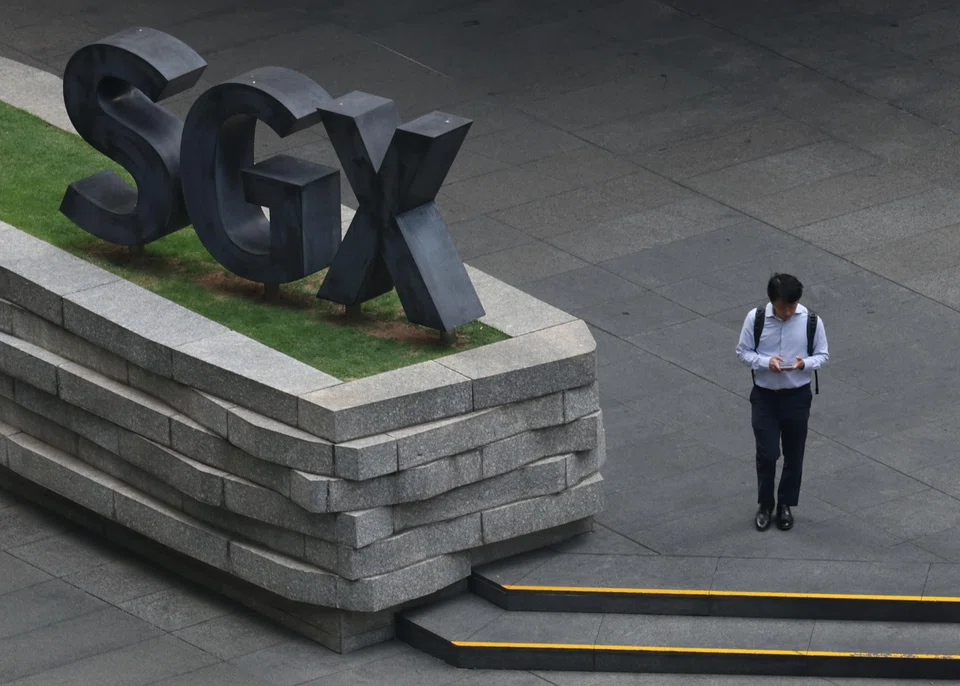
[SINGAPORE] Singapore stocks ended lower on Tuesday (Sep 29).
The benchmark Straits Times Index (STI) lost 0.2 per cent or 14.18 points to finish at 5,714.84.
DFI Retail Group led the gainers on Singapore’s blue-chip index, rising 1.3 per cent or US$0.04 to US$3.24.
The worst performer among STI constituents was Hongkong Land , which fell 6 per cent or US$0.51 to US$8.02.
The three local banks ended mixed on Tuesday. DBS rose 0.4 per cent or S$0.27 to S$78.38; and UOB was up 0.1 per cent or S$0.03 at S$43.32; while OCBC finished 0.2 per cent or S$0.06 lower at S$32.16.
Within the iEdge Singapore Next 50 Index, AEM was the top gainer, rising 4.4 per cent or S$0.41 to S$9.75. Top Glove was the biggest decliner, falling 2.1 per cent or S$0.005 to S$0.23.
Across the broader market, gainers trailed losers 236 to 298, after 1.4 billion securities worth S$2 billion changed hands.
Hiap Seng Industries was the most actively traded stock with 302 million shares changing hands. DBS was the most actively traded stock in terms of value, with a volume of 4.6 million shares and a value of S$357.2 million.
Key regional indices were negative. Hong Kong’s Hang Seng Index lost 0.5 per cent, Japan’s Nikkei 225 fell 0.6 per cent, South Korea’s Kospi was down 0.3 per cent and the FTSE Bursa Malaysia KLCI declined 1.6 per cent.

Crude oil prices remain above US$100 per barrel as Iran and the US are unable to find a compromise to fully reopen the Strait of Hormuz to energy flows, said Vis Nayar, chief investment officer of Eastspring Investments.
Elevated oil prices have pushed refined product prices to new highs as well. Diesel stands out in its central role in transportation, agriculture, construction and back-up power. Some US politicians have suggested a 30-day ban on US diesel exports, which is an immediate risk to prices.
“We think this is unlikely but if it were to happen, it would push diesel prices in Europe and parts of Asia higher,” he added.
This article was written with the assistance of AI and reviewed by a reporter
Decoding Asia newsletter: your guide to navigating Asia in a new global order. Sign up here to get Decoding Asia newsletter. Delivered to your inbox. Free.
Share with us your feedback on BT's products and services