

Singapore stocks gain ground on Wednesday amid mixed regional showing; STI up 1.7%
Jardine Matheson leads the gainers on the blue-chip index
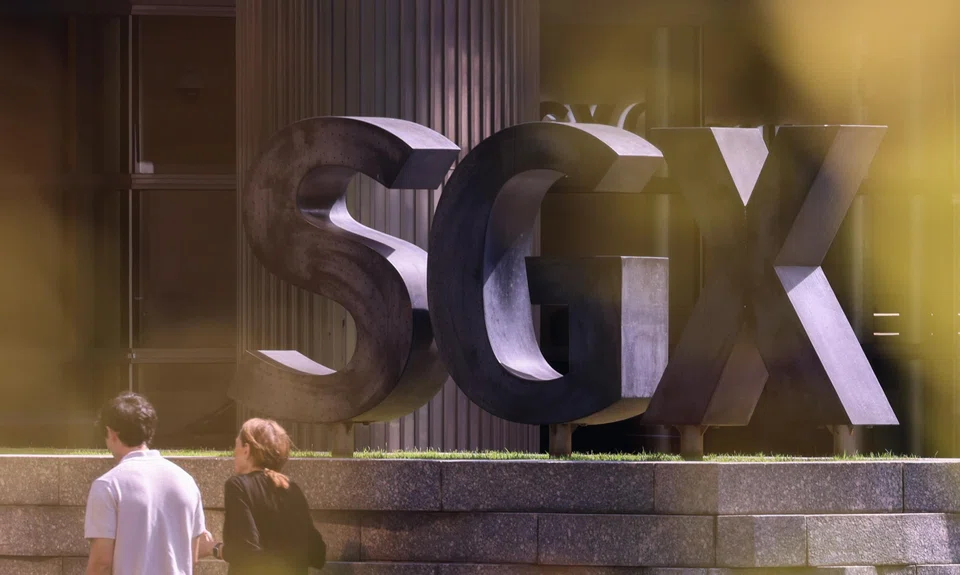
[SINGAPORE] Singapore stocks ended higher on Wednesday (Jul 29) amid a mixed regional showing.
The benchmark Straits Times Index (STI) gained 1.7 per cent or 97.08 points to finish at 5,713.19.
Jardine Matheson led the gainers on Singapore’s blue-chip index, rising 6.1 per cent or US$3.88 to US$67.99.
The worst performer among the STI constituents was Seatrium , which shed 8.5 per cent or S$0.20 to close at S$2.16.
The three local banks ended higher. DBS advanced 1.5 per cent or S$1.09 to S$75, OCBC rose 2.9 per cent or S$0.85 to S$29.78, and UOB was up 1.7 per cent or S$0.75 at S$43.89.
Within the iEdge Singapore Next 50 Index, ESR Real Estate Investment Trust was the top gainer with a 3.1 per cent or S$0.08 rise to S$2.65, while UMS Integration was the biggest decliner, retreating 3.5 per cent or S$0.08 to S$2.19.
Across the broader market, gainers outnumbered losers 351 to 261, after 1.3 billion securities worth S$2.5 billion changed hands.
Key regional indices were mixed. Japan’s Nikkei 225 fell 1.5 per cent and South Korea’s Kospi was down 6 per cent.
Meanwhile, the FTSE Bursa Malaysia KLCI added 0.2 per cent and Hong Kong’s Hang Seng Index advanced 2 per cent.


Nigel Green, chief executive of financial advisory deVere Group, noted that Brent crude prices have surpassed US$80 a barrel following a re-escalation of the Middle East conflict. He described this as a case for preparation rather than panic.
He said: “Complacency should worry investors here far more than conflict itself. Wars in this region have flared and paused for months now, and each pause has tempted markets back into assuming the risk has passed.”
“It hasn’t passed. It’s simply been waiting for the next spark, and today supplied one,” he added, referring to Iranian strikes on American forces in the Middle East on Wednesday, and the ensuing US retaliation.
“The risk premium in energy was always going to return the moment this conflict resumed, and portfolios built on the assumption of lasting peace in this region need to be stress-tested against the reality that peace here has proven fragile every single time.”
This article has been written with the assistance of AI and reviewed by a reporter
Decoding Asia newsletter: your guide to navigating Asia in a new global order. Sign up here to get Decoding Asia newsletter. Delivered to your inbox. Free.
Share with us your feedback on BT's products and services
TRENDING NOW

Once staunchly pro-China, Malaysian Chinese businesses are now distancing themselves from Beijing

Looking beyond looming CEO succession, should UOB potentially pursue a transformative merger?

Could stablecoins be the future of money?

Grab CEO’s wife Chloe Tong on life with Anthony Tan and finding her purpose

