

Singapore stocks’ market cap down 2.8% in May on global macro uncertainty

Uma Devi
THE total market capitalisation of companies listed on the Singapore Exchange (SGX) fell again in May, extending losses amid elevated global macroeconomic uncertainty brought about by rising risks of recession, inflationary pressures and the banking crisis.
Data compiled by The Business Times showed that on a month-on-month basis, the total value of Singapore-listed stocks fell 2.8 per cent or S$22.8 billion in May to S$792 billion, from S$814.8 billion.
Of the 627 SGX-listed companies, losers outnumbered gainers 341 to 163.
This was the second month in a row in which Singapore stocks booked a decline in value, following a 0.5 per cent or S$4.4 billion loss in April.
The benchmark Straits Times Index (STI), too, did not escape unscathed. The combined value of the 30 constituent stocks fell to S$523.8 billion in May, down 2.9 per cent or S$15.8 billion from S$539.6 billion the month before.
SGX market strategist Geoff Howie said that in May, the STI “traded in a range that was twice the size of what was produced in April”.
“Again, global cues mattered, with increased expectations that the (US Federal Reserve) will not pause, but rather hike on Jun 14, while stock bid tones also moderated as the US debt-ceiling negotiations entered the 11th hour,” he said.
DBS analysts said in a note on Wednesday (May 31) that they expect the STI to hold at the level of 3,180 points over the next one to two months.
“(The) STI’s seasonal trend supports a June base post the May correction, with a tradeable rebound starting either in June or July,” they said, adding that two possible triggers for a tradeable rebound would be a pause to the Fed’s rate hikes or a raised US debt ceiling with no default.
Mainboard-listed companies appeared to have fared worse in May, with their total value declining 2.9 per cent or S$22.7 billion to S$783.7 billion. Catalist-listed stocks lost only 0.8 per cent or S$0.1 billion to S$8.3 billion.
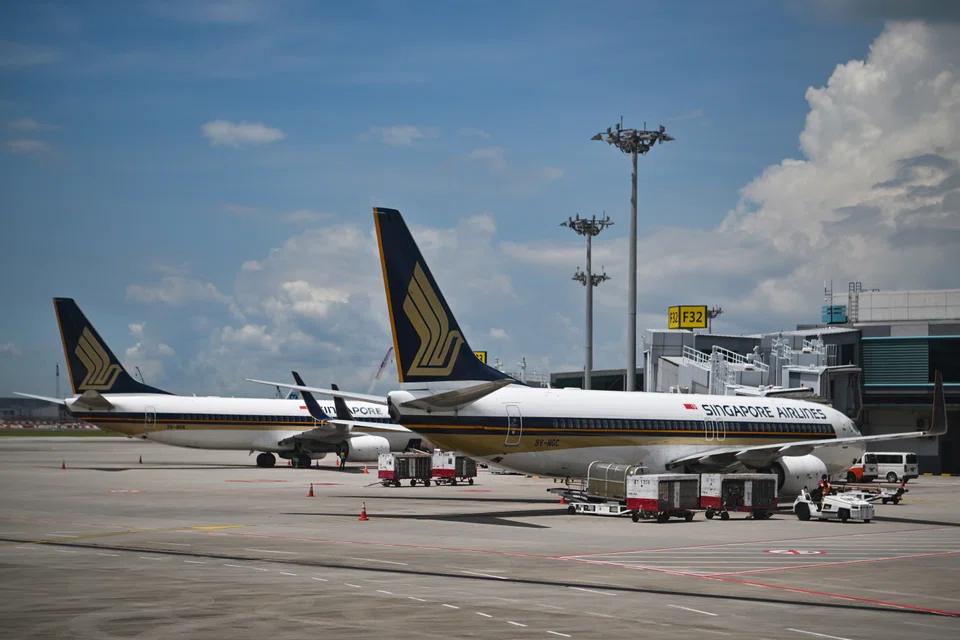
Singapore Airlines (SIA) booked the biggest gain in value in the month, adding S$1.7 billion in value from April. The flag carrier had posted record-high full-year earnings of S$2.2 billion for FY2022/23, versus a net loss of S$962 million in FY2021/22, on the back of stronger demand and a continued recovery in the global aviation sector.
OCBC analysts said SIA’s strong passenger flown revenue had offset weaker cargo revenue, and that there is “robust near-term forward passenger sales across all cabin classes”.
They noted that there could be “further legs” to SIA’s recovery, as Chinese international travel activity rebounds more meaningfully in the second half of the year. The group is looking to expand its services to China by resuming Scoot flights to cities such as Jinan and Nanchang, and increasing flight frequencies to key cities including Fuzhou, Guangzhou and Hangzhou.
Other top gainers for May included Sembcorp Industries , Jardine Matheson Holdings and Prudential .
Keppel Corporation was also among the top advancers for the month, with a gain of S$255.2 million. The conglomerate has been reorganising its operations, and recently said it plans to scale its assets under management to S$200 billion by 2030.
The biggest decliner in May was DBS , which took a S$6.5 billion hit to its value. OCBC was another top decliner, shedding S$1.4 billion.
Analysts warned that local banks, which had a good run amid higher interest rates for a prolonged period, could be in for tougher times as loan growth moderates. Local savers could also put their money in higher-interest fixed-deposit products.
Looking ahead, DBS analysts said one positive takeaway from the recently concluded results season is that some stocks – while having a weak first-quarter showing – are on the cusp of a turnaround, or could book improved earnings in the coming quarters.
“Investors should look beyond the current weakness and position in these stocks,” they said. “Conversely, investors should take profit on counters which have seen a sharp run-up in their share prices after posting record results and/or recent developments.”






