Singapore stocks rise on Thursday amid mixed regional showing; STI up 1.1%
Across the broader market, gainers beat losers 329 to 239
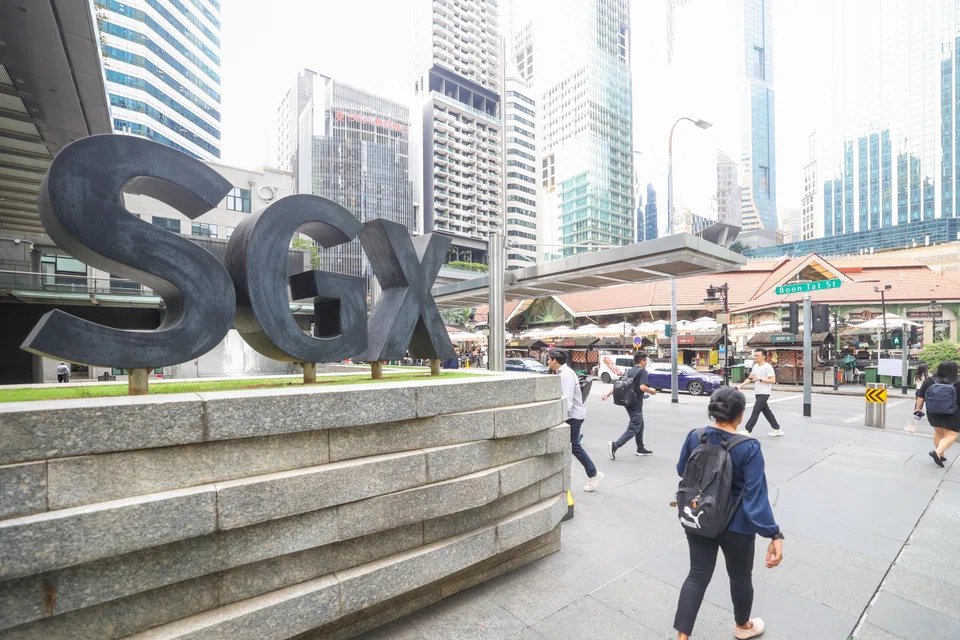
[SINGAPORE] Singapore stocks ended higher on Thursday (Jul 2).
The benchmark Straits Times Index (STI) gained 1.1 per cent or 55.65 points to finish at 5,217.15.
ST Engineering led the gainers on Singapore’s blue-chip index, rising 2.7 per cent or S$0.28 to end at S$10.84.
The worst performer among STI constituents was Sembcorp Industries , falling 0.6 per cent or S$0.04 to close at S$6.19.
The three local banks ended higher. DBS gained 1.5 per cent or S$1 to S$66.43, OCBC rose 1.7 per cent or S$0.42 to S$25.08, and UOB was up 1.1 per cent or S$0.42 at S$40.07.
Within the iEdge Singapore Next 50 Index, First Resources was the top gainer, rising 6.5 per cent or S$0.20 to finish at S$3.28, while PC Partner was the top loser, falling 12.9 per cent or S$0.40 to end the session at S$2.70.
Across the broader market, gainers outnumbered losers 329 to 239, after 1.4 billion securities worth S$1.6 billion changed hands.
Key regional indices were mixed. Hong Kong’s Hang Seng Index gained 0.8 per cent, Japan’s Nikkei 225 index fell 2.5 per cent, South Korea’s Kospi was down 7.9 per cent and the FTSE Bursa Malaysia KLCI advanced 0.3 per cent.
“AI momentum continues to push equity markets to new highs despite geopolitical and economic challenges,” Vincenzo Vedda, chief investment officer; Benjardin Gartner, global head of equity; and Tobias Rommel, sector head for information technology at DWS said in a note on Thursday.
“Corporate willingness to invest in the new technology continues to be matched by investors’ appetite for it,” they said.
“The sector’s dynamism is also reflected in rapid shifts in market share, pricing and even business models,” they added. “All this argues against a buy-and-hold strategy.”
This article has been written with the assistance of AI and reviewed by a reporter
Decoding Asia newsletter: your guide to navigating Asia in a new global order. Sign up here to get Decoding Asia newsletter. Delivered to your inbox. Free.
Share with us your feedback on BT's products and services