

Singapore turns to next-generation power systems to scale AI, train future workforce
This comes as the Republic transitions to a low-carbon energy grid while advancing regional net-zero ambitions

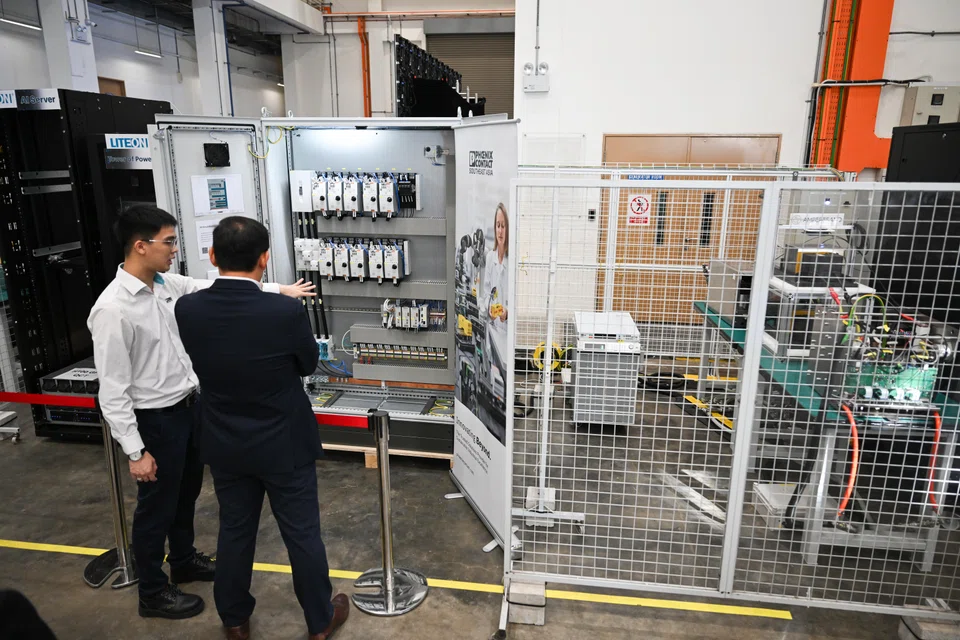
[SINGAPORE] As artificial intelligence (AI) drives rising energy demand, data centre operator ST Telemedia Global Data Centres (STT GDC) is deploying more efficient power systems to scale its operations, through a pilot it described as being the first in South-east Asia.
Dubbed the FutureGrid Accelerator, the high-voltage direct current (HVDC) AI test bed was launched on Monday (Jan 26) at the Nanyang Technological University (NTU) Electrification and Power Grids Centre on Jurong Island.
The move comes as Singapore moves towards a low-carbon energy grid while advancing South-east Asia’s energy transition and net-zero ambitions.
Lim Mingcheng, country head for Singapore at STT GDC, noted that traditional alternating-current systems “are hitting their physical and efficiency limits”.
As AI model training increases, the power demand for server racks also rises. Currently, a typical server rack draws about 20 kilowatts of power – equal to the monthly power usage of 30 five-room HDB flats.
Lim said that by 2030, companies such as Nvidia could push this demand up to 1 megawatt (MW), or enough to power about 1,500 five-room flats for a month.
“So, the question is not whether this growth will happen, but rather, how (we can) support this sustainably,” he added.
With the new HVDC infrastructure, data centres will be able to support ultra-high-density racks exceeding 1 MW, with higher reliability and lower costs.
HVDC power systems will also create energy savings of up to 30 per cent from their alternating-current counterparts, while using 45 per cent less copper and having a power-infrastructure footprint that is smaller by up to 40 per cent.

Up to 400 tonnes of carbon emissions will be reduced per MW annually. Lim noted that this is roughly equivalent to more than 100 million trees a year across a single large data-centre facility.
The pilot will run through this year. STT GDC hopes to deploy this technology in future data centres in Singapore and progressively scale it within South-east Asia over the next few years.
Talent development
“You will also need the people with the skills to operate (advanced AI infrastructure),” said Lim.
He noted that many companies still face a capability gap between their strategic ambition and their ability to execute AI workloads at an operational level. This gap, he added, is especially pronounced for emerging technologies such as HVDC.
To address this, STT GDC signed multiple memorandums of understanding with the Institute of Technical Education, Singapore Polytechnic, NTU and the National University of Singapore.
In total, more than 8,000 Singaporeans will benefit from industry-aligned training in AI infrastructure and sustainable energy systems over the next five years.
Key initiatives proposed include internship opportunities, sponsorships as well as graduate pathways.
STT GDC said these will ensure that the “scaling of HVDC – and the broader energy transition – is matched by the transformation and availability of skills, jobs and talent development pathways”.
Decoding Asia newsletter: your guide to navigating Asia in a new global order. Sign up here to get Decoding Asia newsletter. Delivered to your inbox. Free.
Copyright SPH Media. All rights reserved.
TRENDING NOW

Philippine power giant First Gen rebuffs foreign offers, plans up to US$2.6 billion in expansion
Cliff Tan has 7 million followers and a 4-month waitlist. Why won’t he expand his business?

Could stablecoins be the future of money?
From finance aspirant to Asean CEO: TUV SUD’s Jonas Strahberger on finding people who believe in you

