

Singapore video game company’s Nasdaq listing values it at US$1.2 billion
Grand Centrex Limited (GCL) aims to eventually build a sizeable game studio in Singapore, capable of producing blockbusters

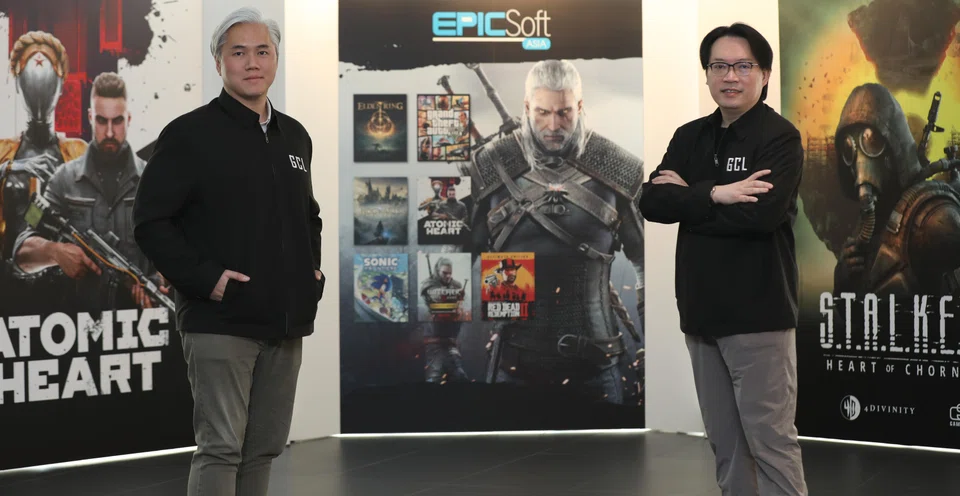
VIDEO game distributor and publisher Grand Centrex Limited (GCL) has come a long way.
The company got its break in 2008, distributing physical copies of the popular video game Grand Theft Auto IV. More recently, it was one of the publishers behind Black Myth: Wukong – the company has global publishing rights for physical copies of the game.
GCL on Friday (Feb 14) debuted on Nasdaq via a business combination with special purpose acquisition company (Spac) RF Acquisition at US$3.10 per share – down 69 per cent from its initial public offering price of US$10.
The business combination, which valued the company at US$1.2 billion, raised US$42.9 million.
The GCL group of companies comprises: video game publishers Epicsoft Asia and 4Divinity; video game distributor 2Game; and Titan Digital Media – the influencer marketing company owned by YouTube personality Tan Jianhao.
It also owns gaming chair company Martiangear.
Apart from Grand Theft Auto IV, GCL has distributed hits such as Cyberpunk 2077 and Sega’s Yakuza series.
As video games moved from physical CDs to digital downloads, GCL has evolved too. Digital downloads recorded a boost during Covid-19, with consumers offered savings compared to buying a physical copy.
Additionally, the company now conducts distribution negotiations with games studios to include the sale of activation codes, or even a cut of the online sales. For example, the company also has the rights to sell activation codes for Black Myth: Wukong in Taiwan.
The way GCL sees it, getting a slice of the digital pie is now essential. Otherwise, it would be marketing a video game with no assurance that it gets any returns if consumers do not buy the physical copies.
“The challenge today is: How do you do marketing if you don’t represent all the platforms?” Jacky Choo, executive chairman of GCL, told The Business Times.
The company has moved up the value chain and publishes games as well, tapping more than 16 years of games distribution experience. Publishers foot part of the bill when developing a game, and can localise the content for the intended market.
The experience and data collected from games distribution has given it insight into whether a game would perform well in their markets.
“The data has allowed us to get a pulse of the market, and enables us to understand what kind of hits are coming up,” said Sebastian Toke, group chief executive officer of GCL.
It has also published games such as Atomic Heart, a first-person shooter title that was released in February 2023. It recently expanded its markets beyond Asia, to Europe and the US.
GCL’s latest financial results showed that revenue for FY2024 ended Mar 31, 2024, grew 25.9 per cent to US$97.5 million, from US$77.4 million in FY2023. This rise was driven mainly by the sale of console games.
However, it reported a loss of US$1.4 million for the year, reversing from a profit of US$2 million in FY2023. This was due to a fall in gross profits from games publishing and advertising services.
Operating expenses increased in tandem with the preparation for the business combination with the Spac.
Nasdaq firepower
After its success in games distribution and publishing, GCL seeks to move up the value chain in its next phase by developing games. This move will require a lot more capital and investors that understand the video game industry.
The company had considered listing for a couple of years now, said Toke.
He added that the decision to list on Nasdaq rather than on the Singapore Exchange came down to a number of factors. These include market liquidity and the relevance of the exchange for GCL’s main business of video games.
There are other video game companies listed on Nasdaq, including giants such as Activision Blizzard, Electronic Arts and Take-Two. GCL aims to tap US video game studios, investors and media houses as part of its listing on the exchange.
Toke added: “Last, but not least, is access to capital in the US market and the track record of investors investing in big IP (intellectual property). It was a natural choice for us.”
The choice of combining with a Spac rather than going for an initial public offering was a pragmatic choice.
The company wanted to avoid paying fees and lodging applications before there was even any certainty that it could list on the exchange. With a Spac combination, its listing status was more certain.
“Our subsidiaries are also looking at us to become a listed company, and it is a choice by us not to spend a lot of money yet risk not getting listed,” he noted.
With the proceeds from the business combination, GCL plans to invest in game studios.
The experience gleaned from selling “AAA” (Triple-A) rated games – or “blockbuster” games with typically higher development and marketing budgets – has enabled the company to gain insights into what video game IP and product consumers are looking to buy.
Choo said: “Instead of waiting for people to develop the games, we do the development. I want to shorten the development cycle with AI (artificial intelligence) and technology. If we can make the games better and faster, that will reduce the cost of investment.”
The key focus for GCL will be to develop Triple-A video games with IP that it will own. This will enable the company to monetise the IP through selling merchandise, media adaptations and future sequels.
Besides investing into existing studios, it aims to eventually build a sizeable game studio in Singapore capable of producing Triple-A titles. Its Nasdaq listing is intended, in part, to generate working capital as it works towards this goal.
Choo added: “The difference between a Singapore game studio and other regions is that the cost may just be double. But if you have a Triple-A hit, the return is 10 to 20 times – so the cost is not that material.”






