

DBS, OCBC, UOB swell to almost half of ST Index after recent run-up
This comes after the share prices of DBS and OCBC hit new highs, with DBS comprising about a fifth of the benchmark index’s market cap


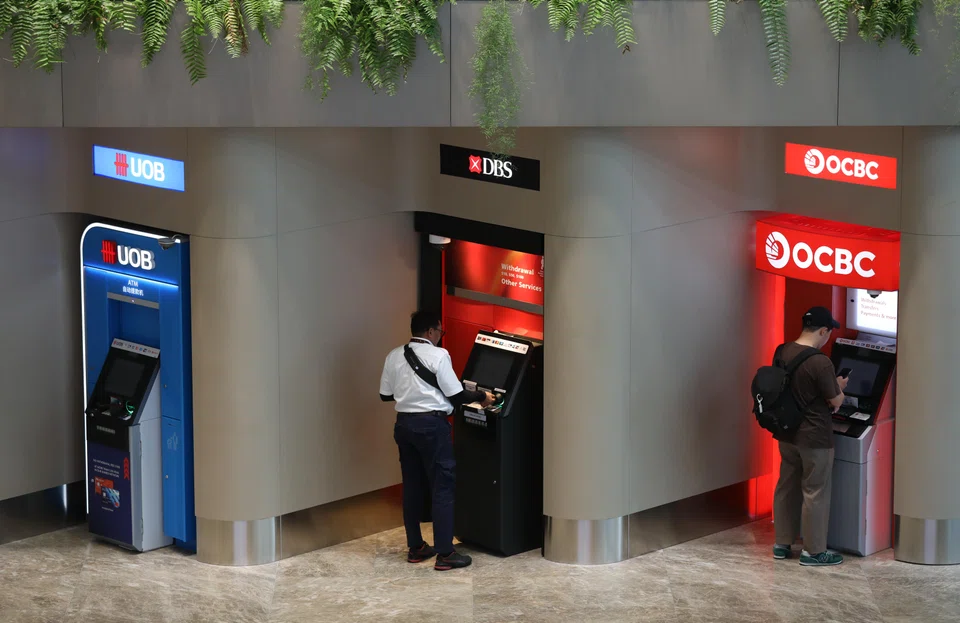
AFTER a strong performance this year and an even more spectacular run-up this week, the three local banks are increasingly dominating Singapore’s benchmark index.
The proportion of the market capitalisation represented by DBS , OCBC and UOB may rise even further in the coming weeks, as second-quarter results are released and higher-for-longer interest rates are likely to stay, analysts said.
This increased concentration of banks on the Straits Times Index (STI) highlights the significance of the sector in Singapore, said Danny Khoo, country head of sales trading at Saxo.
“This increase also demonstrates the substantial growth these banks have experienced over the past decade, seeing that they accounted for only 22 per cent (of the STI) in 2014,” he said.
Following their outperformance in the last couple of months, the local banking trio now make up around 45 per cent of the STI by market cap, with DBS comprising about a fifth of the benchmark index.
Based on data from Bloomberg, the market cap of the STI stood at S$507.6 billion as at Wednesday (Jul 3). DBS was at S$108 billion, OCBC at S$67.3 billion and UOB, at S$54 billion.
This comes after the share prices of DBS and OCBC hit new highs on Wednesday, at S$38.17 and S$15.07, respectively. UOB’s share price also reached close to its March 2022 high of S$32.50, at S$32.45.
At Wednesday’s close, DBS rose 2.3 per cent or S$0.86 to S$37.96, OCBC was up 1.2 per cent or S$0.18 to S$14.98, while UOB gained 2 per cent or S$0.62 to S$32.27.
This dominance is in contrast with other key markets in the region, where banks are not as heavily concentrated in their indices, notes Glenn Thum, senior research analyst at Phillip Securities Research.
“Banks make up about 22 per cent of the Hang Seng Index, about 0.7 per cent of the Nikkei 225, and about 27 per cent of the FTSE Bursa Malaysia KLCI,” he said.
This concentration is also higher than that of major indices such as the S&P 500, noted Yeap Jun Rong, analyst at IG.
“The financial sector accounts for around 13 per cent of the S&P 500, but this includes the credit services, insurance and asset management industry as well,” he said.
The weightage of banks on the S&P 500 is around 3 per cent when the other financial services are factored out. The US stock markets, however, are dominated by the tech giants instead.
Analysts such as Thum noted that “there would be risks involved if the banks do not perform well, and a shift in the sector would lead to an overall decline in the STI”.
In any case, Thum added, the STI historically has a higher weightage in the banking sector due to Singapore’s status as a major financial hub, while the concentration also reflects the importance of banks to the Republic’s economy.
“The rising concentration towards the banking sector is backed by (the banks’) earnings resilience,” said IG’s Yeap, adding that this justifies the concentration and leads to less concern around it.
The earnings resilience coupled with the high interest rate environment have compelled investors to pile into Singapore banks.
New highs on higher-for-longer interest rates
The recent rise in bank stocks was likely a result of renewed focus on the higher-for-longer interest rate environment, analysts said.
Yeap noted that markets have been pricing for higher odds of a Donald Trump presidency in the US, with Trump’s economic agenda likely resulting in higher deficits and policies, such as immigration and inflationary tariffs.
That has triggered a steepening of the bond yield curves, as market participants bet on higher long-term bond yields, which in turn have a positive impact on the banks’ margins, he added.
Their funding structure and liquidity also made Singapore banks big beneficiaries of higher-for-longer interest rates, said Thilan Wickramasinghe, head of Singapore research at Maybank Securities.
“This should show up in shareholder capital returns, as the sector has capacity to improve already very attractive dividend yields (as they report their) first-half results in a few weeks,” he said.
The banks have been the top performers on the STI already this year, with DBS up 25 per cent, OCBC rising 15.2 per cent, and UOB higher by 13.4 per cent.
Attractive yields
In the higher-for-longer interest rate environment, analysts predict that interest in the bank counters will persist, especially as they are expected to post yet another set of resilient results in August, the upcoming earnings season.
The growth drivers for banks continue to be stable net interest income, loan growth recovery and double-digit growth in fee income, said Phillip’s Thum.
Investors are also likely to look for higher dividends as earnings continue to grow, he added.
As for IG’s Yeap, he noted that the break to a new all-time high is “significant”, with buyers finding renewed traction for the banks after a period of indecision since May this year.
“We may expect the upward trend to continue into the upcoming earnings season, albeit with some intermittent breathers along the way,” he said.
TRENDING NOW

Grab CEO’s wife Chloe Tong on life with Anthony Tan and finding her purpose
Brokers maintain ‘buy’ on CDL despite investor reservations over strategic review

Deal between tycoon friends sparks scrutiny of Philippine power sector

Hwa Seng Builder, two China companies win S$1.2 billion Tuas Road Viaduct phase two contracts

