SingLand builds on sustainability efforts, sees ESG credentials as prerequisite to attracting tenants
Having a sustainable workplace will become a major criterion for companies looking to attract and retain talent, says CEO

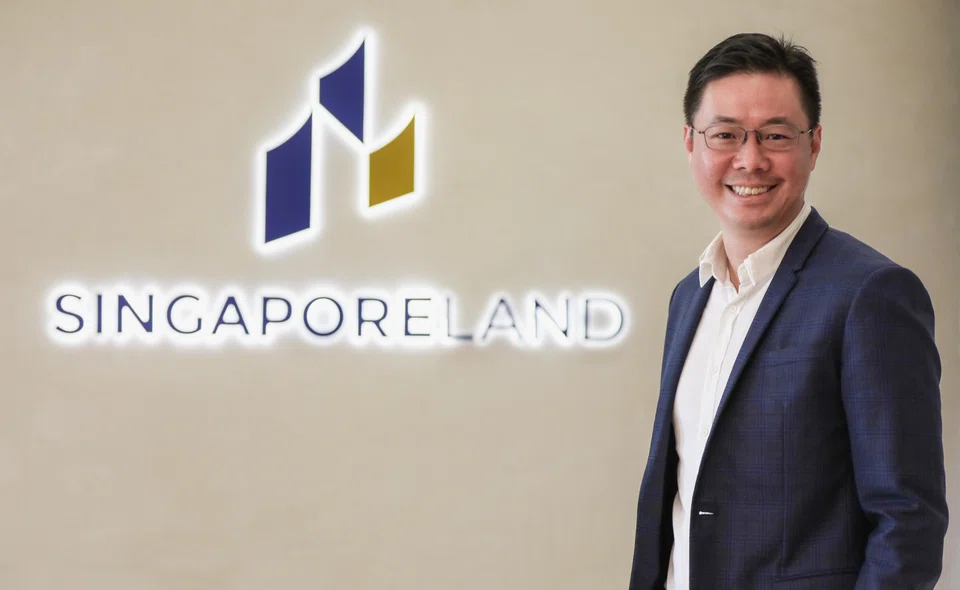
JONATHAN Eu, the chief executive officer of property developer Singapore Land (SingLand), believes that green buildings will increasingly be seen as a “prerequisite” for tenants seeking office space.
Having a sustainable workplace, he says, will become a major criterion for companies looking to attract and retain talent. And he has the numbers to back this up.
At the Singapore Land Tower office building at Raffles Place, for example, asking rents per square foot were “firmly” in the single digits before its S$160 million asset enhancement initiative began.
Rents are now “very comfortably in the double digits for all floors”, Eu said in an interview with The Business Times.
A major retrofit of the Singapore Land Tower is almost complete after three years of extensive asset enhancement works.
Built in 1980 and located in the heart of the Central Business District, Singapore Land Tower will see more lush green spaces, energy-efficient features, a double-glazed facade and new tenant amenity spaces after the retrofit is completed.
While he declined to share exact occupancy rates, he said committed occupancy was “north of 80 per cent” in September. This is up from 74 per cent as at end-2023 and 65 per cent in 2022.
Eu said: “We’ve had very positive reversions in terms of rental, and it’s exceeded a lot of our underwriting. Our committed occupancy, looking forward, is very healthy and strong.”
A decision was made to retrofit the building instead of redeveloping it after SingLand conducted an embodied carbon impact study. The study involved looking at the impact of both options on the group’s carbon emissions.
In 2022, the Singapore Land Tower was certified Green Mark Platinum for its improvements in energy efficiency through upgrading of chiller plants.
“Globally, there is a very clear differentiation between buildings that re-invest in the right way and have the right environmental, social and governance (ESG) credentials in their buildings,” Eu said.
“The quality and profile of the tenants that go into those buildings and the corresponding rents they are willing to pay in those buildings (are) very different from those which are from the secondary stock.”
There may be an increasing number of tenants who would like to know their utilities consumption and carbon footprint, Eu said.
While tenant usage data is widely shared in some countries such as the United Kingdom and Australia, this is not currently required in Singapore. The group is assessing how it can better track and share such data.
As part of asset enhancement works, Singapore Land Tower has been retrofitted with two floors of tenant amenities spanning 22,000 square feet (sq ft).
Operated by The Executive Centre, the space – dubbed The Exchange – comprises an auditorium which can accommodate 200 people, large and small-format meeting rooms, four large private offices and 150 hot desks. The two floors have opened progressively since 2023.
When asked about the demand for co-working spaces, Eu said the industry remains relevant even though some consolidation is to be expected.
He added: “Depending on how you play in the co-working space, you’ll have different levels of success. As an end-user, there will be people who say they need transition (or a) smaller space and don’t want to go to a landlord because they don’t know how much time they will (spend) there.”
Resilient office subsector
The broader office market in Singapore has been largely “resilient and stable”, Eu noted.
While some right-sizing might have taken place, with Singapore’s reopening post Covid-19 as well as how the city-state has positioned itself, the market has maintained a very healthy level of office demand, he said.
“If you look at quality vacant stock, our view is that it doesn’t matter which micro market you are in. If you have a high-quality building with the right idea of what your end clientele is, you will have an ability to attract the right profile of tenants.”
Another major asset owned by the group is Clifford Centre, which is undergoing redevelopment that is expected to be completed in the second half of 2028.
The 999-year leasehold site in Raffles Place will be redeveloped into more than 500,000 sq ft of commercial and retail space, which is about a 34 per cent uplift in gross floor area.
“We are going to incorporate everything from biophilic design (to) tenant amenity spaces and community engagement spaces,” Eu said.
SingLand is one of the 10 founding stakeholders of the Raffles Place Alliance, which was part of a programme by the Urban Redevelopment Authority to transform public spaces in the area.
Eu said: “Most Central Business District areas hollow out after a certain time so they are trying to do a healthy mix of re-introducing a live-in population and also creating spaces that can be activated once people leave work.”
At Marina Square, a stone’s throw away, SingLand is exploring adding homes to the massive mixed-use development.
Last August, it had proposed to rezone a portion of the development from “hotel” to “residential with commercial at first storey”.
When asked for an update on the site’s potential redevelopment, Eu said plans are still “cooking”.
“It’s a complex site – we have three hotels and a mall. It’s a discussion we’ve been having for a period of time. We are hopeful that we are closer to a finishing line of what’s possible there.”
Living in the Marina Bay area may not be the primary option for a young Singaporean family with children who have to consider where to send them to school and other factors beyond price, said Eu.
“But I do think there are people who like the centrality and the allure of being close to work and also having amenities which are accessible and close by,” he added.
“Retail in Singapore is quite resilient because of the mixture of domestic support during Covid-19 and tourism. From our own portfolio, we have seen that in terms of footfall, rents and new tenants, I think that’s been very encouraging.”
For example, he pointed to West Mall’s ongoing asset enhancement which is expected to complete in the first half of 2025. Eu said: “That’s another exciting example of us adding new space and beginning a slow repositioning of the asset because we see Tengah as a new town that’s nearby which may change the profile of tenants in West Mall.”
Overseas footprint
The group is also looking to venture beyond Singapore, and will be looking at opportunities both together with parent company UOL and on its own.
There are opportunities now, given that the interest rate environment is beginning to normalise, Eu said.
SingLand and UOL in October announced their joint purchase of a 50 per cent stake in 388 George Street in Sydney for a consideration of A$460 million (S$405 million). The building is a 30-storey commercial building, comprising a mix of office and retail.
London, Sydney and Melbourne are key gateway cities where UOL or SingLand already has a presence, so it would be a “natural starting point” to look at these cities, Eu said. However, the group is not limiting itself to those locations.
SingLand’s primary focus for its acquisitions would be commercial office-led, but the group is not ruling out other asset classes, he added.