SingPost banks on e-commerce as Covid-19 hits other business segments
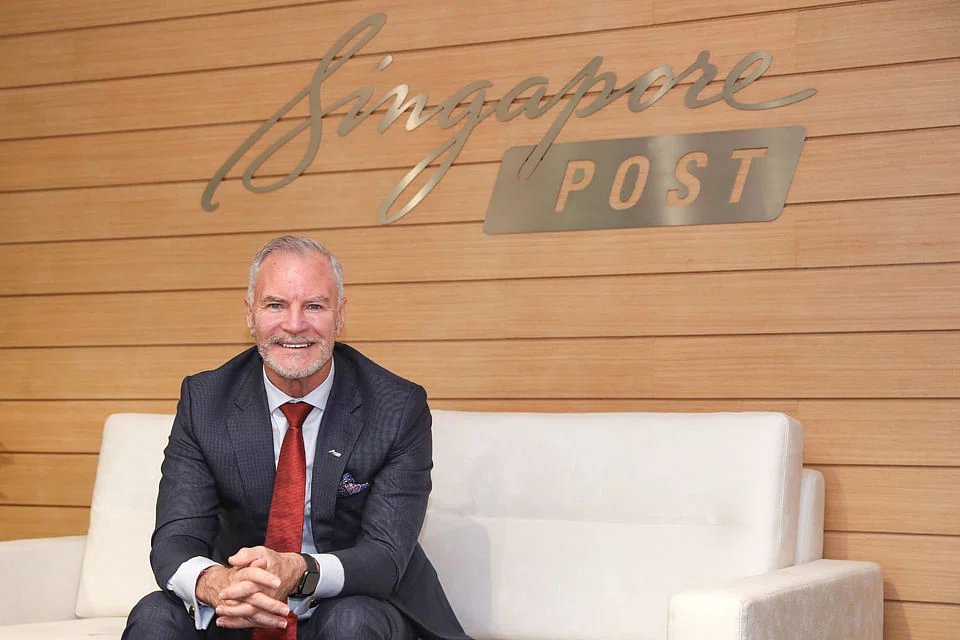
CEO Paul Coutts is unfazed about intensifying competition as he believes that can help grow a bigger pie for all players.

Singapore
LIKE many other firms, Singapore Post saw its net profit drop sharply due to the Covid-19 pandemic, but group chief executive Paul Coutts sees some of the disruptions as temporary shifts, remaining sanguine about the postal service provider's future.
The mainboard-listed company posted a 47.7 per cent fall in full-year net profit to S$47.6 million for the fiscal year ended March, down from S$91.1 million the previous year.
Speaking to The Business Times, Mr Coutts attributed the deterioration of its financial performance to several "crunch points".
One major cost comes from having to provide accommodation to its Malaysian workers who have been based in Singapore after border closures meant they could no longer commute between the two countries daily anymore. Another reason is the hike in terminal dues, which is paid to postal unions for delivering its products overseas.
The third "significant" cause comes from the loss of SingPost's international post and parcel business, due to the curtailed air capacity at Changi Airport, which served as a transshipment hub for products to be delivered to a third country.
"We just couldn't move the business into Singapore, and therefore, that was a choke point for us, which meant that the product, which is a very healthy-margin product for us actually kind of disappeared," said Mr Coutts.
Calling this a "major cause for concern", Mr Coutts also displayed confidence this business will be back once capacity at Changi Airport resumes, even though he concedes that many customers have had to find alternatives in the mean time.
Asked if he is concerned they will shift to these alternatives permanently, Mr Coutts said: "Those customers use Singapore because of safety, because of security and because it's a very efficient and attractive hub from a transshipment perspective - those key things, I don't believe have changed ... but of course, we can't take anything for granted.
"We have to go back out there very aggressively when we see things starting to open up again and convince those customers that those are compelling reasons to come back."
In the short term though, these challenges are expected to remain, going into the next quarter or even half year, particularly since Changi Airport is not expected to operate at full capacity any time soon, thus creating a squeeze in supply that will continue to drive costs up into the foreseeable future, Mr Coutts said.
"But what we are continuing to do is to engineer our cost base on an ongoing basis to make sure that we're squeezing our costs down as best as we possibly can at the same time as we're seeing rising costs perhaps in some other areas," he said.
One example is in driving automation which has helped to reduce unit costs in SingPost's Australia operations, even if the company has had to keep labour costs due to the increased volume, he said.
Similarly in Singapore, the company has re-engineered its automation processes, which has helped to reduce its operational costs, he said.
In fact, its next-generation smart letter box PostPal, which is currently on a one-year trial at Block 202 Clementi Avenue 6, is meant to help raise productivity and efficiency for the company, he added.
Mr Coutts is clear about what constitutes permanent structural shifts versus the temporary ones caused by the pandemic. The reduced capacity at Changi Airport is a temporary shift that Mr Coutts believes will be resolved when air travel returns.
Similarly, the impact on SingPost's property business brought about by reduced footfall is likely to be alleviated as the economy makes a recovery in the post-pandemic world, he said. The group's property segment saw a 4.7 per cent dip in revenue to S$115.4 million for the full year, due to rental rebates for eligible tenants and lower receipts from carpark and atrium sales.
"There are definitely permanent structural shifts that have taken place in the last 12 months or so and everybody needs to adapt to that pretty quickly, but they also need to reposition themselves as well for the new world, and that's what we're focused on," he said.
But what he considers a permanent shift is the accelerated decline of letters that had emerged during the pandemic. As more companies transform their internal processes and digitalise, they have also come to rely less on using physical letters.
"We've seen this on an ongoing basis with the decline in letters - it doesn't come back. Once it's gone, it's gone," said Mr Coutts, noting that this phenomenon has been observed in every other market. "It's something that we've factored into our plans for the future, so the good thing is that it's not a surprise as we know it's going to happen. The question is always going to be, at what point does that start to bottom out," he added.
This is the reason SingPost is aggressively driving its e-commerce market share and getting more volume through the door, since this is the element that will fill the gap, he said.
Asked about the intensifying competition in the e-commerce space from logistics startups as well as government-owned services like the nationwide parcel delivery locker service Pick Network, Mr Coutts was unfazed, believing that competition can help grow a bigger pie for all players.
Referencing his previous experience with DHL, Mr Coutts said: "The lesson for me was those competitors I'd say brought a completely new approach to the market, and we had to step up our game to be able to compete with the new market entry."
He said those competitors helped to raise the whole profile of the industry, which grew the market "exponentially". This meant that while they neither gained nor lost market share, they had a much bigger market overall, and consequently, a much bigger pie.
"Pick is a more regulated environment, but I do think the infrastructure play they're putting in place is great for consumers. It actually does have somewhat more of a natural synergy in terms of PostPal and our infrastructure. I think both can exist alongside each other really well and actually leverage from each other pretty well," said Mr Coutts.
One lucrative overseas market for SingPost is Australia, where its last-mile delivery business has been a fast-growing segment; its Couriers-Please reported a 50.3 per cent growth in revenue for the full year.
"The good thing about Australia is not only is the e-commerce penetration high, but it's also still actually really fast-growing," said Mr Coutts, noting that part of this comes from the increased volume in online shopping as a result of the pandemic.
SingPost's recent investment in Freight Management Holdings, a fourth-party logistics (4PL) service company, will help the company to make further inroads Down Under, alongside CouriersPlease, which is a third-party logistics (3PL) provider, he said.
"So we have a 4PL and 3PL hybrid type approach to the market. It's a winning formula for us and also gives us the ability and another element of our strategy of not only getting into B2B (business-to-business) and B2C (business-to-consumer), but also B2B2C ... an end-to-end supply chain solution for the market," said Mr Coutts.
Beyond Australia, SingPost also considers the South-east Asia market an attractive one, given that Singapore holds a strong position as the primary gateway for the region.
The postal network remains critical, with 70 to 80 per cent of e-commerce products delivered to date going through the network, he said.
"So having those postal agreements with our Asean colleagues is very critical for us in terms of those supply chain flows on e-commerce. That's only going to continue to grow - we see how quickly Indonesia, Malaysia and Thailand are going around e-commerce, and Singapore as well," said Mr Coutts, adding that SingPost is already "plugged into that growth curve".
But it's not about to build last-mile infrastructure in these countries, he said, given that there are already plenty of players providing good service at competitive rates. "We need to plug ourselves into the supply chain at origin, and we need to use Singapore as a transshipment point, and then we need to deliver that product into those markets in South-east Asia, and connect the supply chain to a broader ecosystem with a number of partners who can then give us the optimum solution in terms of delivery to consumers at the right price."