SingPost's e-commerce, logistics units show promise, but challenges remain

SINGAPORE Post (SingPost) reported an improved set of financial results for the half year to September, as its e-commerce and logistics businesses grew strongly amid the pandemic and skyrocketing freight rates.
During the 6-month period, the century-old national postal service provider's logistics business delivered revenue of S$379.5 million. This made logistics the group's largest top line contributor, overtaking its post and parcel business' revenue contribution of S$325.5 million.
SingPost's logistics revenue - contributed by e-commerce logistics and freight forwarding - was 29.6 per cent higher year on year. The increase was helped by a 63.3 per cent rise in revenue at the group's freight forwarder Famous Holdings on the back of higher sea freight rates.
At the operating profit level, contributions from the logistics business almost trebled year on year to S$16.2 million, as margins improved to 4.3 per cent versus 1.9 per cent for the same period last year.
Logistics was still only the second-largest contributor to operating profit though. SingPost's property business - specifically SingPost Centre - was the largest contributor here, pulling in S$26.6 million in operating profit for the period. With margins of 44.5 per cent, it remains a very profitable business segment for the group.
Meanwhile, revenue from the delivery of letters and printed papers, which is a sub-segment of the company's post and parcel unit, continued its downward trajectory.
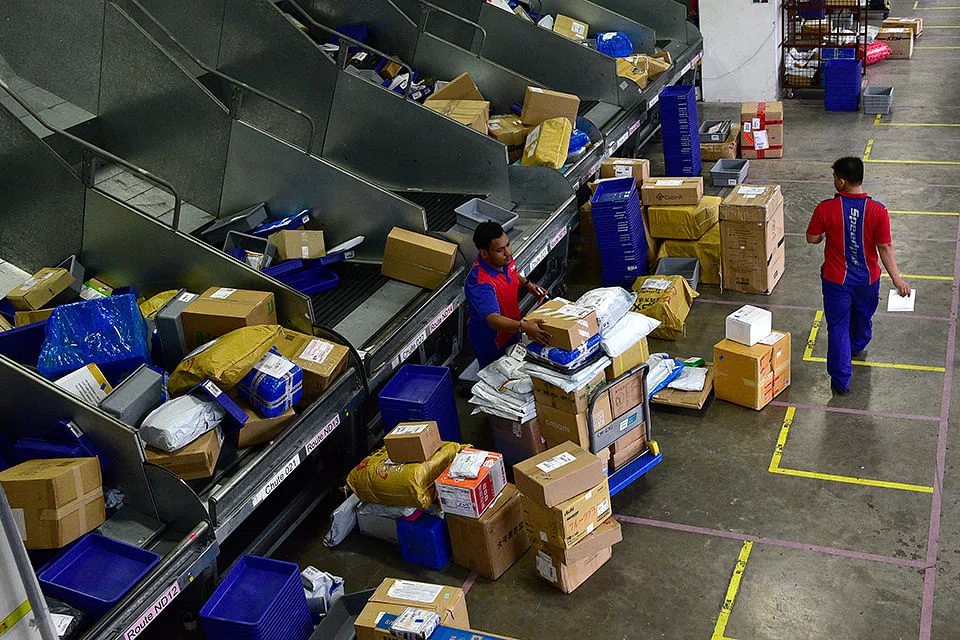
On the other hand, e-commerce logistics, which is another sub-segment of the post and parcel unit, has been growing fast. For H1 FY2022, it accounted for 40 per cent of domestic post and parcel revenue, up from 32 per cent during the same period a year ago.
SingPost noted that revenue growth from e-commerce logistics has more than offset the decline in revenue from the delivery of letters and printed papers for 4 straight quarters.
SingPost also stated that its e-commerce logistics business, including the operations in Australia, accounted for 55 per cent of its total revenue for the half year, as last-mile deliveries in both markets increased.
So, after its bottom line plunged 55.7 per cent to S$16.7 million in H2 FY2021, SingPost appears to have arrested the decline with the fruits of its investments in e-commerce and logistics.
SingPost's net profit was S$35 million for H1 FY2022, about 13.3 per cent higher year on year.
The big question is whether the group's earnings from e-commerce logistics will keep rising as competition intensifies and sea freight rates normalise.
For now, SingPost is increasing its footprint in Australia. For H1 FY2022, revenue contributions from the group's Australian units amounted to 19.1 per cent of total revenue, up from 17.2 per cent for the same period last year.
In contrast, revenue SingPost derived from Singapore shrank from 62 per cent to 51 per cent.
As it sees its Australian e-commerce logistics and freight forwarding business flourish, SingPost has announced that it will bring forward its plan to raise its stake in Australian fourth party (4P) logistics service provider Freight Management Holdings to 51 per cent from 28 per cent.
Making Freight Management Holdings a subsidiary could provide SingPost with the control it needs to better derive synergies and build scale to further capitalise on the e-commerce boom in Australia.
The Australian company provides integrated supply chain and distribution solutions to customers in Australia through a 4PL technology platform, matching customers' freight profile with the optimal carrier, thereby "increasing efficiency, utilisation and profitability" for both customer and carrier.
The acquisition, however, could stretch SingPost's finances. For H1 FY2022, the group's finance expenses were up 39.8 per cent year on year to S$7.1 million.
This means that 13.8 per cent of SingPost's latest reported operating profit was used to service debt - compared to 12.7 per cent for the corresponding period a year ago.
SingPost also noted its interest coverage ratio was about 12.1 times - sliding from 14.4 times a year ago.
With continued pandemic-related uncertainties, the company will need to ensure it has decent cash flows as well as adequate cash on its books.
SingPost's chief executive Vincent Phang said the firm's transformation of its business model will be done with its expenses, cash flow and liquidity being managed carefully.