

Singtel H2 net profit up 6.1% to S$1.1 billion, proposes final dividend of S$0.053


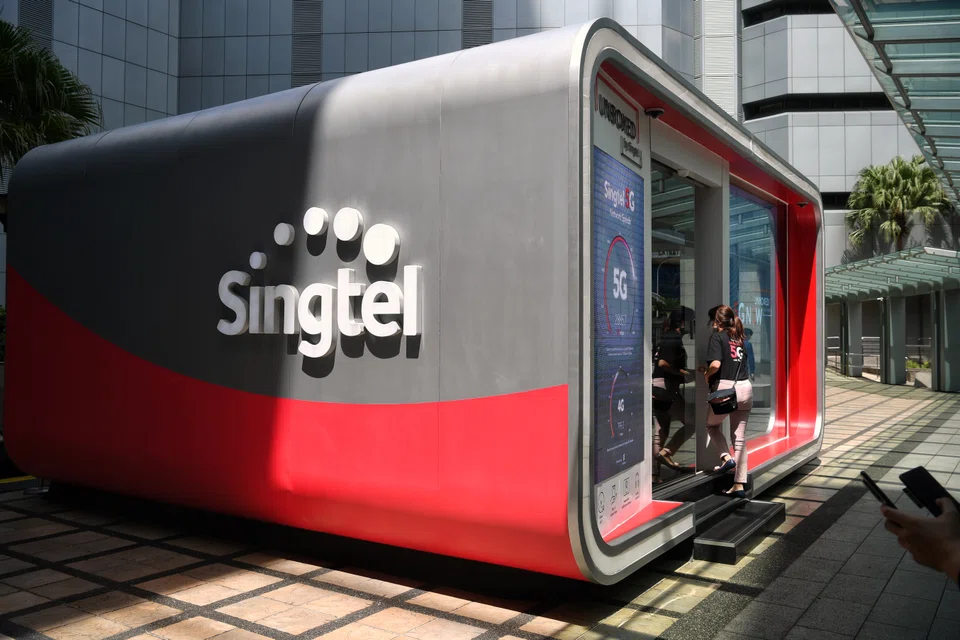
SINGTEL on Thursday (May 25) posted S$1.1 billion in net profit for the second half ended March, up 6.1 per cent from the S$994.5 million reported in the corresponding period the year before.
This came as the telco recorded growth in its mobile segment, price uplifts as international travel and roaming recovered, rising 5G adoption, and an increase in demand for information and communication technology (ICT) services.
The results translate to an earnings per share (EPS) of S$0.0639 for H2. The group’s net profit before exceptional items, or underlying net profit, for the second half stood at S$1 billion, up 11.5 per cent from S$941 million in the same period the previous year.
Operating revenue fell 4.2 per cent to S$7.4 billion from S$7.7 billion, due to the absence of migration revenue from Australia’s National Broadband Network (NBN) and contributions from Amobee, the digital marketing subsidiary which was divested in 2022. There was also a 7 per cent depreciation of the Australian dollar.
Excluding the contributions from the NBN migration and Amobee, operating revenue would be 5.9 per cent higher on a constant currency basis amid sustained roaming recovery, Singtel noted.
For the full year ended March, Singtel’s net profit increased 14.2 per cent to S$2.2 billion from S$1.9 billion, translating to an EPS of S$0.1348. Underlying net profit was up 6.8 per cent to S$2.1 billion, while operating revenue was down 4.7 per cent to S$14.6 billion.
The company noted the pre-tax contributions to profit from its regional associates grew 10 per cent to S$2.3 billion despite currency challenges.
Adjusting for the strength of the Singapore dollar relative to these currencies, their contributions would have increased by 15 per cent on Airtel’s “sustained growth momentum”.
Airtel had delivered double-digit increases in operating revenue due to higher mobile average revenue per user.
Singtel’s board has proposed a final dividend of S$0.053 per share to be paid on Aug 17 if approved by shareholders. Including an interim dividend of S$0.046 and a S$0.05 special dividend, the total dividend payout for FY2023 stands at S$0.149.
Positioning for growth
At Singtel’s earnings briefing, group enterprise chief executive Bill Chang said that he hopes to grow the company’s regional data centre business by recycling five of its oldest data centres.
Their power capacity could then be used to develop DC Tuas, the company’s upcoming data centre development with a lower power usage effectiveness ratio of 1.3. The plan is still pending regulatory approval.
In addition to the company’s earlier-announced plans to build new data centres in Thailand and Indonesia, this will increase its data centre capacity from the current 60 MW to about 155 MW by 2026.
Furthermore, the company is looking for local partners in Malaysia and Vietnam to build new data centres.
Chang said: “We really want to work with strategic partners who are from that country and who know that country very well, bringing our capabilities and the strategic partners to make sure that we can execute very fast.”
Chang is also optimistic about Singtel’s Paragon 5G multi-edge compute solutions, which the company is offering to other telcos in Asia, US, Canada and the Middle East to differentiate their 5G networks.
Multi-edge compute solutions place cloud-computing capabilities closer to the user, reducing the bottlenecks between where data from companies are generated and processed.
As for whether the digital infraco unit that was announced in April this year – which will hold both the Paragon platform and the regional data centre business – could be spun off, Singtel chief executive Yuen Kuan Moon said the company is still in the midst of building the unit up.
The consolidation of these physical infrastructure assets under one unit could also allow the company to look at the value of the business individually and ”unlock some of its value” in the future, he said.
Meanwhile, NCS’ Ng Kuo Pin is bullish about the ICT solutions provider’s ability to scale and grow its business across different geographies, such as in Australia, where it completed a number of acquisitions in 2021 and 2022.
Still, the business segment appears to have some ways to go in growing sustainably.
In the half year ended Mar 31, NCS’ operating expenses grew by 18.4 per cent, outpacing the 15.2 per cent in operating revenue growth that it posted over the same period. Staff costs accounted for the greatest rise in expenses, rising 46.5 per cent to S$577 million.
“I think we have to balance pricing and cost very carefully,” he said, adding that the company has been improving its “cost to serve”. This includes serving more clients overseas without the need to be physically present.
Singtel was trading on Thursday down 1.2 per cent or S$0.03 at S$2.53, as at the midday trading break.






