

Singtel’s interim dividend up 35%, H1 profit falls 42.4% to S$1.23 billion in absence of exceptional gain
Soft enterprise demand is expected to improve in the coming months, and data centre customers are paying reservation fees to secure limited capacity


SINGTEL’S net profit for the first half ended September fell 42.4 per cent year on year to S$1.23 billion from S$2.14 billion.
This was in the absence of a S$1.2 billion exceptional gain booked in the same period a year prior, for the issuance of Telkomsel shares to integrate Indonesian broadband provider IndiHome.
Underlying net profit, which is the basis of core dividend payout, grew 6 per cent to S$1.2 billion, from S$1.1 billion over the same period a year earlier.
On Wednesday (Nov 13), the telecommunications provider declared an interim dividend of S$0.07 per share, up from S$0.052 in H1 FY2024.
The latest dividend comprises a core dividend of S$0.056 per share and a “value realisation” dividend of S$0.014 per share, both of which will be paid out on Dec 9.
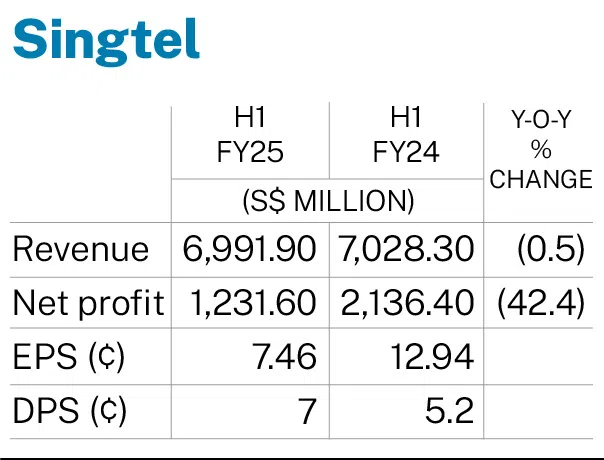
Operating revenue for the half year dropped 0.5 per cent to S$6.99 billion versus S$7.03 billion in the year-earlier period, which Singtel considered to be “stable” post the divestment of Trustwave.
Excluding associate contributions, earnings before interest and taxes (Ebit) grew 27 per cent to S$738 million.
The group attributed this to better mobile performance and disciplined cost management at Optus, as well as continued margin improvements and solid bookings at NCS, with Optus’ and NCS’ Ebit rising 58 per cent and 40 per cent, respectively.
Enterprise uncertainty
However, Singtel’s management noted that enterprise spend across both the Singtel Singapore business segment and the NCS business segment slowed in the half year.
Singtel Singapore’s half-year operating revenue declined 0.9 per cent year on year to S$1.9 billion due to softer information and communication technology demand in enterprise, as well as lower data and Internet revenue.
Meanwhile, NCS posted a 2.5 per cent year-on-year rise in half-year operating revenue to S$1.4 billion on a 7.8 per cent increase in revenue generated from its “Gov+” business group, while enterprise and “Telco+” revenue declined by 6.4 per cent and 8.5 per cent, respectively.
At the company’s earnings briefing on Wednesday, NCS chief executive Ng Kuo Pin said that across the Asia-Pacific region, macroeconomic headwinds have led market sentiment to soften in the last six to 18 months.
Still, he said that the situation may improve over the next six to 12 months. He added that the company has been investing in providing artificial intelligence (AI) and digital resiliency solutions in the enterprise space.
“A year ago, you would hear us talk about proofs of concept, but increasingly we are putting some of these (solutions) into real production systems with clients.
”In terms of absolute numbers, it’s still not there yet but the interest level is very high,” he said.
Meanwhile, Singtel Singapore chief executive Ng Tian Chong said that the business division is seeing pockets of growth within the enterprise space.
He said that multinational companies have approached Singtel to build software-defined networks that are global in nature. For instance, the company has worked with Nestle to build such networks, which are meant to connect the company’s different global offices.
Singtel group chief executive Yuen Kuan Moon said that in a more volatile and uncertain global environment, the company will have an opportunity to connect the East with the West as it has relationships with telcos across the world.
“Having that reach and connectivity will provide some global enterprise customers the ability to reach any parts of the world with our connections.
“This presents a new opportunity that previously may not be needed and we have to navigate this cautiously,” he said.
Delivering on growth
The company’s Digital InfraCo business posted an 8.2 per cent growth in half-year revenue to S$219 million. This came on the back of a 17.6 per cent growth in data centre revenue to S$169 million.
Tight market dynamics remain a boon for the company, said Bill Chang, chief executive of Digital InfraCo.
He said that the data centre business has been able to grow its revenue through customer reservation fees for new data centres, such as DC Tuas, which the company is still building. It is slated to come into operation in January 2026.
”Because (there is) limited supply, there are customers who demand it so strongly that they are paying reservation fees,” Chang said, adding that such fees are non-recurring.
He added that the unit has also grown revenue through rental price hikes when contracts come up for renewal, as well as passing through energy costs to clients.
Earnings per share for H1 FY2025 stood at S$0.0746, versus S$0.1294 a year prior. Shares of Singtel ended Wednesday trading S$0.03, or 1 per cent, higher at S$3.19.
TRENDING NOW

DBS, OCBC, UOB rout lops billions from STI as inflation, rate concerns spook investors

OCBC sheds S$8 billion in value as shares close nearly 6% down; analysts cautious on banks

IOI Properties and CapitaLand Investment closer to acquiring One Raffles Place in joint bid

Grab CEO’s wife Chloe Tong on life with Anthony Tan and finding her purpose

