

SK Hynix weighs closer ties with Japan’s memory industry
It is exploring ways to deepen cooperation with Japanese customers and suppliers in the sector
 Add BT as a preferred source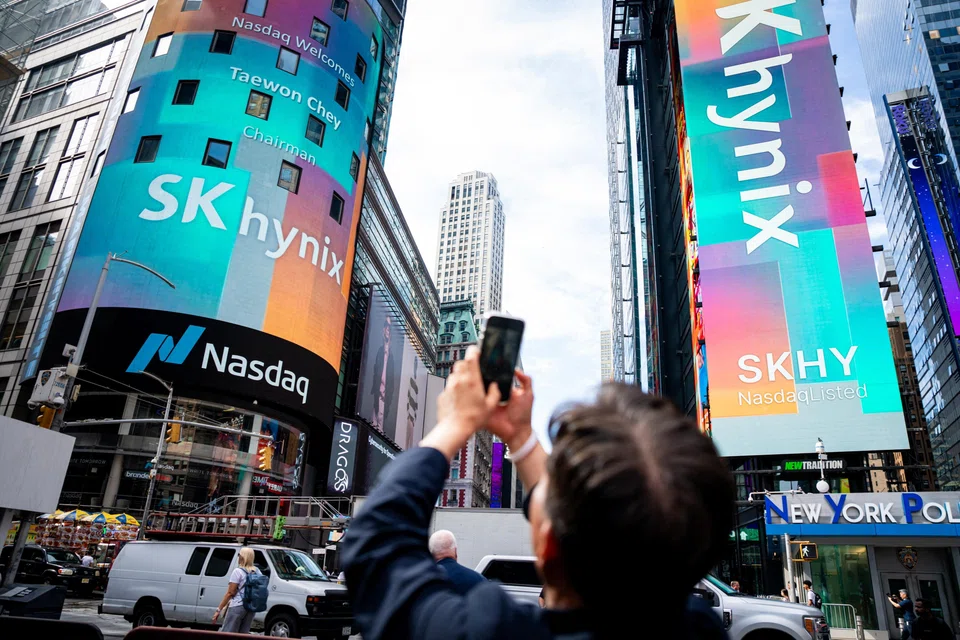
[SEOUL] SK Hynix is exploring ways to deepen its cooperation with Japanese customers and suppliers in the memory industry, chief executive officer Kwak Noh-jung said.
“We are very carefully looking at how we can co-develop the Nand flash market with our customers and suppliers,” he told reporters on Thursday (Aug 27) after a groundbreaking ceremony for a new US plant in West Lafayette, Indiana.
Kwak also said the South Korean chipmaker does not have “any fixed plans” for its significant indirect stake in Kioxia.
SK Hynix, the world’s second-biggest memory maker, is keen to contribute to the development of Japan’s semiconductor industry, much as it aims to do in Indiana, where it is investing more than US$4 billion, Kwak said. “It is our responsibility,” he added.
Indiana plant to be HBM hub
The company is building an advanced memory packaging facility in Indiana, marking a milestone in Washington’s expansive campaign to rebuild domestic supply chains and manufacturing capabilities in strategically important sectors.
The West Lafayette plant, occupying a 133.5-acre site, will be SK Hynix’s first high-bandwidth memory (HBM) packaging base in the US.
Its cleanroom is expected to open by October 2028, with mass production of next-generation HBM scheduled to begin in the second half of 2029, Kwak said at the event.
When fully operational, it will be a major HBM hub employing about 1,000 people, he said.
HBM is an indispensable part of the global artificial intelligence hardware boom, as the chips are needed in Nvidia’s advanced AI acceleration systems.


That has helped SK Hynix grow to become South Korea’s second most valuable company, right behind Samsung Electronics, which has also been lifted by runaway demand for HBM and other memory products.
Kioxia specialises in Nand flash memory, a type of storage that preserves data even when the power is switched off.
The Tokyo-based company’s shareholder structure shifted after former parent Toshiba reduced its stake earlier in August, making BCPE Pangea Cayman2, an investment vehicle for shares earmarked for SK Hynix, Kioxia’s largest shareholder with a 14.19 per cent stake.
SK Hynix holds bonds that can be converted into “substantially all” of the voting rights of BCPE Pangea Cayman2, according to Kioxia’s annual report. Kioxia identifies SK Hynix’s holdings as a risk factor in the report, citing the potential for conflicts of interest.
SK Hynix was part of the Bain Capital-led consortium that acquired Kioxia from Toshiba in 2018. Under the terms of that investment, SK Hynix agreed to keep its voting interest in Kioxia at 15 per cent or less until 2028 unless the Japanese chipmaker consents to a larger stake.
Asked whether SK Hynix could expand its investments in the US, Kwak declined to provide details.
He said the company remains open to investing in locations that can provide reliable access to power, water and skilled workers. “We are open to everywhere, but still, nothing is decided,” he said.
Kwak also said SK Hynix continues to review the possibility of listing its US Nand subsidiary, Solidigm.
Earlier in August, SK Hynix said Solidigm was considering “various measures to strengthen its competitiveness” after South Korean media reported that the company was pursuing a pre-initial public offering fundraising of between 5 trillion won (US$3.6 billion) and 10 trillion won.
SK Hynix said at the time that no decision had been made and that it would make another disclosure once details were confirmed or within one month. BLOOMBERG
Decoding Asia newsletter: your guide to navigating Asia in a new global order. Sign up here to get Decoding Asia newsletter. Delivered to your inbox. Free.
Share with us your feedback on BT's products and services
TRENDING NOW

Asia-Pacific aviation: is up really the only way?

Russia’s ‘pivot to Asia’ takes a turn as it prioritises ties with isolated regimes over bigger economies

Why disciplined stewardship matters when managing wealth in uncertain markets

More than 15,000 sign up for national accounting body’s AI programme in two months

