Smaller boutique managers winning private capital with localised knowledge
They also offer advantages such as greater flexibility and good exposure to particular sectors



BETTER value, local networks and specialised knowledge. These are some of the reasons smaller private markets might outperform even as the industry favours larger managers.
“It’s not really about the size of the manager; it’s about the skills of the manager,” said Robert Ides, co-founder of European real estate specialist Arete Investment Group. “I’ve seen mandates changing from large to niche managers.”
Ides’ firm, Arete, has partnered Singapore-based fund manager Euro Asia Asset Management to offer regional investors access to European industrial properties.
Karol Piovarcsy, Euro Asia’s chief executive, said the choice of a smaller manager was calculated to suit Asian investors seeking diversification outside their home markets.
“A smaller manager, as a diversifier, has higher flexibility and (can move) much faster than big, commingled funds,” Piovarcsy noted. “Your ability to generate alpha is way superior.”

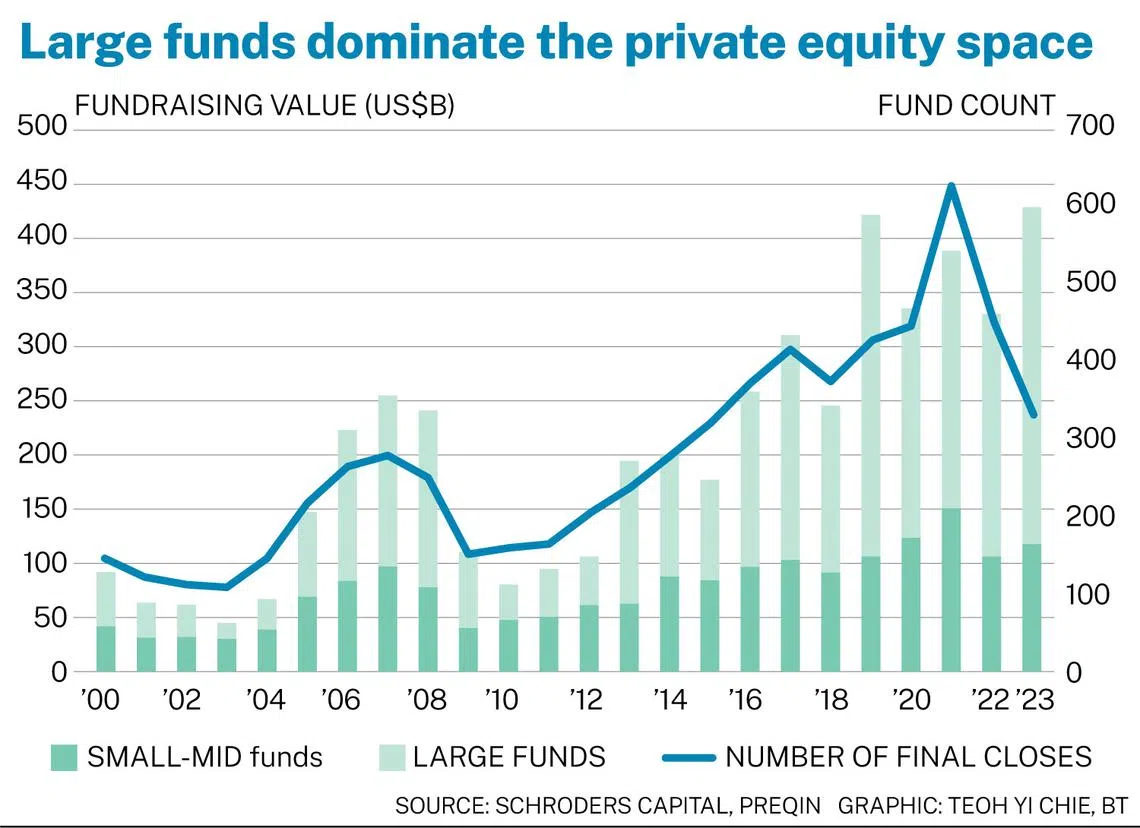
Piovarcsy is not alone in this opinion, but larger managers remain a dominant force. Limited partners (LPs), the entities that invest into funds run by general partners (GPs), prefer larger and more diversified GPs.
“We have seen a flight to quality over the last couple of years, during which LPs preferred to allocate to big, established and global blue-chip GPs, or top up GPs they had supported before,” said Ben Balzer, partner at Bain & Company.
“Smaller GPs found it more difficult to raise – especially if these were first-time GPs or those with a less established track record.”
Between 2010 and 2022, large players accounted for 42 per cent of money raised but 2 per cent of the total number of funds.
Chee Jiun Wen, head of private markets and alternatives at Bank of Singapore (BOS), said bigger is sometimes better.
“Private-market fund managers with larger assets under management typically have better means to invest in platform capabilities – for example, post-investment operating resources, technological infrastructure and risk management – that may help to enhance performance and governance,” he said.
The “scale of a fund manager is rarely evaluated in isolation”, though. The bulk of BOS’ partner GPs continue to be those with some scale, but Chee said boutique GPs may still boast some advantages.
“They may have the edge in flexibility and nimbleness, which may better position them to capitalise on dynamic market situations and opportunities,” Chee said. The small size of their funds may also lead them to be more selective – which could mean better performance, but also more volatility.
The boutique GPs BOS works with “tend to invest with a strategy (for example, technology or early stage) or a geographical specialisation”. They would also have strong track records – with a history of managing at least two funds prior – as well as an investor base with institutional oversight.

Boutique funds stand out
As big managers get bigger, more opportunities emerge for boutique managers to distinguish themselves.
Arete’s Ides has sensed a “significant” shift in his part of the private markets space over the last year. Cheap money made investing easier, he said, but higher interest rates mean managers now need to rely more on their experience and relationships.
For Arete, that experience includes intimate knowledge of European towns and cities.

Ainsley Lee, director and portfolio manager at investment manager Aura Group, said managing a smaller fund has meant that he is able to “chase opportunities that generally big investment managers can’t”.
The multi-asset fund he manages for Aura – which incorporates publicly listed assets to offer greater liquidity – also has a “heavy statistical process” that is possible because the fund has fewer holdings.
“As the fund grows, the way you manage it changes,” said Lee, who spent years managing very large endowment and superannuation funds. “Scale helps, but there’s also a downside to that.”
Lee is now using the network he built as a manager of large funds to access opportunities that might not be as readily available to other boutique managers, and offering what he calls an “institutional investment process” to the retail investor.
Networks are especially important in private markets, said Denny Goenawan, managing partner at South-east Asia-focused Indies Capital Partners.
His firm and its partners have been operating in Indonesia’s private credit market for years – “back when it was called other things”, Goenawan noted, and have become “a local partner of choice for global firms”.
Returns are higher in developing markets such as Indonesia; which are riskier, more complex and therefore less accessible. Indies’ relationships give it an edge in deal sourcing and structuring, he added.
Pram Kurniawan, a partner at Indies, said that even if deal structures can be copied on paper, they cannot always be executed. “There are nuances and customs when you negotiate with borrowers,” he pointed out. “In private credit, the borrower needs to be comfortable with you.”
Where smaller is better
Among LPs polled by The Business Times, localised knowledge topped the list of reasons to invest with a smaller manager.
Liam Coppinger, senior managing director and Asia head of private equity at Manulife Investment Management, said that boutique GPs are “an important part of our investment programme in South-east Asia”. “We find they give us good exposure to certain geographies and industry sectors, and offer the opportunity for outperformance and co-investment potential.”

As the private markets investment scene grows, however, boutique managers may also be a smarter investment.
Dr Rainer Ender, global head of private equity at asset manager Schroders Capital, noted that the flood of money into large funds has created an oversupply of capital in some parts of the market.
“There is lots of money chasing large investments and not much money looking for small and medium businesses,” he said. Yet, these larger businesses tend to perform much more similarly to publicly traded companies and would not reflect as much of the benefits of investing in the smaller businesses that constitute the bulk of the private markets.