Social platforms, crypto exchanges can help fight money laundering and fraud, say Fintech Festival panellists

They add that the transboundary nature of financial crimes make data sharing between jurisdictions tricky

Yong Jun Yuan
Published Thu, Nov 7, 2024 · 07:02 PM
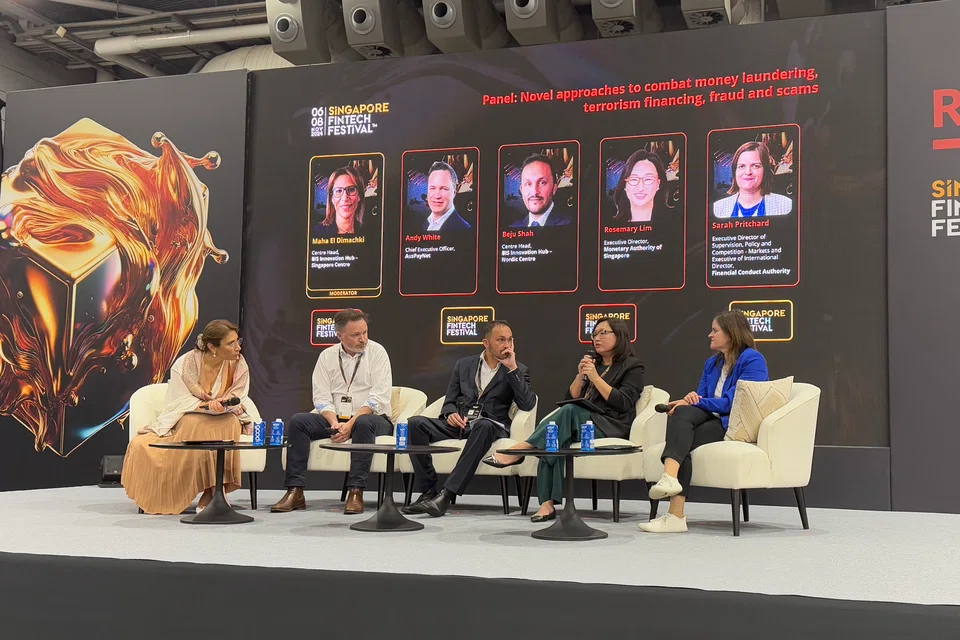
    • The panellists at the forum titled "Novel Approaches To Combat Money Laundering, Terrorism Financing, Fraud And Scams” at the Singapore Fintech Festival.
    • The panellists at the forum titled "Novel Approaches To Combat Money Laundering, Terrorism Financing, Fraud And Scams” at the Singapore Fintech Festival. PHOTO: YONG JUN YUAN

    A CALL went out on Thursday (Nov 7) for more industry sectors – specifically those which could be used by criminals to enable fraud and money laundering – to be roped into stopping fraud and tracking down illicit fund flows.

    A panel of four financial regulators and service providers, who were airing their views in a forum at the ongoing Singapore Fintech Festival 2024, identified social media networks and crypto exchanges as possible partners in the fight against such crimes.

    The panellists noted that progress has been made in some countries to involve parties beyond the financial regulators; in Singapore, for example, the telco sector has been included in the Shared Responsibility Framework for scams, but they added that still more can be done to engage other partners.

    Panellist Beju Shah, who heads the Bank for International Settlements (BIS) Innovation Hub Nordic Centre, said that a connected response involving telcos, social media companies and crypto exchanges is necessary, to connect the dots when crime is committed.

    Andy White, chief executive of Australian Payments Network (AusPayNet), said that perpetrators for half the scams in Australia use crypto to cash out their ill-gotten gains, which adds another layer of complexity to how they can be caught.

    He also said that although Australia’s national anti-scam centre started out as a voluntary arrangement and has created positive results, regulation is still needed to ensure that all parties in the life cycle of a scam are motivated to do the right thing.

    “If we could get there, then things like website takedowns, takedowns of malicious adverts and the prevention of phishing SMSes become much easier because those entities are incentivised (to do so).

    “You’re stopping these crimes at the source, rather than trying to deal with them by the time you get to a payment.”

    The panellists also pointed out that because of the transboundary nature of financial crimes, more needs to be done to ensure that data sharing between jurisdictions is feasible.

    Rosemary Lim, the executive director of Monetary Authority of Singapore’s payments department, said international understanding and best practices need to be first established, before businesses can be educated about their role in detecting financial crimes.

    “(Such efforts) do add some friction in the process, but if you were to be caught up in a major money laundering case, there could also be huge impact to your reputation and the way you are able to then continue doing business in future,” she said.

    UK Financial Conduct Authority executive director of markets and international Sarah Pritchard said data sharing is important, but that what is shared and the quality of data shared are also important, and to be considered as well.

    Speaking from her experience working in financial crimes compliance in a bank, she said that dated information culled for customer due diligence led to transaction monitoring alerts that were unhelpful.

    Of customer due diligence information that is not sound, she said: “Your customer is no longer the 12-year-old who opened the bank account, but is now in employment and earning a wage, so you don’t know what normal looks like.”

    She added that by keeping due diligence and basic information up to date, banks can get more accurate pings from their controls, instead of inaccurate pings based on old information.

    BIS’ Shah noted that while there are privacy-preserving federated learning techniques which enable for data to be shared without revealing sensitive individual information, such techniques are not perfect, and regulators will need to learn from their experience with these technologies.

    “That experimentation, working in cohorts with people, means that you can start getting to those details and understanding what risk controls you need and how far you can get. (You will also see) the effectiveness or efficiency of those (techniques),” he said.

    The three-day Singapore Fintech Festival 2024 being held at the Singapore EXPO ends on Friday. The official event website says more than 66,000 participants from 150 countries are attending the event. Participants include representatives of central banks and regulators, banks and financial bodies, government, fintech and technology companies, investors, advisory and professional services, think tanks and non-profit bodies.