

SoftBank tumbles after record profit fails to impress
 Add BT as a preferred source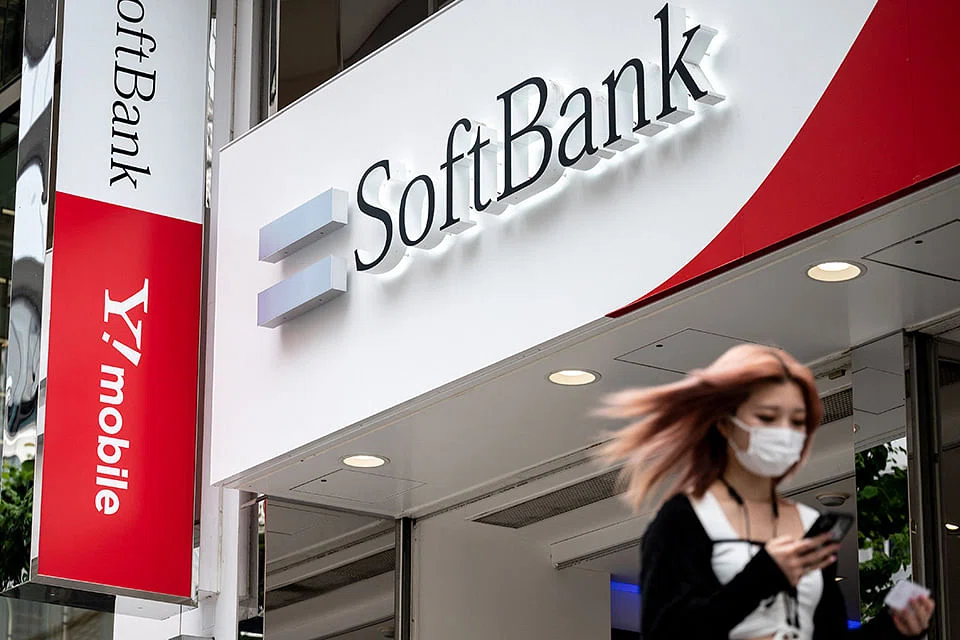
DeeperDive is a beta AI feature. Refer to full articles for the facts.
Tokyo
SOFTBANK Group Corp plunged by the most since the early days of the coronavirus pandemic after the Japanese company declined to pledge a continuation of buybacks that have propped up its stock.
Shares tumbled as much as 8.7 per cent on Thursday, the most on an intraday basis since March 2020, despite record profit in the March quarter. The company has lost more than 6 trillion yen (S$73 billion) in market value in the past three days. Investors are skittish about whether SoftBank will keep buying back its own stock after completing a 2.5trillion-yen allotment for repurchases.
"We believed that SoftBank would follow up its massive buyback with another one. But we are extremely surprised that it did not," Atul Goyal, senior analyst at Jefferies, wrote in a research note. "Without the buyback, SoftBank stock price is likely to reflect the performance of its listed investments."
SoftBank on Wednesday reported net income of 1.93 trillion yen for the three months ended March 31, the most ever for a Japanese company, with essentially all of that coming from its investment in the newly public Coupang Inc. That's nearly twice the 1-trillion-yen tally from the next highest Japanese company, Toshiba Corp.
In a presentation after results, founder Masayoshi Son argued that investors aren't giving him credit for the value he's creating at SoftBank. With holdings like Coupang and Alibaba Group Holding Ltd, the net asset value for the company is now north of 15,000 yen a share, he said, more than 70 per cent higher than the current share price. "In simple terms, they're undervalued," Mr Son said.
Navigate Asia in
a new global order
Get the insights delivered to your inbox.
SoftBank's Vision Fund investment arm went from being the source of the biggest loss in SoftBank's history a year ago to the main driver of earnings, with a 2.3-trillion-yen profit in the March quarter. The rally in tech shares boosted Vision Fund profits to three consecutive records, raising the value of holdings in the likes of Uber Technologies Inc and paving the way for public listings from startups such as Coupang and DoorDash Inc.
What's really driven SoftBank shares though, has been its buybacks. Beginning in March of last year, Mr Son announced he would sell assets and repurchase 2.5 trillion yen of his own stock.
SoftBank said on Wednesday it has spent all of the money it has allocated - and investors have been anticipating more buybacks. But Mr Son didn't commit to further repurchases.
Mr Son tried to keep the attention on his startup successes. Coupang, the South Korean e-commerce leader, contributed US$24.5 billion to Vision Fund's profit in the fourth quarter. Auto1 Group SE, a German wholesale platform for used cars which went public in February, contributed US$1.8 billion of the gains, while Uber posted a US$200 million loss.
The Japanese conglomerate doesn't have to sell equity holdings to book income, so most of its profits are unrealised.
"The discount SoftBank is trading at, around 30 per cent, has widened again in recent months, but it's a far cry from the gap that Son has railed against historically," said Kirk Boodry, an analyst at Redex Research in Tokyo. "I get his points, but the last two years have shown there can be extreme volatility in returns and little agreement on future prospects."
Mr Son has said that SoftBank could see between 10 and 20 public listings a year. Grab Holdings Inc will go public in the United States by July through the largest-ever merger with a blank-cheque company, valuing the South-east Asian ride-hailing and delivery giant at about US$40 billion.
Its Chinese counterpart Didi Chuxing has filed with the US Securities and Exchange Commission for an initial public offering that could value the company as highly as US$70-100 billion.
SoftBank has a portfolio of 224 companies across three different funds as at end-March. But tech stocks are sliding globally as investors contend with higher US bond yields and concerns about stretched valuations.
Mr Son did take a victory lap in touting his returns so far. He said that limited partners in the first Vision Fund now have a blended internal rate of return (IRR) of 22 per cent, compared with negative 1 per cent a year ago. SoftBank's own IRR for the fund is 39 per cent, while its IRR for the second Vision Fund is 119 per cent.
SoftBank also boosted the capital committed to its Vision Fund 2 to US$30 billion, up from US$20 billion.
Mr Son's controversial programme of trading options cost him during the quarter. The company posted a 33-billion-yen derivatives loss in the period. While the overall profit in the asset management arm was 46 billion yen in the period, the business still posted a full-year loss of 67 billion yen.
SoftBank held a total of US$19.9 billion of "highly liquid" securities as of the end of quarter, including a US$6.2 billion investment in Amazon.com Inc, US$3.2 billion in Facebook Inc and US$1 billion in Microsoft Corp. The operation is managed by its asset management subsidiary SB Northstar, where Mr Son personally holds a 33 per cent stake. BLOOMBERG
Decoding Asia newsletter: your guide to navigating Asia in a new global order. Sign up here to get Decoding Asia newsletter. Delivered to your inbox. Free.
Share with us your feedback on BT's products and services
TRENDING NOW

Shelving S$5 billion office redevelopment plan proved ‘wise’ as geopolitical risks mount: OCBC chairman
OCBC is said to emerge as lead bidder for HSBC Indonesia assets

Middle East-linked energy supply shocks put Asean Power Grid back in focus

Eurokars Group introduces rental car franchises Enterprise Rent-A-Car, National Car Rental, and Alamo to Singapore

