Solar cable project to help cut Singapore's emissions, boost electricity supply

SINGAPORE'S ongoing adoption of renewable energy sources and its commitment to mitigate climate change - against the current backdrop of the ongoing global climate conference COP26 - will be given a substantial boost by the Australia-Asia PowerLink (AAPowerLink) project, connecting Singapore to a solar farm Down Under.
The project, expected to begin supplying Singapore in 2027, is tipped to significantly cut the nation's greenhouse gas (GHG) emissions and provide up to 15 per cent of its total electricity needs every year.
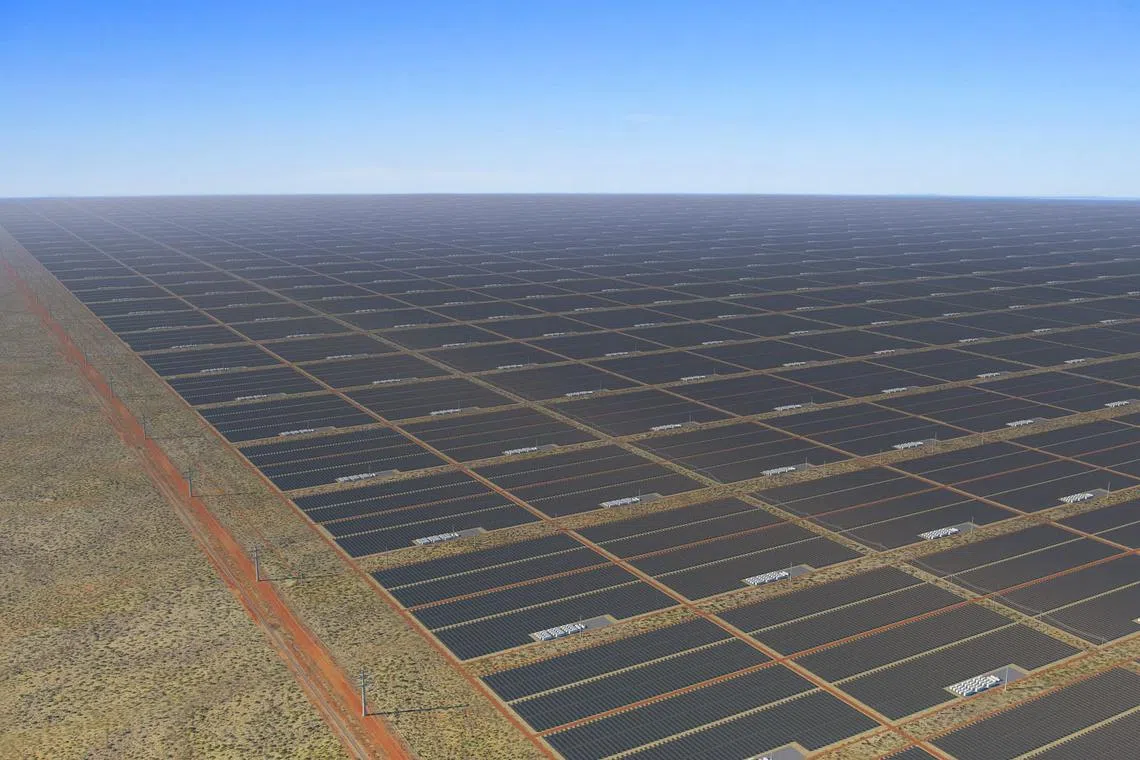
AAPowerLink, headed by Australia's Sun Cable with the participation of 5 industry giants including Singapore's SMEC, will connect the Republic via a 4,200 km subsea cable to a high-capacity solar generation, storage and transmission system that will transmit large volumes of renewable electricity from Australia's Northern Territory to Darwin (Australia) and Singapore markets.
"The AAPowerLink will provide Darwin and Singapore with high-quality, dispatchable renewable electricity supply," said Fraser Thompson, chief strategy officer of Sun Cable.
Construction is expected to take 4 to 5 years and could start in early-2024. Supply of power to the Northern Territory is scheduled to begin in 2026, with supply to Singapore expected in 2027; the system is expected to be fully operational by the end of 2028.
"Currently, about 95 per cent of Singapore's electricity is generated from natural gas, resulting in GHG emissions and also exposing Singapore to large volatility in prices, as seen recently with the large spikes in prices.
"This project alone can reduce Singapore's 2030 emissions by over 6 MtCO2e (metric tonnes of carbon dioxide equivalent), which is more than Singapore currently requires to meet its 2030 Paris Agreement commitments for emissions reductions," Dr Thompson said.
The Paris Agreement was inked by 196 parties in 2015; they agreed to limit global warming to between 1.5 and 2 degrees Celsius, compared to pre-industrial levels, by cutting their GHG emissions until they reach net-zero by 2050.
It works on a 5-year cycle of increasingly ambitious climate action carried out by signatories, known as Nationally Determined Contributions (NDCs); its next key milestone is this year's COP26, the 26th Conference of the Parties (COP) to the United Nations Framework Convention on Climate Change (UNFCCC), currently being held in Glasgow, United Kingdom.
Singapore in March 2020 had submitted its enhanced NDC to the UNFCCC: it stated an absolute emissions target to peak emissions at 65 MtCO2e around 2030. Singapore's long-term Low-Emissions Development Strategy (LEDS), also submitted to the UNFCCC, builds on its enhanced NDC by aspiring to halve emissions from its peak to 33 MtCO2e by 2050.
Singapore's total emissions were approximately 52 MtCO2e and 0.1 per cent of global emissions in 2018.
Beyond climate-change mitigation, the AAPowerLink is also expected to significantly add to Singapore's power needs, while helping to attract investment.
"The AAPowerLink is capable of providing up to 15 per cent of Singapore's total electricity needs every year, commencing in 2027. It will contribute to the security, reliability, and affordability of Singapore's energy supply by increasing Singapore's access to clean electricity that is reliable, stable and competitively priced," Dr Thompson said.
"Beyond these benefits, the project can also help the Republic attract foreign direct investment. Increasingly, key sectors like data centres and semiconductors are requiring 100 per cent renewable electricity for their operations. This will become the new 'license to operate' in many sectors and, by providing this renewable electricity to Singapore, this makes the Republic well placed to capture that investment.
"This renewable electricity can also help support Singapore's shift to electric vehicles and the country's 30 by 30 food security strategy, which requires support for energy-intensive processes like vertical farming," he added.
Sun Cable announced recently that it is open to expressions of interest from customers in Singapore who are keen on dispatchable zero-emission electricity. "Sun Cable is engaging with commercial and industrial power users in Singapore with strong emphasis on meeting their sustainability targets, and so far, the enthusiastic response from these power users is an indication of a strong demand for renewable power in Singapore," Dr Thompson said.
Singapore's SMEC, a global specialist engineering and design consultancy and a member of the Surbana Jurong Group, will focus on the generation side of AAPowerLink; it will contribute design leadership and technical expertise to the development of a 12,000-hectare solar farm.
Surbana Jurong Group is helping to facilitate the project through early-works preparation that includes mapping out the regulatory approvals required to tie Sun Cable's solution into the Singapore grid, as well as providing technical services for receiving infrastructure such as voltage source converters, substations and subsea cables for landing the power in Singapore.
The other parties in the project are: American engineering, construction and project management company Bechtel, which will manage the project delivery; global engineering, project management, and professional services company Hatch, which will manage the undersea high-voltage direct current transmission system; global insurance broker and risk adviser Marsh, which will be in charge of risk management; and professional services firm PwC Australia, which will take charge of project advisory.
READ MORE:
- BT Explains: What is COP26 and how will it affect you?
- BT Explains: What is 'net zero'?
- Greening Asia's economies will cost over US$12 trillion: ING report
- G-20 leadership needed to manage climate crisis: PM Lee
Decoding Asia newsletter: your guide to navigating Asia in a new global order. Sign up here to get Decoding Asia newsletter. Delivered to your inbox. Free.
Copyright SPH Media. All rights reserved.