

South-east Asia’s private equity landscape demands more of managers
Investors who hope to profit from the Asean story may need to seek out specialist managers with the ability to close deals and even build market leaders from scratch


PRIVATE equity’s (PE) under-representation as a source of capital in South-east Asia is partly a reflection of the challenges that managers face in hunting for and securing targets.
As the region’s economic growth continues to accelerate, investors who hope to profit from the Asean story may need to seek out specialist managers with the ability to close deals and even build market leaders from scratch.
Data compiled by Bain shows that PE and venture capital (VC) investment value in South-east Asia is 0.2 per cent of gross domestic product. In Japan and South Korea, PE investment is 1 per cent of GDP. In North America, it is 0.7 per cent. The figure for Asia-Pacific is 0.4 per cent.
PE/VC deal value in South-east Asia is 10 per cent of all mergers and acquisitions. The equivalent figures for Japan, South Korea, North America and Apac are 34 per cent, 33 per cent, 14 per cent and 19 per cent, respectively.
Vish Ramaswami, partner and head of Apac private investments at investment advisory Cambridge Associates, said one possible reason for South-east Asia’s lag is the relatively higher growth rates in the region’s economies.
“Japan, Korea and Australia are generally straight buyout markets as these are more mature markets,” Ramaswami said.
In buyouts, PE managers acquire whole or controlling stakes and aim to generate returns typically with a combination of leverage, acquisitions and improving efficiencies.
In comparison, South-east Asia’s PE activity is dominated by growth equity strategies – which is when PE funds a fast-growing company in exchange for a minority stake.
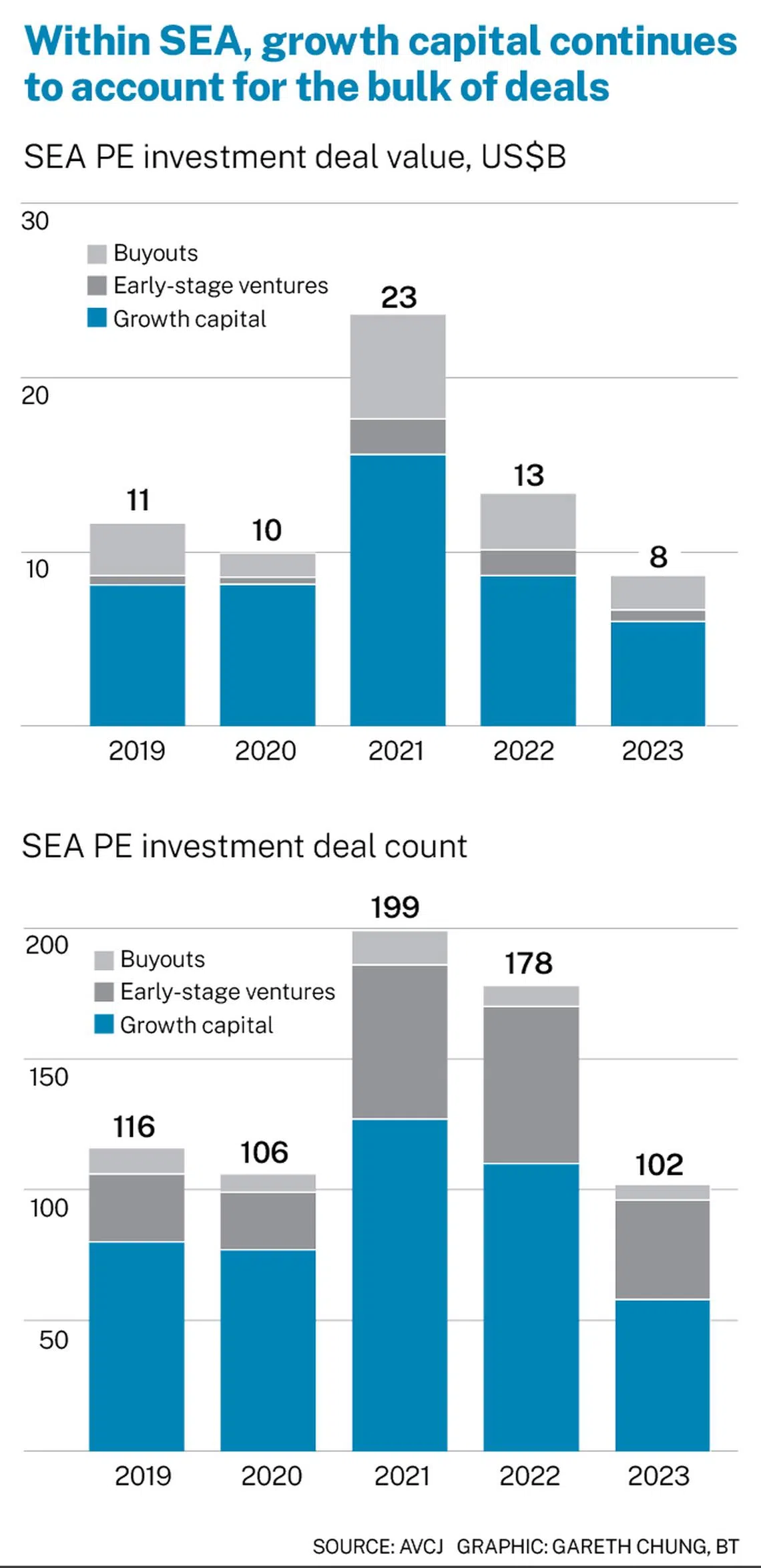
“Many South-east Asia economies are high-growth economies, meaning deals are more likely to be unlevered growth equity for minority equity ownership,” said Ramaswami. “Controlling shareholders often want to grow their companies bigger rather than sell control.”
As the two strategies are quite different, deals are not strictly comparable and managers may require different skills.
In developed markets, Ramaswami said, “managers that can create value in a period of slower economic growth, higher leverage costs and a tightening capital-market environment will be key to generating attractive returns for investors”.
In South-east Asia, the difficulty is finding the right business and then getting a foot through the door.
Abrar Mir, co-founder and managing partner of healthcare-focused PE firm Quadria Capital, said that unlike in the developed markets, South-east Asia does not have as many active intermediaries – parties that shop deals around.
“Here you have to hunt,” Mir said. “You have to go and convince, explain why you are a good partner.” Owners of strong and attractive businesses typically do not need funding, he added.
“(The owner) might say: I eat three times a day. Even with your money, I’m not going to eat four times a day,” Mir said. “So we have to be very specific about what value we are bringing.”
For Quadria, that is sometimes access to innovation, new markets or new products – made possible because of its industry-focused approach to investing.
Through Quadria’s partnerships in the US and Europe, for instance, it was able to help a portfolio company secure manufacturing rights for new products – leading to significant increases in revenue and profits.
James Chern, managing partner and chief investment officer of infrastructure-focused PE manager Seraya Partners, said being local also matters.
“Effective communication, trust and networking are crucial for sourcing deals, negotiating and working with deal partners,” Chern said.
“Sharing the same language, culture and network generally makes it easier to establish trust, rapport and effective communication. Therefore, local managers often have an advantage over foreign managers. This holds true not only in South-east Asia but also in the United States, Europe, South America, and other parts of the world.”
Having decision makers on the ground who can react swiftly and align with real-time market dynamics, and who understand individual market differences, can also be an advantage, Chern added.
Such localised advantages are also the reason why local conglomerates, families and government-linked companies are dominant players in much of South-east Asia’s economy.
Within its chosen infrastructure space, Seraya is therefore focusing on what it calls “next-generation infrastructure” – infrastructure related to low-carbon energy and data centres.
“These sectors are new, and not within the domain expertise of incumbents,” Chern said. “More importantly, our strategy of building platforms from scratch is unique as it combines infrastructure sector expertise with PE buyout governance, PE growth goals and a venture capital approach of supporting strong entrepreneurs and management.”
In the PE space, a platform approach generally means buying an initial company and using it to acquire more companies. Some PE firms may also start a company, which is what Seraya has done.
“Since the next-generation infrastructure sector is new, there are few companies to invest in or buy. This is why we need to create and build these companies from scratch,” Chern said.
Seraya is able to hand-pick all members of management, start with a clean slate and avoid overpaying for acquisitions in expensive auctions.
Both Seraya and Quadria also emphasise the importance of the community.
“In South-east Asia, a win-win mindset and philosophy are essential,” Chern said. “This is a more culturally attuned way of doing business in Asia and reflects our local understanding of what it takes to be successful in the long run in our home markets.”
Mir said hospitals that it backs never turn patients away for pecuniary reasons. Its investment thesis for healthcare is to scale up, and generate returns from economies of scale.
“In every business that we have invested in, we have re-invested all of the profits to fund future growth.”
TRENDING NOW
32 companies, 6 individuals bag accolades at Singapore Corporate Awards 2026

He built the Vingroup empire. Now South-east Asia’s richest man is handing some key roles to his sons

URA to review guidelines on floor space to give developers more design flexibility: Chee Hong Tat

Chagee, Mixue and Luckin won the market. Sustaining their edge is the harder part

