Specialty chemicals giant Evonik trains sights on Asia, sustainability growth

Renald Yeo
Renald Yeo

Published Mon, Sep 4, 2023 · 05:00 AM
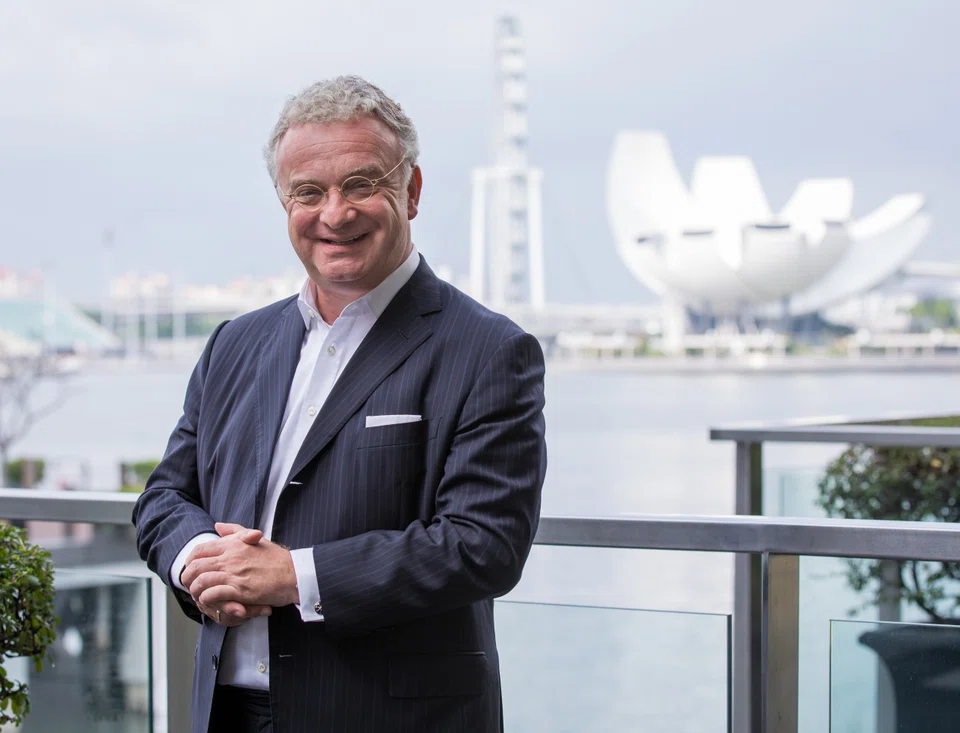
    • Evonik’s executive board chairman and chief executive officer Christian Kullmann was in Singapore in mid-August to officiate the groundbreaking ceremony of a new alkoxides production plant on Jurong Island.
    • Evonik’s executive board chairman and chief executive officer Christian Kullmann was in Singapore in mid-August to officiate the groundbreaking ceremony of a new alkoxides production plant on Jurong Island. PHOTO: CHERYL ONG, BT

    CHINA’S hotly anticipated reopening has so far failed to live up to expectations of igniting demand for specialty chemicals. But Evonik Industries is looking beyond the near term, and has set its sights on Asia to fuel future growth.

    The German specialty chemicals giant has targeted the Asia-Pacific (Apac) region’s share of revenues to grow to 30 per cent of sales by 2030, up from 20 per cent currently.

    But first, Evonik has to navigate its way through some choppy waters. Sluggish demand from industrial clients has led to a global glut in the supply of specialty chemicals.

    When China first reopened amid an abrupt dismantling of Covid-19 restrictions in December last year, many – including Evonik’s executive board chairman and chief executive officer Christian Kullmann – expected its economy to “run out of the railway station with a good amount of steam”.

    “But this kind of assumption has not been fulfilled as of today,” said Kullmann, who describes China’s economy as a “locomotive”.

    “And if we do read the signs on the wall right, we do not expect (things) to change for the better in 2023,” he told The Business Times.

    He pointed to the country’s debt-to-gross-domestic-product (GDP) ratio, and its youth unemployment rate – both of which stand at record highs – as areas of concern.

    China’s debt-to-GDP ratio hit a record high of 279.7 per cent in the first quarter of 2023, according to Bloomberg data. The unemployment rate among 16- to 24-year-olds in urban areas stood at 21.3 per cent in June.

    Beyond China, global markets are also “in front of something like a stagnation that could become severe”, Kullmann added.

    Indeed, some of the stagnation was reflected in Evonik’s results for the six months ended Jun 30, 2023.

    The company, which is listed on the Frankfurt Stock Exchange, on Aug 10 reported a net loss of 223 million euros (S$325.7 million) for H1 2023. This was in sharp contrast to a net profit of 611 million euros in the year-ago period.

    The decline was due mainly to lower revenue and impairment losses of 388 million euros on production facilities for methionine – an essential component in animal feed – and silicas.

    Revenue for H1 fell 15 per cent to 7.9 billion euros, from 9.3 billion euros previously, as sales volumes and selling prices dipped.

    The company’s performance largely mirrors that of its competitors, as the global specialty chemicals sector grapples with persistent headwinds.

    Another German chemicals giant, BASF, had in July reported a drop in quarterly earnings, and cut its budget for capital expenditures.

    In a profit guidance issued on Jul 10, Evonik said it will slash capital expenditures to some 850 million euros in 2023, from a planned 900 million euros.

    July’s announcement came after the company had already cut its investment budget from 975 million euros at the start of the year.

    It also forecasts lower adjusted earnings before interest, taxes, depreciation, and amortisation (Ebitda) of between 1.6 billion euros and 1.8 billion euros for FY2023, from 2.1 billion euros to 2.4 billion euros previously.

    Referencing the same profit guidance, Kullmann noted that the forecast earnings remain unchanged. “In this respect, we are on the safe side, (and will) stay conservative to prevent a second profit guidance,” he said.

    He added: “Do we see in 2023 any signs of recovery? No. Instead, what we do see is a prolongation of the current situation until the end of the year.”

    Growth in Apac

    Nonetheless, the German company has set in motion long-term plans for growth in Apac.

    For one, Evonik has invested in various lithium-ion battery technologies for electric vehicles (EVs), Kullmann said.

    In February, the company announced plans to expand its production facilities for fumed aluminium oxide in Japan. The compound is used as a coating in lithium-ion batteries to enable longer mileage for EVs. It also improves safe usage and fast charging of batteries.

    Evonik is also investing in research and development efforts to recycle lithium from spent EV batteries in less costly and resource-intensive ways.

    Kullmann was in Singapore in mid-August to officiate the groundbreaking ceremony of a new, mid-double-digit-million-euro alkoxides production plant on Jurong Island. He has identified Singapore as a hub for Evonik’s sustainability projects and “profitable green growth” in Apac.

    The plant, which is in the construction phase, will aim for zero Scope 1 and 2 emissions once it goes online by end-2024.

    Scope 1 is a widely-used classification under the Greenhouse Gas Protocol Corporate Standard, and refers to operational emissions arising from sources that a company controls and owns.

    Scope 2 emissions are those tied to the company’s energy consumption.

    The alkoxide catalysts produced will be used mostly in biodiesel production, and will also have applications in the pharmaceutical, agricultural and plastic recycling sectors.

    During his trip, Kullmann also met with the Republic’s senior policymakers and business leaders in various closed-door sessions.

    Aside from discussion of business opportunities, such networking engagements are especially valuable as they allow for trust to be built eye to eye, Kullmann said.

    He explained: “That works exclusively by meeting each other, looking into your eyes, (and) saying ‘Okay, could I rely on him for a bank, or on him for water?’”

    Sustainability, too, has to be a core pillar of all operations on Jurong Island, Kullmann said. He noted the Singapore government’s “impressive” commitment to adopt low-carbon solutions on the industrial hub by 2050.

    He pointed to Evonik’s ongoing projects on the island – such as the alkoxide production plant, and an April announcement of the company’s commitment to purchase green hydrogen from industrial gas player Linde as a way to cut carbon emissions from local methionine production as some examples.

    “If you believe in sustainability, and if you believe that Singapore is a centre for green, profitable growth for Asia, (then) you have to be invested here. And that is what we have done,” Kullmann said.